
Masonry Restoration · Chicagoland, IL
Brick Arches, Soldier Courses, and Corbels: Repairing the Decorative Masonry on Chicago Homes
The brickwork over your windows, the banding under your roofline, the corbelled detail on your chimney — these were laid by hand by someone who knew what they were doing. When they fail, rebuilding them takes reading the original pattern before a single brick comes out.
2026-08-24
Quick Answer
Decorative masonry — jack and segmental arches, soldier and rowlock courses, corbels, quoins, and header bonds — is structural as well as ornamental, and it fails when the steel or mortar supporting it gives way. Repairs require shoring the opening, documenting the original bond and pattern, and rebuilding with matched brick and compatible mortar so the detail reads as original. Paul Lally's Masonry has restored Chicagoland decorative brickwork since 1988 — (708) 448-8866.
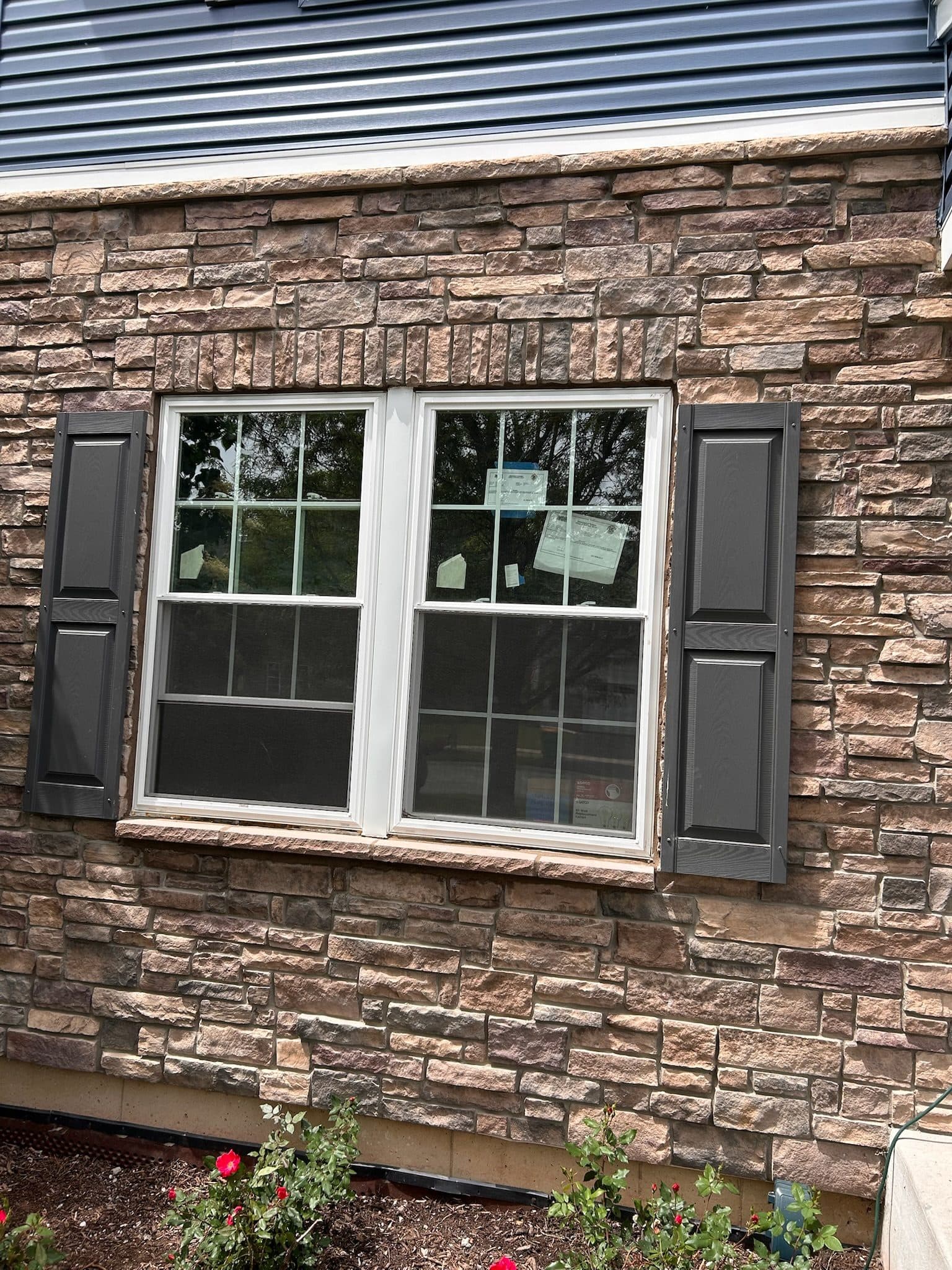
Walk any older Chicago block and look above the windows. You will find brick standing on end in a tidy band, brick laid in a shallow curve, a limestone wedge at the center, a course stepped out under the roofline, corners built with alternating projecting units. None of that had to be there. Somebody laid it by hand because that is how buildings were built.
When those details start to fail — and after a century of Chicago winters, plenty have — the repair is not hard because the masonry is exotic. It is hard because the pattern is the point, and once the detail comes down, there is nothing left to copy.
Paul Lally's Masonry has restored Chicagoland decorative brickwork since 1988. Here is what these elements are, how they fail, and what a proper repair actually involves. Free on-site estimate: (708) 448-8866.
The vocabulary, quickly
You do not need the terms to own the house, but they make the rest of this make sense.
| Element | What it is | Where you see it |
|---|---|---|
| Soldier course | Bricks on end, narrow face out | Bands above windows and doors; belt courses |
| Rowlock | Bricks on edge, end face out | Sills, caps, garden walls, window heads |
| Header course | Bricks laid with the end face out | Structural bonding courses in solid walls |
| Jack (flat) arch | A flat span of wedge-shaped or tapered units | Window and door heads on many older homes |
| Segmental arch | A shallow curved arch | Window heads, basement openings, coach houses |
| Keystone | The central wedge at the top of an arch | Often limestone or cast stone, sometimes decorative only |
| Corbel | Courses stepped progressively outward | Cornices, chimney caps, bay supports |
| Quoins | Emphasized corner units, often alternating | Building corners, entry surrounds |
| Dentil course | Alternating projecting units forming a toothed band | Under cornices and rooflines |
Which of these actually carry load?
This is the question that decides how a repair gets approached, and it does not have a single answer.
A true arch is structural. A jack or segmental arch carries the wall above it by compression — the wedge-shaped units push against each other and transfer load outward and down to the masonry at each end. It is genuinely doing work. Which also means it is only as good as its bearing at the ends: if the masonry the arch pushes against moves, the arch loses its geometry and starts to drop.
Many soldier courses are not structural. On huge numbers of Chicago-area homes, the soldier course above a window is a decorative facing, and the actual work is being done by a steel lintel hidden behind it. That is why cracked or lifted soldier courses so often turn out to be a lintel problem rather than a brick problem.
Corbels carry themselves and whatever sits on them, and each projecting course relies on the mortar bond and the mass of masonry above holding it down.
Getting this wrong in either direction is expensive. Treating a working arch as decoration means taking down something that was holding up a wall. Treating decorative brick as structural means repairing brick while the corroded steel behind it keeps swelling.
How decorative masonry fails
Sagging or dropped arches
The classic. Units shift, the shallow curve flattens, and a line of cracked mortar opens at the joints. Causes: lost bearing at the ends, mortar failure, corroded steel behind, or movement in the wall below.
Cracked and lifted soldier courses
A horizontal crack along the bottom of a soldier course above a window, with the brick above pushed slightly out of plane, is rust jacking — corroding steel expanding to many times its original volume and lifting the masonry. The brick is the symptom.
Displaced keystones
A keystone that has dropped, tipped, or opened up joints on both sides is telling you either that the arch has moved or that the stone itself has failed. If it is a working keystone, this is urgent.
Corbels deteriorating first
Corbels have a hard life: each course projects past the one below, so the top surfaces catch and hold water, and there is no wash or drip edge to carry it clear. They saturate, freeze, and lose their bond, and because they overhang, failure means brick coming down rather than brick crumbling in place.
Rowlock sills failing
Rowlock brick sills are laid on edge with joints running vertically down through them — a lot of joint length for water to exploit, right where water is running off the window. They erode and spall much faster than the field brick around them.
Quoins and bands opening up
Projecting corner units and belt courses interrupt the wall surface, so they collect water at every projection and their joints go first.
Bond patterns lost in past repairs
The most common defect we find is not deterioration at all. It is a previous repair that went back in a different bond — running bond patched into common bond, or a header course omitted — which is permanently visible even when the brick color is a perfect match.
How this work is actually done
- Assess whether the element is structural. Arch, or facing over steel? This determines everything.
- Document obsessively, before anything moves. Photographs from multiple angles and distances, measured course counts, projection dimensions, joint widths and profiles, unit orientation, and the bond pattern across the whole elevation. Once the detail is down, this record is the only reference that exists.
- Shore the opening. Any arch or lintel-supported element gets the masonry above it supported before a single unit is removed. This is not optional and it is where amateur repairs go wrong catastrophically.
- Find and fix the cause. Corroded steel replaced and flashed, lost bearing rebuilt, water path corrected. Rebuilding a detail over the same failure just resets the clock.
- Take down carefully and salvage. Original units are worth far more than new ones. Sound brick is removed, cleaned of old mortar, and kept in order.
- Match what cannot be salvaged. Reclaimed brick of the same era first; where a match is unavailable, salvage from a concealed elevation and put the new brick where nobody sees it.
- Rebuild to the documented geometry. Same course counts, same projections, same orientation, same bond.
- Point in compatible mortar. Matched for color, sand, and texture — and for hardness, which on older Chicago brick means a soft, lime-rich mix, never a hard modern high-Portland mortar.
- Tool the joints to the original profile. Concave, V, weathered, or grapevine — the shadow line is a large part of why a detail reads correctly.
- Restore the water management. Wash, drip edges, flashing, and joints that shed rather than hold, so the rebuilt detail lasts.
Materials: why mortar hardness decides the outcome
Chicago's pre-1930s housing stock — bungalows, two-flats, greystones, workers' cottages — was built with soft common brick and lime-rich mortar, and the two were designed to work together. The mortar is meant to be the softer, sacrificial part of the wall: it absorbs movement, it takes the freeze-thaw damage, and it can be replaced.
Rebuild a decorative detail in that wall using a hard, high-Portland modern mix and you invert the relationship. Now the mortar is stronger than the brick, so every bit of thermal movement and every freeze cycle is taken out of the brick faces instead of the joints. On a corbel or an arch — details that are already saturating more than the field wall — that shows up as spalling within a few seasons.
Matched brick in the wrong mortar is a repair with an expiration date.
Chicago context: where the detail work lives
- The bungalow belt. Chicago's bungalows are full of decorative brickwork — soldier and rowlock courses, contrasting-brick banding, limestone accents, patterned porch piers, and corbelled chimney caps.
- Greystones. Limestone fronts with brick side and rear walls, heavy stone detail on the facade, and softer brick elsewhere. The two materials need different handling on the same building.
- Two-flats and three-flats. Decorative brick at the cornice line and around openings, plus front-elevation detail that was never repeated on the sides.
- Workers' cottages and coach houses. Segmental arches over openings, simple corbelling, and rowlock sills.
- Commercial storefronts in the older suburban downtowns — La Grange, Downers Grove, Tinley Park, Lemont — with decorative parapets, corbelled cornices, and patterned brick above the storefront line.
All of it is now well past a century of Cook, DuPage, and Will County freeze-thaw, and the detail elements — the projections, the arches, the rowlocks — are exactly the parts that hold water longest.
What drives the cost of decorative masonry repair
We do not publish rates, because these are not repeatable units of work. What genuinely moves an estimate:
- Whether the element is structural and needs shoring
- Repair versus rebuild, and how many units are involved
- Documentation and layout time for complex patterns
- Brick match difficulty — reclaimed sourcing, or salvaging from a hidden elevation
- Underlying corrections — steel, bearing, flashing, water path
- Height and access — a first-floor window head versus a cornice or a chimney corbel needing staging
- Mortar match, including specifying a soft, compatible mix for historic brick
- Number of similar details on the elevation, since they tend to fail together
- Season and curing conditions
The assessment is free. Call (708) 448-8866.
DIY vs. hiring a mason
This is the least DIY-friendly masonry there is, and the reasons are specific:
- Shoring. Removing units under a load-bearing arch without proper support can bring the wall above down. This is the one genuinely dangerous mistake on the list.
- Reading the pattern. Recognizing a working arch from a decorative facing, and recording the bond before it comes apart, is experience rather than technique.
- Geometry. Rebuilding an arch to the original curve and joint taper is not something you can eyeball.
- Sourcing. Knowing where era-matched reclaimed Chicago brick comes from is half the job on an older house.
- Mortar specification. Hard mortar on soft brick is invisible on day one and destructive by year three.
- Irreversibility. A flattened arch, a lost bond pattern, or a corbel rebuilt two courses short does not get undone later.
Maintenance and prevention
- Look above your windows and doors once a year for horizontal cracks or lifted courses
- Watch arches for a flattening curve or opened joints at the ends
- Check corbels and cornices for loose or drummy units, and keep the ground below clear
- Keep gutters and downspouts working — most decorative-detail failure starts with water that should have been elsewhere
- Address rust staining at a soldier course early, before the steel lifts the masonry
- Repoint the details on the same cycle as the rest of the wall, using compatible mortar
- Photograph your decorative masonry now, while it is intact — the best reference for a future repair is a picture taken before anything failed
Related services
- Masonry restoration — historic and decorative work with compatible materials
- Brick repair and brick replacement — for failed and spalled units
- Tuckpointing and repointing — matched color, texture, hardness, and profile
- Lintel replacement — the steel behind most soldier-course failures
- Limestone and sill repair — keystones, bands, and stone trim
- Chimney repair and rebuilds — corbelled caps and decorative stack detail
The short version
Decorative brickwork is not trim glued onto a building. Some of it holds weight, all of it sheds water badly, and all of it is a pattern that exists in exactly one place — your wall. A proper repair starts with determining whether the element is structural, documenting the geometry before anything moves, shoring the opening, fixing the cause, and rebuilding with matched units in mortar the original brick can live with.
Get that right and nobody can tell where the repair is. Get it wrong and the whole elevation tells on you from across the street.
Paul Lally's Masonry Inc. is a family-owned, insured masonry contractor serving Chicago and the Chicagoland suburbs since 1988 — tuckpointing, brick repair and replacement, chimney repair and rebuilds, lintel replacement, masonry restoration, and waterproofing for residential and commercial properties. Built on Craftsmanship. Backed by Experience. Free on-site estimates — call (708) 448-8866.
If an arch is sagging, a soldier course is lifting, or a corbel has gone loose on your Chicago-area home, we will assess it and tell you what it needs. Request a free on-site estimate or call (708) 448-8866.
Frequently Asked Questions
What is a soldier course?
It is a course of bricks stood on end with the narrow face outward, most often used as a decorative band above windows and doors or as a belt course across a facade. On many homes it also sits directly on a steel lintel, which is why a cracked or lifted soldier course usually points to corroding steel behind it.
Why is the brick arch over my window sagging?
Either the arch has lost its bearing at the ends and the bricks have shifted, or the steel behind it has corroded and dropped, or mortar failure has let individual units slip. A true arch carries load by compression, so once units move, the arch stops working as one and continues to drop.
Can a sagging brick arch be repaired, or does it need rebuilding?
If the units are sound and the mortar has failed, an arch can often be shored, repointed, and stabilized. If units have dropped, cracked, or the supporting steel is spent, the arch has to be shored, taken down, and rebuilt to the original geometry.
What is a keystone and does it matter structurally?
The keystone is the central wedge at the top of an arch, and in a true arch it locks the other units into compression. On many Chicago homes the keystone is a decorative limestone or cast stone piece rather than a working structural element, and telling the difference matters before anyone disturbs it.
What are corbels?
Corbels are courses of brick stepped progressively outward to carry or decorate something above — a cornice, a chimney cap detail, a bay. Because each course projects past the one below, corbels shed water poorly and are usually among the first details on a building to deteriorate.
Why does my repaired brickwork look wrong even though the brick matches?
Almost always because the bond pattern changed. If a wall was laid in common bond with a header course every sixth row and the repair went back in running bond, the eye reads that difference immediately even when the color match is perfect.
Do decorative brick details actually hold weight?
Some do and some do not, and that is exactly why they should be assessed before repair. Arches genuinely carry load by compression, while many soldier courses and rowlocks are cosmetic facings over a steel lintel doing the real work.
Can you match brick for a decorative repair on an old Chicago home?
Usually. Reclaimed brick of the same era is the first choice, and where a match is genuinely unavailable we salvage sound units from a concealed elevation and put new brick in the hidden spot instead, so the visible detail is original material.
How is decorative masonry different from ordinary brick repair?
The masonry is the same; the documentation is not. Decorative work has to be recorded thoroughly before it comes apart — course counts, projections, joint sizes, unit orientation — because the pattern is what makes the detail read correctly, and there is no reference once it is down.
Is decorative masonry repair worth doing on an older home?
On Chicago's older brick housing stock, the detail work is much of what gives the building its character, and losing it to a flat patch is not reversible. Restoring it properly protects both the appearance and, where the detail is structural, the wall itself.