
Homeowner Education · Chicagoland, IL
Brick Paver Patios, Walkways and Driveways: Why They Sink, Heave and Spread — and How They're Put Right
Paver flatwork almost never fails because the pavers failed. It fails because of what's under them and what's holding them in at the edges. Here's how a paver installation is actually built, the four ways Chicagoland weather takes it apart, and why relaying a sunken patio properly means taking it up rather than topping it off.
2026-08-25
Quick Answer
Brick paver patios, walkways and driveways sink, heave and spread because of the compacted stone base and edge restraint beneath and around them — not because the pavers themselves wear out. Correct repair means lifting the pavers, rebuilding and recompacting the base, restoring the edge restraint and drainage, and relaying the same units. Paul Lally's Masonry Inc. repairs paver and brick flatwork across Chicagoland. Family-owned since 1988, insured. Call (708) 448-8866.
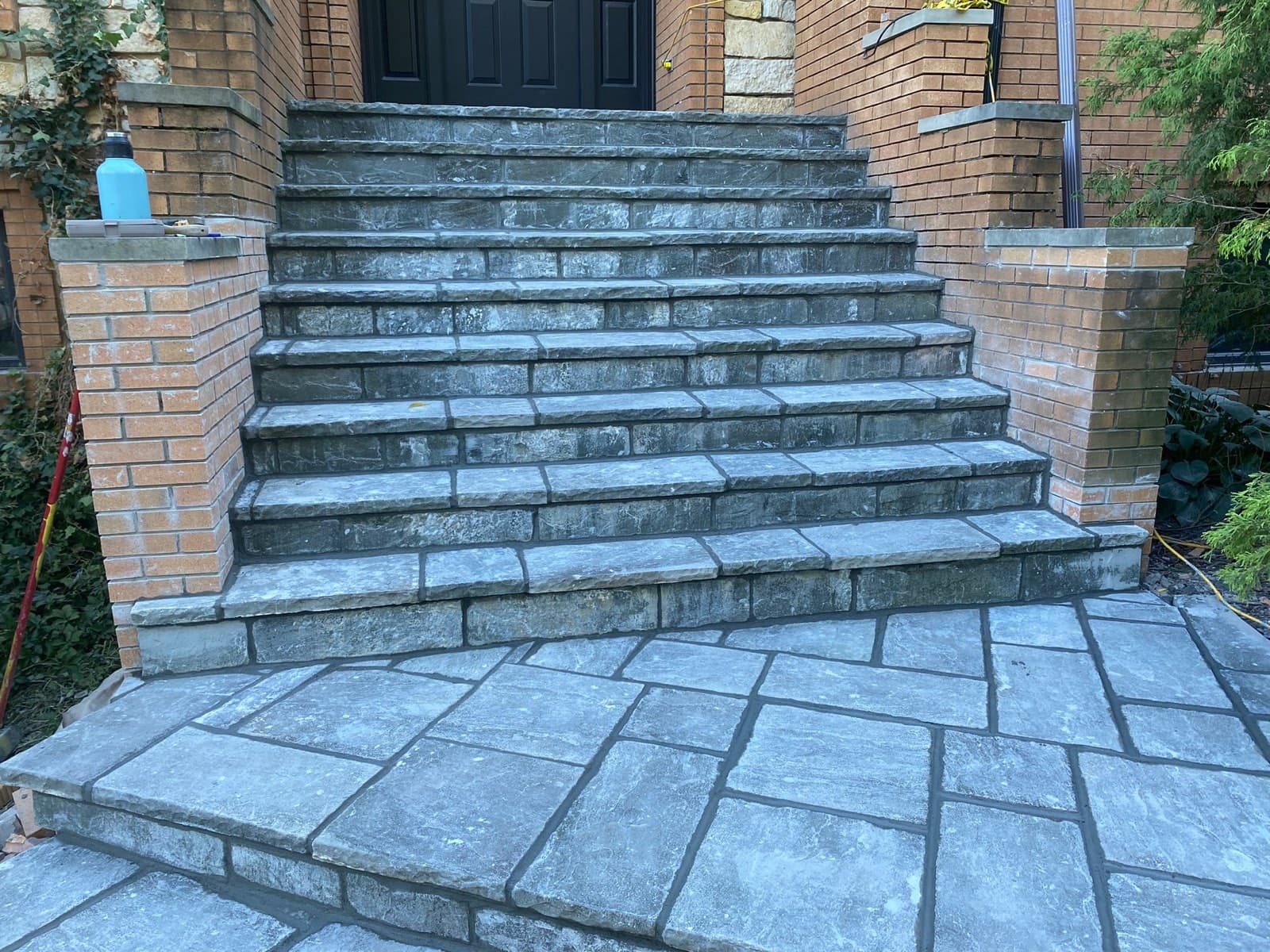
The Pavers Are Almost Never the Problem
A brick paver patio is not a surface. It is a system, and only the top inch of it is visible.
Everything a homeowner sees — the pavers, the pattern, the joints — sits on and depends on a set of layers nobody looks at after installation day. When flatwork sinks, heaves, spreads or ruts, it is essentially never because the pavers wore out. Clay and concrete pavers are extremely durable units. What failed is underneath them or around their edges.
That distinction is the whole reason paver repair works differently than people expect: the fix is usually to take the pavers up, not to add something on top of them.
Paul Lally's Masonry Inc. repairs brick and paver flatwork — patios, walkways, driveways, steps and stoops — throughout Chicago and the Chicagoland suburbs. Family-owned since 1988, insured, free on-site estimates. Call (708) 448-8866.
How a Paver Installation Is Actually Built
From the soil up, a correct installation is:
- Excavation to a depth appropriate for the use — a walkway needs less than a driveway carrying vehicles.
- A prepared subgrade, compacted, with problem soil removed rather than buried.
- Geotextile fabric in many installations, separating soil from stone so the two never mix.
- A compacted aggregate base — crushed stone, placed and compacted in lifts, not dumped in one pass. This layer carries the load and it is where most installations succeed or fail.
- A bedding layer — a thin, screeded, uniform course of coarse sand. This is a setting layer, not a leveling layer, and it is meant to be consistent.
- The pavers, laid to pattern.
- Joint sand, swept in to lock the units together by friction.
- Edge restraint, spiked around the entire perimeter, holding the field in.
- Pitch and drainage, so water leaves rather than sits.
Two of those items cause most of the failures we are called about: the compacted base and the edge restraint.
The Four Ways Chicagoland Takes Flatwork Apart
1. Base failure — the sinker
The most common problem, and the one homeowners most often misdiagnose as "I need more sand."
A base fails when it was too shallow for its use, when it was placed too thick to compact properly in one lift, when the wrong material was used, or when water has migrated through and washed the fines out of it. It also fails when soft soil beneath it was never removed.
The result is a localized depression — a dip near a downspout, a soft spot beside the foundation, a low patch where a tree was removed. The pavers are simply following the base down.
Adding sand under the pavers does not fix this, because sand is not a structural material. It fills the gap for a season, then the same void reopens.
2. Edge restraint failure — the spreader
Look at the perimeter of any paver field that has gone bad and you will usually find the outer course has migrated outward and the joints have opened across the whole area.
Edge restraint — plastic, concrete or metal, spiked into the base — is what resists that. When the spikes corrode or work loose, when the restraint was set on soil instead of on the base, when it was omitted entirely along a soft edge, or when a mower or plow has hit it, the field starts to creep.
Every load on a paver surface pushes outward. Something has to push back.
3. Frost heave — the lifter
This is the one people blame on cold, but it is really about water.
When water sits in poorly draining base material or in saturated soil beneath the installation, freezing expands it and lifts everything above it. In Chicagoland that cycle runs many times each winter. A patio that heaves in the same place every year is telling you there is water sitting in that place every year.
The fix is drainage and base material, not thicker pavers.
4. Surface deterioration — salt, spalling and wear
Less common but real. De-icing salt dissolves into meltwater, soaks into the units, and crystallizes inside them as they dry — that crystallization flakes the surface off from within. Concrete pavers can surface-spall badly under repeated salting; clay pavers vary. Snow plows and shovels chip edges, and vehicle turning wears rut lines into driveway fields.
Reading Your Own Flatwork
| What you see | What it usually means |
|---|---|
| A dip or low spot in one area | Base failure or soil settlement under that spot |
| Water ponding after rain | Loss of pitch, following a base problem |
| Joints opening across the whole field | Edge restraint failure |
| Outer course visibly migrated outward | Edge restraint failure |
| A ridge or lifted area, worst in winter | Frost heave — water trapped below |
| Ruts in a driveway wheel path | Base too shallow for vehicle loading |
| Sinking right along the house | Backfill settlement, or a downspout discharging there |
| A hump with a tree nearby | Root growth under the base |
| Sand washing out repeatedly | Water running across the surface with nowhere to go |
| White bloom on the units | Efflorescence — salts carried out by moisture moving through |
| Flaking or pitting on paver faces | Salt and freeze-thaw surface damage |
Risks of Waiting
Flatwork problems are progressive, and they are also a trip hazard, which puts them in a different category from most masonry.
Once joints open, water gets into the base faster, which washes out more fines, which deepens the settlement. Once the edge lets go, the field keeps creeping every time it is loaded. A dip that holds water freezes in winter and heaves, then thaws and settles further.
There is also a foundation angle worth naming: flatwork that has lost its pitch and now slopes toward the house is delivering water to your foundation wall. That is a bigger problem than the patio.
How a Repair Is Actually Done
- Diagnose the cause — base, edge, drainage, roots or surface — before lifting anything.
- Check the pitch across the whole area and establish where water is supposed to go.
- Lift the pavers in the affected area, cleaning and stacking them for reuse. Almost all of them go back down.
- Open up and inspect the base. This is the step that separates a repair from a delay.
- Address the cause — remove roots, correct a downspout, replace unsuitable soil, add drainage where water has nowhere to go.
- Rebuild the base in properly compacted lifts with correct material and correct depth for the use.
- Re-screed the bedding layer to a uniform thickness, not used to make up for an uneven base.
- Relay the pavers to the original pattern, cutting replacements only where units are genuinely damaged.
- Reinstall or replace the edge restraint, properly spiked into the base rather than into soil.
- Re-sand the joints and compact the field so the units lock together.
- Confirm the finished pitch carries water away from the building.
Materials and Technique
Base aggregate is a graded crushed stone that locks together when compacted, not round gravel and not fill sand. Depth is dictated by use — a driveway carrying vehicles needs substantially more than a garden path.
Bedding sand is coarse and screeded thin and uniform. Its job is to seat the units, not to level the installation. A thick bedding layer used to correct a bad base is a guaranteed future settlement.
Joint sand is either standard sand or a polymeric product that binds when watered. Polymeric resists washout and slows weeds, but it must go in dry, be swept off the paver faces completely, and be watered exactly as specified — otherwise it hazes and crusts on the surface. It is not a structural fix.
Edge restraint must be spiked into the compacted base, not into soil, and it must run the full perimeter, including along soft edges where it is most tempting to skip.
Sealing is optional and often oversold. On sound flatwork a breathable sealer can help with staining and joint stabilization; it does nothing for a moving base, and a film-forming product on masonry that stays wet will cloud and peel.
Related work often runs alongside: brick repair and brick replacement where units are damaged, foundation masonry repair where flatwork has been feeding water to a wall, and waterproofing where drainage is the underlying issue.
DIY vs. Hiring a Pro
Lifting a few pavers and sweeping sand into joints is genuinely a homeowner job. Where it goes wrong is the layer below.
Compaction is the part that cannot be improvised. Achieving proper density means the right material, the right lift thickness and a plate compactor used correctly — and getting it wrong is invisible on day one and obvious in year two. So is establishing pitch across a large area, and so is knowing when a soft spot means "add stone" versus "this soil has to come out."
The honest guidance: joint sand, weeds and a single tipped paver are fine to handle yourself. A dip, a heave, a spreading edge or anything sloping toward the house is a base problem, and base problems are worth doing once.
Why This Is a Chicagoland Problem
Several regional factors stack against paver flatwork here.
Freeze-thaw frequency. This region cycles above and below freezing many times each winter rather than freezing once and staying frozen, and each cycle works on any water trapped in the assembly.
Heavy clay soils across much of Cook, DuPage and Will County drain slowly and hold water against the base, and they swell and shrink seasonally.
Road and walk salt in volume, applied directly to the surface all winter.
Mature tree canopy on older lots, with root systems that lift bases and drop organic debris into joints.
Snow removal — plows, blowers and shovels catching edges and restraint season after season.
And the housing stock itself: brick bungalows, greystones and two-flats with narrow gangways and side walks, post-war ranches with paver additions, and newer subdivision homes across the southwest suburbs with substantial paver driveways and patios now twenty to thirty years old — right at the age when an under-built base announces itself.
Maintenance That Actually Helps
- Keep the joints full. Top up joint sand as it depletes; open joints let water into the base.
- Keep water off the field. Downspout extensions matter more here than almost anything else.
- Check the pitch after any settlement, especially along the house.
- Clear organic debris so weeds have nowhere to germinate.
- Watch the edges. Restraint that is lifting or loose is a cheap fix now and a full relay later.
- Go easy on the salt, and shovel before you treat.
- Watch tree roots near flatwork and address them before they lift a whole section.
- Fix a dip while it is small. A localized base repair is a fraction of a full relay.
Related Services
- Brick repair and brick replacement
- Foundation masonry repair
- Waterproofing and masonry sealing
- Residential masonry restoration
- Tuckpointing and repointing
The Bottom Line
If your patio has sunk, your walkway has spread, or your driveway heaves in the same spot every February, the pavers are fine. They are reporting on the base and the edge restraint beneath and around them.
That is genuinely good news, because it means the material you already own goes back down. What you are paying for is the part nobody sees — and doing that part properly once is the difference between a surface that lasts decades and one you keep patching.
Paul Lally's Masonry Inc. is a family-owned, insured masonry contractor serving Chicago and the Chicagoland suburbs since 1988 — tuckpointing, brick repair and replacement, chimney repair and rebuilds, lintel replacement, masonry restoration, and waterproofing for residential and commercial properties. Built on Craftsmanship. Backed by Experience. Free on-site estimates — call (708) 448-8866 or request an estimate online.
Frequently Asked Questions
Why is my paver patio sinking in one spot?
Almost always a base problem under that spot — either the stone base was never compacted properly there, or water has washed fines out of it, or soil beneath it has settled. The pavers are simply following the base down, which is why topping up the sand around them does not hold.
Can sunken pavers just be lifted and re-sanded?
Only if the base underneath is still sound and the settlement was in the bedding layer. If the compacted stone base has lost material or was never right, the pavers have to come up, the base has to be rebuilt and recompacted, and then they go back down. Anything less repeats within a season or two.
Why are my pavers spreading apart at the edges?
That is edge restraint failure. The plastic or concrete restraint at the perimeter, and the spikes holding it, are what keep the field from creeping outward under load. Once it breaks, rots out, or lifts, the outer courses migrate and the joints open up across the whole field.
What causes pavers to heave upward in winter?
Frost. Water trapped in poorly draining base material or in saturated soil beneath freezes and expands, lifting the pavers above it. It is a drainage problem more than a cold problem, which is why the same patio heaves in the same spot every year.
Should I use polymeric sand in the joints?
It has real advantages — it resists washout and slows weed growth — but it is not a fix for a failing base, and it must be installed dry, swept properly and watered exactly as specified or it hazes and crusts. On a patio that is moving, joint sand of any kind is treating the symptom.
Why do weeds keep growing between my pavers?
Usually because joint sand has washed out and organic debris has filled the gaps, giving seeds somewhere to germinate — most weeds in a paver field grow from the top down, not up through the base. Restoring the joints and keeping the surface clear does more than any spray.
Is salt bad for brick pavers?
De-icing salt is hard on any masonry. It dissolves in meltwater, soaks into the units, and crystallizes inside them as they dry, which flakes the surface off from within. Clay pavers vary in how well they tolerate it, and concrete pavers can surface-spall badly under repeated salting.
Can a paver driveway be repaired, or does it need replacing?
If the units themselves are sound, a paver driveway is one of the most repairable surfaces you can own — that is the whole advantage of the system. Damaged areas are lifted, the base is rebuilt, and the same pavers go back down. Replacement is generally only about the units, not the installation.
How much does paver repair cost in Illinois?
It is driven by area, how much base has to be rebuilt, access for materials and equipment, whether drainage or edge restraint must be corrected, and whether any units need replacing. Paul Lally's Masonry Inc. looks at it in person and puts the estimate in writing — call (708) 448-8866.
How long should a properly built paver installation last?
A long time, because the wear items are the joints and the edge restraint rather than the pavers themselves. The single biggest determinant is what happened before the first paver was laid — base depth, compaction and drainage. Installations that fail early almost always failed at that stage.