
Chimney Repair · Chicagoland, IL
Chimney Repair Chicago: The 4 Parts That Fail First (Crown, Cap, Flashing & Mortar Joints)
Nearly every chimney leak in Chicago starts in one of four places — the crown, the cap, the flashing, or the mortar joints. Here is what each part does, how it fails in our freeze-thaw climate, and when to repair versus rebuild.
2026-07-04
Quick Answer
The four parts of a masonry chimney that fail first are the crown, the cap, the flashing, and the mortar joints — and nearly every chimney leak in Chicago traces back to one of them. Paul Lally's Masonry Inc. has diagnosed and repaired these failures across Chicago and the suburbs since 1988. For a free on-site chimney inspection, call (708) 448-8866.
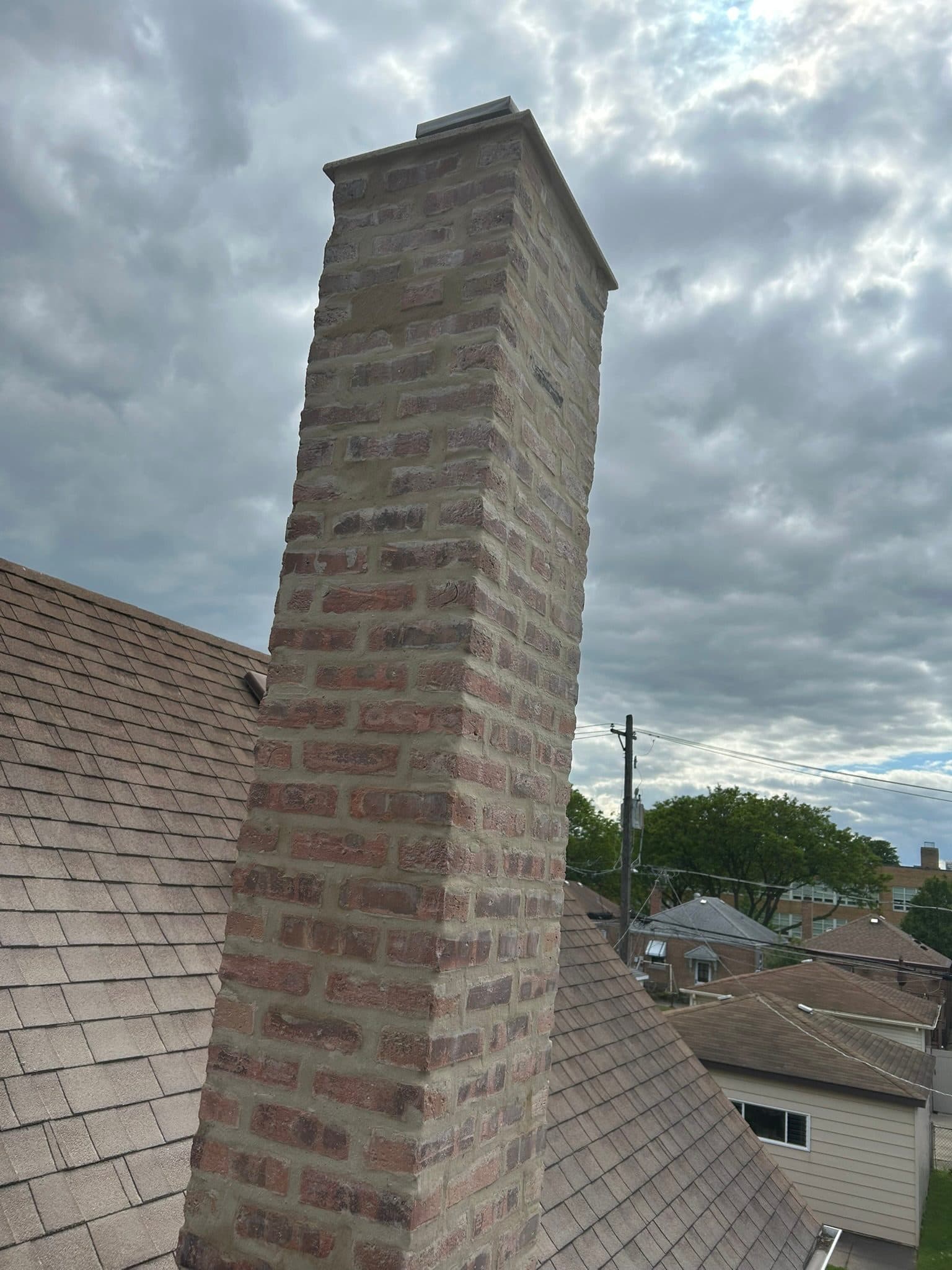
If your ceiling has a brown stain near the chimney, or you see crumbs of concrete in the gutter after a storm, the problem almost always starts in one of four places: the crown, the cap, the flashing, or the mortar joints. These are the four parts of a masonry chimney that fail first, and in Chicago's freeze-thaw climate they fail sooner than almost anything else on the house. Get to them early and the fix is usually straightforward. Ignore them and water follows a predictable chain down into the structure, turning a small repair into a rebuild.
Paul Lally's Masonry Inc. has been diagnosing and repairing these exact failures across Chicago and the Chicagoland suburbs since 1988. This guide walks through what each part does, how each one fails, the water-damage chain that connects them, and how a master mason decides between a targeted repair and a rebuild.
Chimney anatomy: crown vs. cap vs. flashing vs. joints
Homeowners tend to lump the whole thing together as "the chimney," but a mason sees four distinct systems, each with its own job and its own failure mode. Understanding the difference is the fastest way to understand where your water is coming from.
| Part | What it does | How it fails | Typical fix |
|---|---|---|---|
| Crown | Sloped concrete/masonry slab that tops the chimney and sheds water off the stack | Cracks, spalls, and crumbles; lets water into the brick below | Crown coat/resurface, or rebuild the crown |
| Cap | Metal cover over the flue opening | Rusts, blows off, or goes missing; lets in rain, animals, and downdraft | Replace with a stainless or galvanized cap |
| Flashing | Metal seal where the chimney meets the roof | Rusts, lifts, and pulls loose; old sealant dries out | Re-seal, re-flash, or reinstall step/counter flashing |
| Mortar joints & brick | Bond the masonry and keep water out of the wall | Joints recede; brick spalls and loosens above the roofline | Tuckpointing/repointing, or partial rebuild |
Notice the pattern: three of the four are about keeping water out from the top and sides, and the fourth is about holding the structure together. When any one fails, water gets a path in — and water is what destroys masonry.
The crown: the concrete lid that sheds the rain
The chimney crown is the sloped slab of concrete or mortar that forms the very top of the chimney, surrounding the flue and covering the top course of brick. Its whole job is to shed rainwater away from the flue and out past the edge of the brick, like a tiny sloped roof. A good crown has a slight overhang — a drip edge — so water drips clear of the wall instead of running down the face of the brick.
Crowns fail because they are thin, exposed, and constantly wet. Over the years, the surface develops hairline cracks. Water works into those cracks, freezes in a Chicago cold snap, expands, and pries them wider. The next thaw lets more water in, the next freeze widens it again. This is freeze-thaw in miniature, and it is relentless. Eventually the crown spalls — chunks flake and break away — and once it is broken, it stops shedding water. Now every rain runs straight down into the top of the stack.
How to tell your crown is going:
- Visible cracks radiating across the top slab
- Chunks or crumbs of concrete in the gutters or at the base of the chimney
- A crown with no overhang, so water runs down the brick face
- Efflorescence (white chalky staining) on the brick just below the crown
A crown caught early — fine surface cracks only — can often be sealed or resurfaced with a proper crown coat that restores its ability to shed water. A crown that is broken, heavily spalled, or crumbling needs to be rebuilt so it slopes and drains correctly again. The wrong move here is smearing a bead of caulk over a failing crown; it hides the problem while the water keeps working underneath.
The cap: the metal hat over the flue
The chimney cap is the metal cover that sits over the top of the flue opening. People confuse it with the crown constantly, but they are two different parts doing two different jobs. The crown covers the brick; the cap covers the hole — the flue itself. A cap does three things at once: it keeps rain out of the flue, it keeps animals out (birds, squirrels, and raccoons love an open flue), and its top screen or mesh helps block downdrafts and stray embers.
Caps fail in blunt ways. A cheap galvanized cap rusts through. A poorly secured cap blows off in one of our lakefront windstorms and is simply gone. And plenty of older Chicago chimneys never had a cap at all. Whatever the reason, an open flue is an open funnel — every rain pours straight down the inside of the chimney onto the damper, the smoke shelf, and the firebox.
Signs the cap needs attention:
- No cap visible at the top of the flue
- Rust streaks running down the crown or brick
- Rain sound or dripping inside the fireplace
- Nesting material or animal noise in the flue
- Persistent downdraft or smoke rolling back into the room
Replacing a cap is one of the simpler chimney repairs, and it is one of the highest-value ones. A quality stainless or heavy galvanized cap keeps water, wildlife, and downdrafts out of the flue for years. On chimneys with a large chase or multiple flues, the same protective role is filled by a chase cover — a single metal top that spans the whole opening — which fails and gets replaced for the same reasons.
Flashing: the number-one source of chimney leaks
If there is one part to watch, it is the flashing. Flashing is the metal seal at the joint where the chimney passes through the roof. It is usually two layers working together: step flashing woven into the roof shingles, and counter flashing tucked into the mortar joints of the brick and folded down over the step flashing. Done right, it makes a watertight transition between two materials that expand, contract, and move at different rates.
That constant movement is exactly why flashing is the single most common source of a chimney leak. The chimney and the roof shift with temperature; the thin metal fatigues; the sealant that tops the counter flashing dries out and cracks. Over the seasons the flashing rusts, lifts at the edges, and pulls loose from the mortar. Water then runs behind it, and because the leak enters below the roofline, it often shows up as a ceiling stain several feet away from the chimney — which is why flashing leaks get misdiagnosed as roof problems.
Flashing warning signs:
- Ceiling or wall stains near the chimney chase
- Rust on the metal at the roof line
- Flashing edges visibly lifted or gapped
- Old, cracked, crumbling tar or sealant around the base
- Daylight or drafts in the attic where the chimney passes through
Good flashing repair is not a bucket of roof tar. It is re-seating or replacing the metal and re-cutting the counter flashing into clean mortar joints so the seal is mechanical, not just glued. Tar is a temporary patch that buys a season at best.
Mortar joints and brick: where the wall itself gives out
The fourth failure point is the masonry itself — the mortar joints and the brick that make up the visible stack. Mortar is intentionally softer than brick; it is the sacrificial layer that is supposed to wear before the brick does. Above the roofline, though, the chimney is exposed on all four sides with no wall or overhang to shield it, so the mortar takes a beating.
Over time the joints recede — the mortar erodes back, leaving shallow gaps that collect and hold water. Once water sits in an open joint and freezes, it does the same prying work it does everywhere else on a chimney. If the mortar keeps failing, water eventually saturates the brick, and the brick begins to spall: the face pops off, the brick softens, and courses start to loosen or lean.
Here is the decision a mason makes:
- Tuckpointing (repointing): If the brick is still sound and only the mortar joints have receded, the fix is to grind out the failed mortar and pack in fresh, matched mortar. This restores the joints and the weather seal without touching the brick.
- Partial rebuild: If the brick itself is spalling, loose, or leaning, tuckpointing alone won't hold. The failed section is taken down and rebuilt with new brick and mortar.
The tell is simple: receding joints → tuckpointing; failing brick → rebuild. A close-up inspection is what settles which one you're looking at, because from the ground a spalled chimney and a tuckpointing candidate can look identical.
The water chain — and why waiting makes it worse
Every one of these four failures does the same thing: it gives water a path in. And once water is inside a chimney, it follows a predictable chain of destruction:
- Entry — through a cracked crown, an open flue, failed flashing, or open joints.
- Saturation — water soaks into the brick and mortar and sits there.
- Freeze-thaw — it freezes, expands, and pries the masonry apart, then thaws and repeats through a Chicago winter.
- Spread — water travels down the stack into the framing, drywall, damper, and firebox.
- Structural damage — rotted framing, stained ceilings, a rusted-out damper, and a cracked flue liner, which is both a fire hazard and a carbon-monoxide concern.
The critical point is that each failure accelerates the next. A hairline crown crack this fall is a spalled crown next spring, saturated brick the following winter, and a leaning stack a couple of seasons after that. Waiting doesn't hold the problem steady — it moves you along the chain, and every step up the chain is a bigger, more expensive repair. This is why a small, promptly handled crown or flashing repair is one of the best-value jobs in masonry.
Repair vs. rebuild: the roofline is the dividing line
The most common question we get is whether a chimney can be repaired or has to be rebuilt — and the honest answer is that it depends almost entirely on where the damage is and how much of the masonry has failed.
- Above the roofline is where chimneys die first. This section is fully exposed to sun, wind, rain, and freeze-thaw on every side. When the brick above the roof is spalling and the joints are shot, an above-the-roofline rebuild takes the stack down to a sound course and rebuilds up from there — often paired with a fresh crown and new cap.
- Below the roofline the masonry is more sheltered and usually holds up far longer, so full rebuilds down low are less common and typically point to a deeper problem.
As a rough field guide: if a small share of the joints have receded and the brick is sound, it's a tuckpointing job. If a larger portion of the brick and joints have failed but the base is solid, it's an above-the-roofline rebuild. If the failure runs deep or the stack is leaning, more extensive restoration is warranted. No responsible mason assigns a percentage from a photo — the call comes from getting up to the chimney and looking at it directly.
What drives the cost of chimney repair
We never quote chimney work by phone, and it isn't a dodge — it's because the same-looking chimney can be a quick cap swap or a multi-day rebuild depending on factors you can't see from the driveway. The honest cost drivers are:
- Height and access. A one-story ranch chimney is a different job than a three-story stack, and a chimney tucked behind steep or complex rooflines takes more setup.
- Scaffolding and staging. Some chimneys can be worked from a roof and ladder; taller or less accessible ones need scaffolding, which changes the labor.
- Extent of the damage. Crown coat versus crown rebuild, cap swap versus chase cover, spot tuckpointing versus above-the-roofline rebuild — the scope is what moves the number.
- Condition found on inspection. Sometimes what looks like a flashing leak is really a failed crown feeding water down the stack, and the real fix is bigger — or smaller — than it appeared.
Because of all this, Paul Lally's Masonry Inc. gives a free on-site estimate after actually inspecting the chimney. That is the only way to price it honestly, and it's the only number we'll stand behind. Call (708) 448-8866 to set one up.
DIY vs. pro — and why Chicago chimneys are the worst case
Some homeowner maintenance is reasonable: keeping gutters clear, watching for ceiling stains, and eyeballing the crown and cap with binoculars each season. But the actual repairs on this list happen at height, over a hard roof, on masonry that has to be diagnosed correctly before it's touched — and the failure mode of a bad DIY chimney repair is a hidden leak that keeps rotting the structure while looking "fixed."
Chicago makes this harder than most places. Our chimneys endure a brutal number of freeze-thaw cycles, our lake-effect winds test every cap and flashing edge, and the temperature can swing wildly across a single day. A chimney is the most exposed masonry on the entire house — it stands alone, above the roof, catching weather on all four sides with nothing shielding it. That's precisely why the crown, cap, flashing, and joints fail here first and fail fastest. Getting the diagnosis and the repair right the first time is what keeps water out for the long run, and that's a job for someone who does it every week.
Related services
- Chimney repair & rebuilds — crown, cap, flashing, tuckpointing, and above-the-roofline rebuilds.
- Tuckpointing & repointing — restoring failed mortar joints on chimneys and walls before the brick starts to go.
- Masonry waterproofing — sealing sound masonry so water stops driving the freeze-thaw cycle in the first place.
Frequently asked questions
What are the most common causes of a leaking chimney in Chicago? A cracked crown, a missing or rusted cap, failed flashing at the roofline, and open mortar joints — with flashing being the single most frequent culprit. A free on-site inspection pinpoints which one is letting water in.
What is the difference between a chimney crown and a chimney cap? The crown is the sloped slab that tops the brick around the flue; the cap is the metal cover over the flue opening itself. They're two separate parts, and either can fail on its own.
Can a cracked chimney crown be repaired or does it need replacement? Fine surface cracks can usually be sealed or resurfaced with a crown coat. A heavily spalled or crumbling crown needs to be rebuilt so it sheds water again.
How do I know if my chimney needs tuckpointing or a full rebuild? Sound brick with receded joints means tuckpointing. Spalling, loose, or leaning brick — especially above the roofline — usually means a partial rebuild.
Why does chimney flashing leak so often? It's a thin metal seal at the exact point where masonry and roof meet and move at different rates. Over time it rusts, lifts, and pulls loose while the sealant dries out, making it the top chimney leak source.
Is it safe to keep using a chimney that is leaking water? It's risky — water rots framing, stains ceilings, rusts the damper, and can crack the flue liner, which is a fire and carbon-monoxide concern. It gets worse every freeze-thaw cycle, so have it inspected promptly.
How does Chicago's freeze-thaw weather damage a chimney? Water seeps into cracks and joints, freezes, expands, and pries the masonry apart, then thaws and repeats. A chimney is exposed on all sides above the roof, so it endures more of these cycles than any other part of the house.
The bottom line
Nearly every chimney problem in Chicago starts in the same four places — the crown, the cap, the flashing, or the mortar joints — and they fail in a chain, each one feeding water to the next. Catch them early and the repair is small. Wait, and the freeze-thaw cycle turns a sealed crack into a rebuilt stack.
Paul Lally's Masonry Inc. is a family-owned, insured masonry contractor serving Chicago and the Chicagoland suburbs since 1988 — tuckpointing, brick repair and replacement, chimney repair and rebuilds, lintel replacement, masonry restoration, and waterproofing for residential and commercial properties. Built on Craftsmanship. Backed by Experience. Free on-site estimates — call (708) 448-8866.
If you've spotted a stain, a crack, or crumbs in the gutter, don't wait for the next hard freeze. Request your free on-site chimney inspection or call (708) 448-8866 today.
Frequently Asked Questions
What are the most common causes of a leaking chimney in Chicago?
The most common causes are a cracked crown, a missing or rusted cap, failed flashing where the chimney meets the roof, and open mortar joints in the brick. Flashing failure is the single most frequent source of a chimney leak. A free on-site inspection can pinpoint which one is letting water in.
What is the difference between a chimney crown and a chimney cap?
The crown is the sloped concrete or masonry slab that forms the top surface of the chimney around the flue. The cap is the metal cover that sits over the flue opening to keep out rain, animals, and downdrafts. They are two different parts, and either one can fail on its own.
Can a cracked chimney crown be repaired or does it need replacement?
A crown with fine surface cracks can often be sealed or resurfaced with a proper crown coat. A crown that is heavily spalled, broken, or crumbling usually needs to be rebuilt so it sheds water again. Paul Lally's Masonry Inc. inspects the crown up close before recommending either path.
How do I know if my chimney needs tuckpointing or a full rebuild?
If the brick is sound and only the mortar joints have receded, tuckpointing restores the joints. If the brick itself is spalling, loose, or leaning above the roofline, a partial rebuild is usually the right call. The dividing line is almost always the roofline, since brick above it takes the harshest weather.
Why does chimney flashing leak so often?
Flashing is a thin metal seal between the masonry and the roof, and it lives at the exact point where two different materials meet and move. Over years it rusts, lifts, or pulls loose, and the old sealant dries out. That makes flashing the number-one source of chimney leaks.
Is it safe to keep using a chimney that is leaking water?
It is risky. Water that gets into a chimney rots framing, stains ceilings, rusts the damper and firebox components, and can crack the flue liner, which is a fire and carbon-monoxide concern. The damage compounds every freeze-thaw cycle, so a leaking chimney should be inspected promptly.
How much does chimney repair cost in Chicago?
Cost depends on the height and access of the chimney, whether scaffolding is required, and how much of the crown, cap, flashing, or brick needs work. Because every chimney is different, Paul Lally's Masonry Inc. does not quote by phone. We provide a free on-site estimate after inspecting the chimney.
How does Chicago's freeze-thaw weather damage a chimney?
Water seeps into cracks and open joints, freezes, expands, and pries the masonry apart, then thaws and repeats. Because a chimney is fully exposed on all sides above the roof, it endures more of these cycles than any other part of the house, which is why chimneys fail first.