
Foundation Masonry Repair · Chicagoland, IL
Your Downspout Is the Cheapest Masonry Repair You Will Ever Make
Walk any Chicagoland block and you can find the failing masonry from the sidewalk — it is directly below a downspout that discharges at the wall. Almost every localized foundation failure we are called to has a drainage cause standing right next to it.
2026-09-20
Quick Answer
Most localized masonry deterioration in Chicagoland is caused by water management rather than by the masonry itself — downspouts discharging at the foundation, grade sloping back toward the house, and clogged gutters overflowing onto one elevation. Correcting drainage is the cheapest and highest-value masonry repair available, and repointing without fixing it guarantees a repeat. Paul Lally's Masonry has repaired Chicagoland masonry since 1988 — (708) 448-8866.
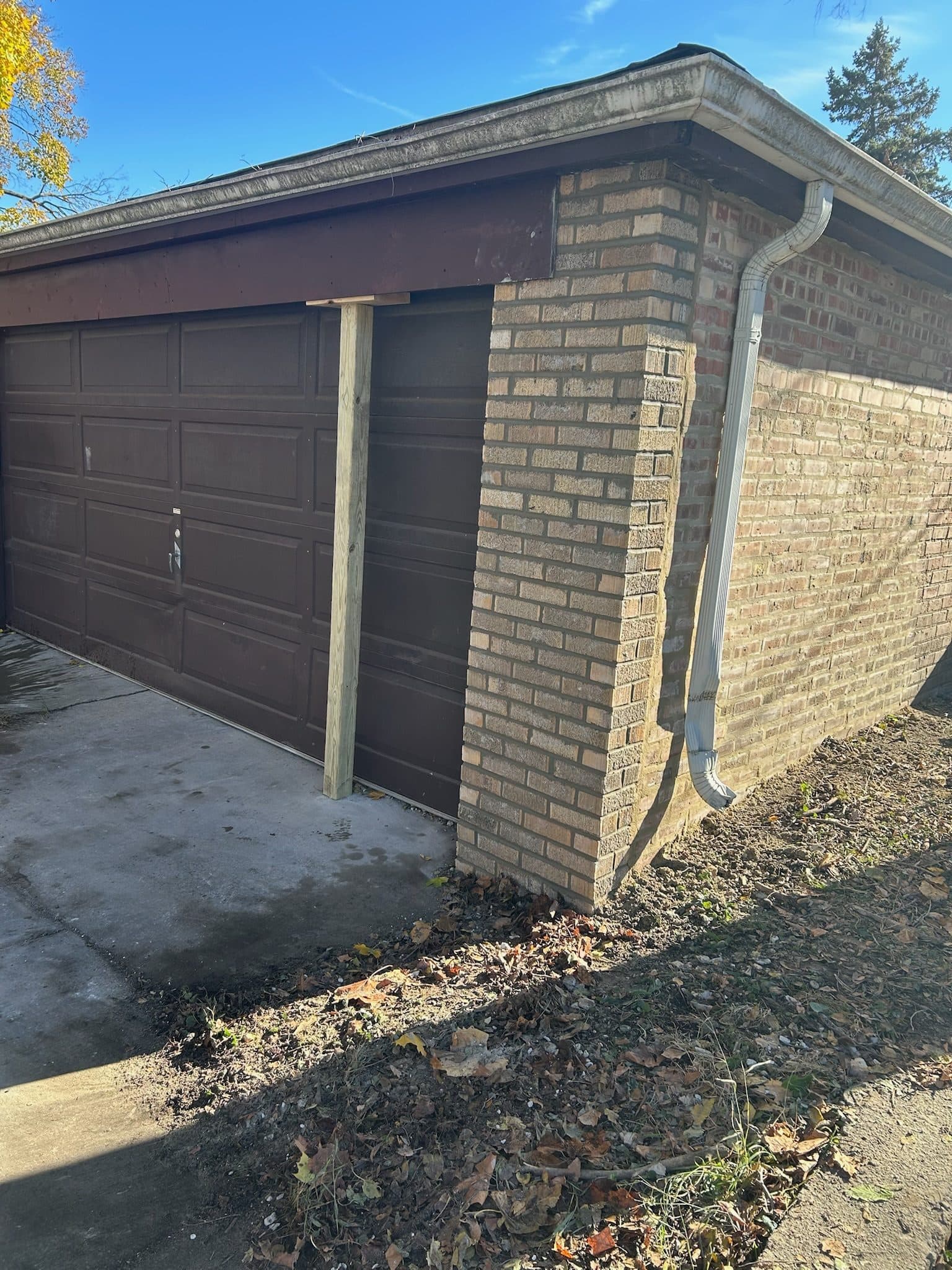
There is a diagnostic trick that works from a car window on almost any Chicagoland street. Find a house with one obviously failing section of brick — crumbling joints, spalled faces, a white bloom of salt across the wall — and then look straight up.
Nine times out of ten there is a downspout discharging right there. Or a gutter seam that overflows. Or a roof valley dumping onto that one elevation.
The masonry is not failing because the masonry was bad. It is failing because somebody has been pouring water on it, several hundred gallons at a time, for fifteen years. Paul Lally's Masonry has been repairing Chicagoland brick since 1988, and the single most useful thing we tell homeowners is this: fix the water first, or you will buy the same repair twice. Free on-site estimate: (708) 448-8866.
The building science, briefly
Brick and mortar are porous. They absorb water, and in a healthy wall they release it again before anything bad happens.
The damage mechanism is freeze-thaw. Water enters a joint or a brick, the temperature drops, the water freezes and expands by roughly nine percent, and that expansion forces the masonry apart from the inside. Thaw, absorb, refreeze, repeat.
Chicagoland crosses the freezing point dozens of times in a single winter — far more than a consistently cold climate does. Each crossing is a cycle. And the amount of damage per cycle depends almost entirely on how wet the masonry was when it froze.
That is the whole game. Damp masonry survives winter. Saturated masonry does not. Everything below is just a list of ways houses end up saturated in one specific place.
The usual suspects, in order of how often we find them
1. The downspout that discharges at the wall
The champion. A roof sheds an enormous volume of water, and a downspout concentrates a large share of it into one spot. If that spot is eighteen inches from the foundation, you have built a device for soaking one section of masonry.
A splash block helps a little. It is rarely enough on its own, because it spreads the water without moving it away from the backfill zone — the disturbed, looser soil right beside the foundation that water travels down preferentially.
2. Negative grade
Soil should fall away from the house. Over decades it frequently does the opposite: beds get topped up, mulch is added annually, settlement around the foundation creates a dish, and eventually the ground slopes toward the wall. Now every rainfall and every thaw drains to your foundation by design.
3. Clogged or poorly pitched gutters
A gutter full of leaves overflows at its low point, and that overflow lands in one place, all winter. Worth noting: a clean gutter can still overflow if its pitch is wrong or a seam has opened, which is why "I had them cleaned" does not close the question.
4. Mulch and soil against the wall
Beds built up against the masonry hold moisture directly against the lowest courses, block the airflow that would dry them, and on a veneer wall can bury the weep holes the wall depends on to drain.
5. Window wells that do not drain
A window well holding water is a small reservoir pressed against the foundation. They are supposed to drain; many stop.
6. Sump discharge too close to the house
A sump pump exists to move water away from the foundation. Discharge it four feet from the wall and it soaks back into the same soil, returns to the drain tile, and gets pumped again — an expensive loop that keeps the masonry wet.
7. Hard surfaces pitched the wrong way
Driveways, patios, and walks settle over time. A drive that once fell away from the house can end up delivering meltwater to the base of the wall — and in Chicagoland that meltwater is carrying de-icing salt.
8. Sills and projections that stopped shedding
A limestone sill that has lost its wash or its drip edge stops throwing water clear and starts running it down the wall. Same for eroded coping and worn stone bands.
What the damage looks like
Spalling at the base course
The fired outer face of the brick pops off, exposing the soft interior — which then absorbs even faster. Concentrated in the lowest courses, where splash-back, snow, and salt all land.
Mortar you can rake out with a key
Sandy, receded joints. Run a key along one and if it comes away as powder, the binder is gone.
Efflorescence
White powdery salts blooming on the surface. This is not a cosmetic problem — it is proof water is moving through the wall, dissolving salts and depositing them as it evaporates. If it keeps returning after cleaning, the water path is still active.
Step cracks
Cracks stepping diagonally through the joints, which usually indicate movement rather than simple weathering. Worth taking seriously, especially if they are widening.
Interior damp and musty basements
Often the first thing a homeowner notices, and frequently traced to an exterior drainage condition rather than anything inside.
Why Chicagoland makes all of this worse
Freeze-thaw frequency. The region's winters hover around the freezing point rather than sitting well below it, which means far more damaging cycles than a colder climate produces.
Expansive clay soil. Northeastern Illinois sits on clay that swells when wet and shrinks when dry. Chronic saturation beside a foundation is not just a masonry problem — the seasonal shrink-swell is what moves walls and opens step cracks.
Soft historic brick. Chicago's bungalows, two-flats, three-flats, greystones, and workers' cottages were built with soft common brick laid in lime-rich mortar. That masonry is more absorbent and less tolerant of saturation than modern brick — and it is exactly the stock where a downspout problem does the most damage fastest.
De-icing salt. Salt-laden meltwater is absorbed at grade, and the salts then crystallize inside the pores and push the brick apart from within — a second destructive mechanism stacked on top of freeze-thaw.
A worked example
A homeowner in a Cook County bungalow belt calls about the north side of the house. One eight-foot stretch of brick below a bedroom window is visibly worse than anything else on the building — spalled faces across two courses, joints you can rake out with a fingernail, and a chalky white bloom that keeps returning after they scrub it off.
The rest of that elevation is fine. The other three elevations are fine.
What the walk finds: a downspout terminating in a landscape bed eighteen inches from the wall, a bed that has been topped up with mulch for a decade until it sits four inches above the base course, and a gutter seam directly above the damaged section with a rust streak running down from it.
Three water sources, stacked, on the one section that failed.
The repair that works: extend the downspout well clear of the backfill zone, pull the bed back and regrade it to fall away, re-seal or replace the gutter seam — then let the wall dry, cut the failed joints to sound depth, replace the spalled units in matched brick, and repoint in a mortar softer than the brick.
The repair that does not: skip straight to the repointing. The new mortar goes into the same conditions that destroyed the old, and the homeowner calls again in four years with a slightly larger version of the same photograph.
What this means for older Chicago housing specifically
On pre-1930s stock the stakes are higher, because the material is less forgiving.
Soft common brick absorbs more readily and spalls sooner once its fired face is compromised. Lime-rich original mortar is softer by design — it is meant to be the sacrificial, replaceable part of the wall — which works beautifully until somebody repoints it with a hard modern mix and inverts the relationship.
Chicago's greystones add limestone to the equation, and limestone that stays saturated sugars and delaminates. Its weathered outer skin is protective and irreplaceable, which is also why pressure-washing a wet greystone foundation is one of the more expensive mistakes available.
Two-flats and three-flats frequently have a gangway elevation that never sees sun, never dries, and never gets inspected because nobody walks down there. That elevation is where we find the worst drainage-driven damage on the whole building, and it is almost always a surprise to the owner.
Fixing it: the order that actually works
- Find every water source on that elevation. Walk it in the rain if you can — it is the single most informative ten minutes available.
- Extend the downspouts. Carry discharge well clear of the backfill zone, not to a splash block at the wall.
- Correct the grade. Soil falling away from the house, and kept below the base course.
- Clear and re-pitch the gutters, and check the seams, not just the debris.
- Pull beds and mulch back off the masonry.
- Sort the window wells and sump discharge.
- Let the wall dry. Saturated masonry should not be sealed or closed up.
- Then repair the masonry — repoint to sound depth in matched mortar, replace failed units, parge where appropriate.
- Seal last, and only breathable, on sound cured masonry if it is warranted at all.
Steps 2 through 6 are the cheapest items on that list by a wide margin, and they determine whether step 8 lasts.
Materials, and the mortar-hardness rule
When the masonry work does happen, one specification governs everything: the mortar must not be harder than the units it holds.
On Chicago's soft common brick, a hard, high-Portland modern mix makes the brick the sacrificial element — every freeze cycle and every bit of movement gets taken out of the brick faces instead of the joint, and you get spalling within a few seasons. Older brick and stone want a softer, lime-rich mix. Harder modern brick and block can take a stronger mortar.
Matching also covers colour, sand, texture, and joint profile, which is what makes repointing disappear into the wall rather than announcing itself.
For parging on block and rough foundation walls, the same principle applies — and parge must go over sound, repaired masonry. Parging over failing brick hides deterioration for a couple of years and solves nothing.
What drives the cost
- How much wall is deteriorated, in linear feet and height
- Depth of deterioration — surface joints versus rebuilding courses
- Material — brick, block, or stone, and how hard the units are to match
- Excavation or access to reach masonry below grade
- Drainage corrections included in the scope
- Parging over repaired areas
- Whether a structural engineer is needed first, if the wall has moved
- Season and curing conditions
We do not quote foundation work over the phone, because the diagnosis is the job. The on-site assessment is free — (708) 448-8866.
DIY vs. hiring a mason
Here is the genuinely good news in this article: the highest-value work is the part you can do yourself.
Extending a downspout, clearing a gutter, pulling mulch back off the wall, and regrading a bed are homeowner tasks, and they prevent more masonry damage than anything we sell. We would rather tell you that than not.
Where it stops being DIY:
- Judging whether the wall is deteriorating or moving. Those look similar and are completely different problems.
- Cut-out depth. Repointing that stops short of sound material is a cosmetic skin that pops out in a season or two.
- Mortar specification. Hard mortar on soft brick looks fine on day one and is destructive by year three — and it cannot be undone.
- Knowing when to stop and call an engineer. A wall that is bowing is not a pointing job.
Maintenance: the annual walk
- Walk the perimeter once a year, ideally during a heavy rain
- Check downspout discharge — where does the water actually go?
- Confirm grade falls away from the house on every elevation
- Clear gutters twice a year, and check pitch and seams
- Keep mulch and soil below the base course
- Look for efflorescence — it means an active water path
- Scratch-test suspicious joints with a key
- Watch step cracks for widening season over season
Related services
- Foundation masonry repair — deteriorated brick and block at and below grade
- Tuckpointing and repointing — failed joints, cut to sound depth in matched mortar
- Brick repair and brick replacement — spalled and failed units
- Limestone and sill repair — stone that has stopped shedding water
- Masonry waterproofing — a breathable repellent, after repairs and only where warranted
The short version
Masonry in Chicagoland fails from repeated saturation and freeze-thaw. Localized failure almost always has a localized water source standing directly above it — usually a downspout, a grade, or a gutter.
Correcting that costs very little and decides whether the masonry repair lasts a generation or three winters. Repoint without it and you have bought the same job twice.
Paul Lally's Masonry Inc. is a family-owned, insured masonry contractor serving Chicago and the Chicagoland suburbs since 1988 — tuckpointing, brick repair and replacement, chimney repair and rebuilds, lintel replacement, masonry restoration, and waterproofing for residential and commercial properties. Built on Craftsmanship. Backed by Experience. Free on-site estimates — call (708) 448-8866.
Seeing crumbling brick or mortar in one specific area? Look up first — then request a free on-site estimate or call (708) 448-8866, and we will tell you what is actually causing it.
Frequently Asked Questions
Why is my brick crumbling in just one spot?
Look directly above it. Localized masonry deterioration almost always has a water source immediately overhead — a downspout discharging at the wall, a gutter joint that overflows, a valley dumping onto one elevation, or a sill that has stopped throwing water clear.
How far should a downspout discharge from the house?
Far enough that the water lands beyond the backfill zone and runs away from the building rather than soaking in beside it. A splash block at the wall is rarely enough on its own, and a buried or extended discharge that carries water well clear is the durable fix.
Does grading really affect brick and mortar?
Significantly. Soil that slopes toward the house delivers every rainfall and snowmelt straight to the lowest, wettest, hardest-working masonry on the building — and in Chicagoland's freeze-thaw cycling, saturated masonry is exactly what spalls.
Should I fix drainage before tuckpointing?
Yes, always. Repointing a wall that is still being soaked by a downspout or a negative grade means paying for the same repair twice, because the new mortar faces the identical conditions that destroyed the old.
Why does efflorescence keep coming back on my foundation?
Because water is still moving through the masonry and carrying salts to the surface. Efflorescence is a symptom of an active water path, so cleaning it off without correcting the source just resets the clock.
Can mulch and landscaping damage my foundation masonry?
Yes. Soil and mulch banked against the wall hold moisture against brick that was never meant to stay wet, block airflow so it cannot dry, and can bury weep holes on a veneer wall. Keeping beds and grade below the base course is genuinely one of the cheapest protections available.
My gutters are clean but the brick below is still failing. Why?
Check the gutter's pitch and joints rather than just its debris, and look at where the downspout actually terminates. A gutter can be clear and still overflow at a seam, and a downspout can discharge into a bed that drains back toward the foundation.
Is a sump pump discharge a masonry problem?
It can become one. A sump discharging close to the foundation recirculates the same water back into the soil beside the wall, so the line should carry it well clear of the building rather than releasing it a few feet from the masonry it came from.
How much of masonry repair is really a water problem?
On localized deterioration, most of it. Brick and mortar in Chicagoland fail overwhelmingly from repeated saturation and freeze-thaw, so the durable repair is always the masonry work plus the correction of whatever was keeping it wet.