
Waterproofing · Chicagoland, IL
What Causes Efflorescence on Brick — and How a Mason Removes It
Those white, chalky stains on your brick aren't dirt — they're salt left behind by water moving through the wall. Here's what efflorescence really means, how a mason removes it the right way, and why sealing over it makes things worse.
2026-06-22
Quick Answer
Efflorescence is the white, chalky, crystalline deposit that appears on brick when water moves through the masonry, dissolves natural salts, and evaporates at the surface. It's a sign of a moisture problem, not just a stain. Paul Lally's Masonry Inc. removes efflorescence and fixes the underlying water source across Chicagoland — family-owned since 1988. Free on-site estimates: (708) 448-8866.
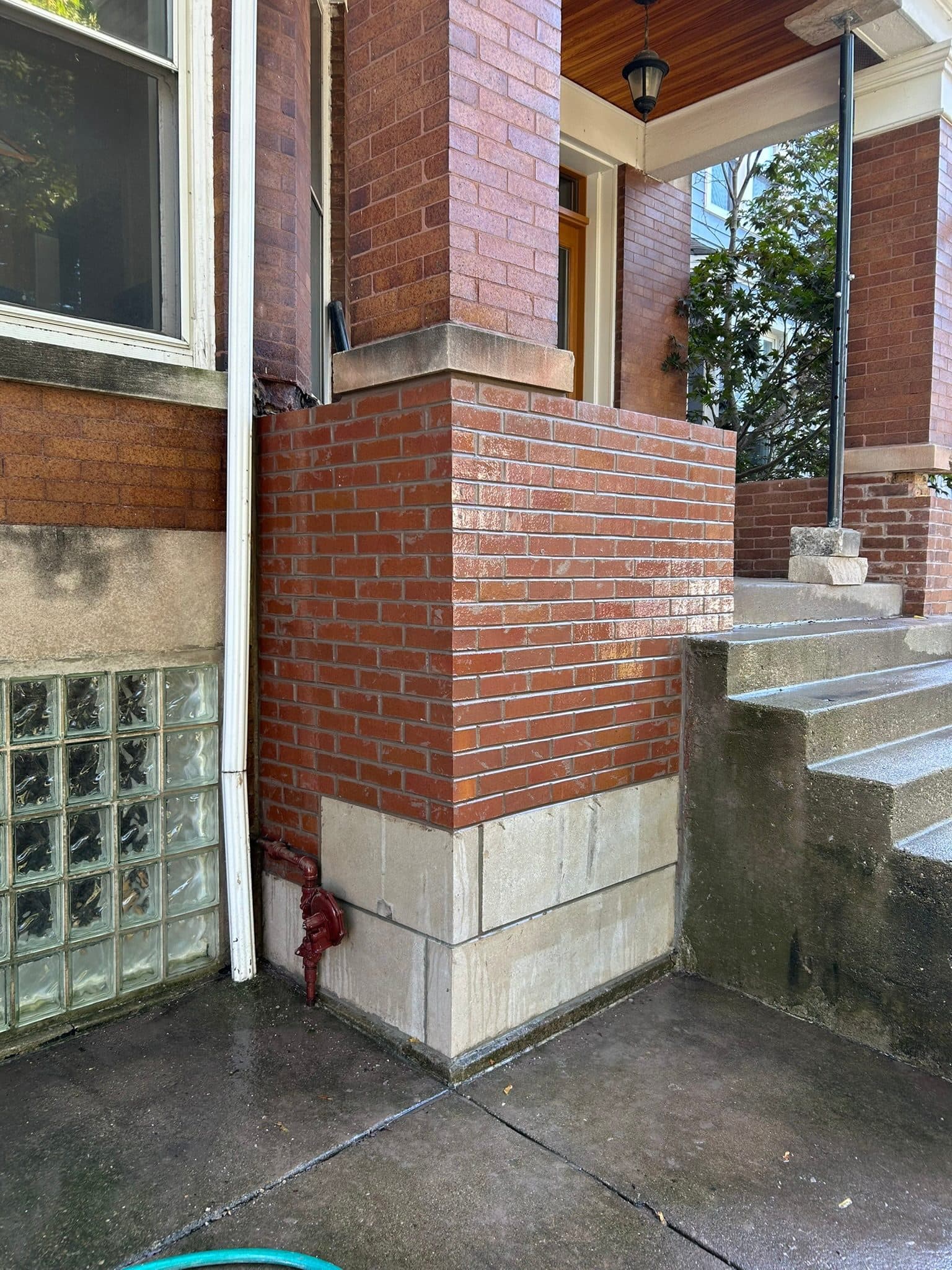
If you've noticed a chalky, white film creeping across your brick — along the mortar joints, near the foundation, under the windows, or across a whole wall after a wet spell — you're looking at efflorescence. It's one of the most common questions we get from Chicagoland homeowners, usually phrased as "why is my brick turning white?" And almost everyone's first instinct is the same: scrub it off, maybe seal over it, move on.
That instinct is exactly how a small problem becomes an expensive one.
Efflorescence is not dirt, and it's not the disease — it's the symptom. The white residue on brick is the visible end of a moisture problem happening inside your wall. Clean the stain without fixing the cause and it comes right back, often with brick damage close behind. This guide explains what efflorescence actually is, what's driving it, how a mason removes it the right way, and why the moisture source — not the stain — is what you're really paying to fix.
Paul Lally's Masonry Inc. is a family-owned, insured masonry contractor serving Chicago and the Chicagoland suburbs since 1988 — tuckpointing, brick repair and replacement, chimney repair and rebuilds, lintel replacement, masonry restoration, and waterproofing for residential and commercial properties. Built on Craftsmanship. Backed by Experience. Free on-site estimates — call (708) 448-8866.
What Efflorescence Actually Is (the building science)
Brick and mortar are porous. They're full of microscopic channels, and they naturally contain small amounts of soluble salts — sulfates and carbonates baked into the clay, present in the mortar, and sometimes wicking up from the soil or concrete behind the wall.
Efflorescence is a three-ingredient recipe, and it needs all three:
- Soluble salts present in the masonry.
- Water to dissolve those salts and move them.
- A path to the surface where the water can evaporate.
Here's the sequence. Water enters the wall — through a failing mortar joint, a clogged weep hole, splashback off the ground, a roof or gutter leak, or simply driving rain on porous old brick. As that water travels through the masonry, it dissolves the salts and carries them along. When the water reaches the surface of the brick and evaporates, the salt can't evaporate with it. It's left behind as a crystalline crust — the white bloom you see.
That's the whole story, and it's why the single most important fact about efflorescence is this: no moving water means no efflorescence. Every patch of white residue on brick is a flag planted exactly where water is getting in and drying out. The salt is just the receipt.
Causes & Warning Signs — Where the Water Is Coming From
Because efflorescence is a moisture symptom, "treating" it means finding the water source. In Chicagoland's older brick housing stock, these are the usual suspects:
- Failing mortar joints. Cracked, receding, crumbling, or missing mortar is the number-one entry point. If the white deposits track along the joints, you very likely need tuckpointing.
- Clogged or missing weep holes. Brick veneer walls are designed to let water that gets behind them drain out through weep holes at the base. When those are painted over, mortared shut, or never installed, water has nowhere to go but through the brick.
- No or failed flashing. Missing through-wall flashing above windows, doors, and at the wall base lets water bypass the drainage system entirely.
- Ground splashback and grade issues. Soil, mulch, or pavement piled against the brick, or a grade that slopes toward the house, keeps the lower courses constantly damp.
- Roof, gutter, and downspout leaks. Water dumping onto or behind a wall feeds efflorescence from above.
- New construction moisture. Fresh masonry holds a lot of build water; a light "new building bloom" in the first year is common and usually clears as the wall dries — but persistent efflorescence is not normal.
Warning signs to watch for:
- A white, powdery or chalky film that wipes or brushes off (that's efflorescence — a salt).
- Deposits that are worse after rain, snowmelt, or a thaw, then fade as the wall dries.
- White staining concentrated along mortar joints, at the base of the wall, or under windowsills.
- Efflorescence appearing alongside spalling — flaking or popping brick faces. That combination means the moisture problem has already started doing structural damage.
| Efflorescence | Spalling | |
|---|---|---|
| What it is | Salt deposit on the surface | Brick face flaking/breaking off |
| Severity | Cosmetic (but a warning) | Structural damage |
| Comes off? | Brushes/cleans off | No — the brick is gone |
| What it means | Water is moving through the wall | Water + freeze-thaw has already broken the brick |
| Fix | Clean + stop the water | Brick repair or replacement + stop the water |
That last row matters in Chicago more than almost anywhere. The same water that produces a harmless white stain in October freezes inside the brick in January, expands, and pops the face off in March. Efflorescence today is often spalling tomorrow if the moisture isn't addressed.
How a Mason Removes Efflorescence — Step by Step
Removing efflorescence correctly is as much about sequence as technique. Here's how we approach it:
- Diagnose the water source first. Before any cleaning, we figure out where the water is getting in — failing joints, weep holes, flashing, grade, a leak above. Cleaning before diagnosis is just scheduling a repeat visit.
- Dry-brush while the wall is dry. Efflorescence is most removable when it's dry and powdery. We use stiff (non-metallic) brushes to knock the salt off. Wetting it first just dissolves the salt and soaks it back into the brick.
- Clean stubborn areas with the right product. Heavier deposits may call for a proper masonry efflorescence cleaner or a correctly diluted acidic wash, applied to pre-wetted brick, worked, and then rinsed thoroughly. The dilution and dwell time matter — too strong or left too long, and the cleaner etches the brick and burns the mortar.
- Rinse completely. Any leftover cleaner or dissolved salt has to be flushed off so it doesn't re-deposit.
- Let the wall dry out fully. Masonry has to release its moisture before any repellent goes on — sealing a wet wall traps the very water you're trying to manage.
- Fix the source, then protect. Tuckpoint failing joints, clear or restore weep holes, correct flashing or grade, and only then consider a breathable waterproofing repellent on a sound, dry wall.
The one thing we will not do: paint or seal over active efflorescence with a film-forming product. It looks like a fix for about a season, then the trapped moisture either pushes the coating off in sheets or freezes inside the brick and spalls it.
Materials & Techniques
- Dry brushing tools — stiff bristle brushes, never wire brushes on softer historic brick (they scratch and embed metal).
- Masonry-specific cleaners — efflorescence removers and properly diluted acidic washes formulated for brick; the product is matched to the brick type and how delicate the surface is.
- Tuckpointing mortar — when failing joints are the entry point, the fix is grinding out the old mortar and repointing with a properly matched Type N (or where appropriate Type S) mortar, color- and profile-matched to the original.
- Breathable, penetrating water repellents — silane/siloxane repellents that block liquid water while letting the wall breathe, applied only after repairs and full drying.
- Weep-hole and flashing components — clearing or reinstating weeps and correcting flashing so the wall's drainage system works as designed.
The technique that separates a lasting result from a cosmetic one is breathability. A masonry wall needs to dry. Anything you put on it must let water vapor escape — otherwise you've converted an ugly-but-harmless salt stain into trapped moisture and freeze-thaw damage.
What Drives the Cost
There's no flat rate for efflorescence work, because no two walls are leaking for the same reason. The honest answer is that the cost is driven by the underlying moisture problem, not the cleaning. Factors include:
- The source of the water — a clogged weep hole is a quick fix; widespread failing mortar means tuckpointing; a flashing or structural issue is more involved.
- The extent of the affected area — one stained corner versus a full elevation.
- Height and access — ground-level work versus upper stories or chimneys that need ladders, scaffolding, or a lift.
- Brick condition — delicate or historic brick needs gentler, slower cleaning.
- Whether spalling has started — if brick faces are already breaking down, brick repair or replacement enters the picture.
We don't quote masonry over the phone or from a photo, and we never publish a price that won't match your wall. The only accurate number comes from a free on-site estimate, where we can find the actual water source and tell you what it'll really take. Call (708) 448-8866.
DIY vs. Hiring a Pro
Light, fresh efflorescence on sound brick? A careful homeowner can dry-brush it off — that part is genuinely DIY-friendly.
Where DIY goes wrong is everything around the brushing:
- Pressure washing drives water deeper and chews up old mortar joints, manufacturing the exact problem you're cleaning.
- Acidic cleaners used at the wrong strength etch brick and burn mortar — permanent damage.
- Sealing over the stain traps moisture and, in our climate, accelerates spalling.
- And critically, DIY almost never fixes the water source, so the white bloom just comes back.
A mason's value here isn't the scrubbing — it's the diagnosis. Knowing why the wall is wet, and fixing that, is what makes the efflorescence stop for good.
Chicago & Chicagoland Local Context
Chicagoland is hard on brick. We have a long, wet shoulder season, lake-effect moisture, and a brutal freeze-thaw cycle that runs water into masonry and then freezes it solid dozens of times a winter. Layer that on top of the region's housing stock — century-old brick bungalows, greystones, two-flats, and commercial buildings with original, porous brick and aging mortar — and you get a recipe for moisture moving through walls.
That's why efflorescence is so common here, and why it deserves more respect than a cosmetic stain. In a dry climate, white salt on the brick might genuinely be nothing. In Cook, DuPage, and Will County, it's water finding a path through your wall right before the freeze-thaw season that turns that water into broken brick.
Maintenance & Prevention
Stopping efflorescence is really about water management:
- Keep mortar joints sound. Inspect annually and tuckpoint failing joints before they become water highways.
- Keep weep holes open. Never paint or mortar them shut; clear debris from the base of veneer walls.
- Manage roof water. Clean gutters, extend downspouts, and keep water off and away from the brick.
- Fix the grade. Slope soil and pavement away from the foundation; pull mulch and dirt back off the brick.
- Maintain caulk and flashing around windows, doors, and wall penetrations.
- Waterproof correctly — last, not first. Once the wall is repaired and dry, a breathable penetrating repellent adds a real layer of protection. Applied in the wrong order, it does harm. See our waterproofing and sealing service for how we approach it.
Related Services
Efflorescence almost always connects to other masonry work, because it's a water problem:
- Masonry Waterproofing & Sealing — breathable repellents applied the right way, after the source is fixed.
- Tuckpointing & Repointing — when failing mortar joints are the water's entry point.
- Brick Repair & Replacement — when the moisture has already moved past staining into spalling and broken brick.
The Bottom Line
Efflorescence is your brick telling you something: water is moving through this wall. The white stain is harmless, but the moisture behind it is what cracks mortar, feeds freeze-thaw damage, and eventually spalls brick in our climate. Clean it the right way — dry first, gentle products, full rinse — but understand that the real fix is finding and stopping the water.
That diagnosis is exactly what we've been doing on Chicagoland brick since 1988. Paul Lally's Masonry Inc. is family-owned, insured, and our name is on every job — so we fix the cause, not just the symptom. Built on Craftsmanship. Backed by Experience.
Seeing white deposits on your brick? Get a free on-site estimate and find out what's really going on inside the wall. Call (708) 448-8866 or reach out here.
Frequently Asked Questions
What causes efflorescence on brick?
Efflorescence is caused by water moving through the masonry. As the water travels, it dissolves naturally occurring salts in the brick, mortar, and backing materials, then carries them to the surface, where the water evaporates and leaves the salt behind as a white, powdery crust. No water movement, no efflorescence — which is why it always points back to a moisture source.
Is efflorescence bad, or just ugly?
The salt itself is mostly cosmetic, but it's a warning light, not the problem. Efflorescence tells you water is actively getting into and through your wall, and in Chicago that same water drives freeze-thaw damage and spalling. The stain is harmless; what's causing it usually isn't.
How do you remove efflorescence from brick?
Start dry: stiff-brush the deposits off while the wall is dry, since wet salt soaks back in. Stubborn areas can be cleaned with a proper masonry cleaner or a correctly diluted acidic wash, then thoroughly rinsed. The critical step most people skip is fixing the water source first — otherwise it returns.
Will efflorescence come back after I clean it?
Yes, if the water source is still there. Cleaning treats the symptom; the salt will keep reappearing every time water cycles through the wall until the leak, failing mortar joint, or clogged weep hole is corrected. Fix the moisture path and the efflorescence stops coming back.
What's the difference between efflorescence and spalling?
Efflorescence is a salt deposit sitting on top of the brick — wipe-off white powder. Spalling is the brick face actually flaking, popping, or crumbling away, which is structural damage. Efflorescence is often the early warning; spalling is the damage that follows if the moisture problem is ignored.
Should I just seal the brick to stop the white stains?
Not until the wall is dry and the water source is fixed. Sealing over active efflorescence or trapped moisture — especially with a film-forming sealer — can lock water inside the brick and accelerate spalling in Chicago's freeze-thaw winters. A breathable penetrating repellent applied to a sound, dry wall is the right approach.
Can I remove efflorescence with a pressure washer?
Be careful. High-pressure water can drive moisture deeper into the masonry and erode aging mortar joints, making the problem worse. Light cleaning is fine, but if the brick is old or the joints are failing, have a mason assess it before blasting it.
Does efflorescence mean my mortar joints are failing?
Often, yes. Cracked, receding, or missing mortar is one of the most common entry points for the water that produces efflorescence. If you're seeing white deposits along the joints, failing mortar and a need for tuckpointing are likely part of the picture.