
Lintel Replacement · Chicagoland, IL
Failing Lintels: Why the Brick Above Your Windows Is Cracking
If the brick above your windows or doors is cracking, sagging, or stepping apart, a rusting steel lintel is usually the culprit. Here's how lintels fail, why it's structural, and how Paul Lally's Masonry Inc. replaces them across Chicagoland.
2026-06-22
Quick Answer
A lintel is the horizontal steel angle iron that carries the brick load over a window or door. When that hidden steel rusts, it expands and lifts the brick above the opening — cracking and sagging it. Paul Lally's Masonry Inc. has replaced failing lintels across Chicagoland since 1988. Free on-site estimates — call (708) 448-8866.
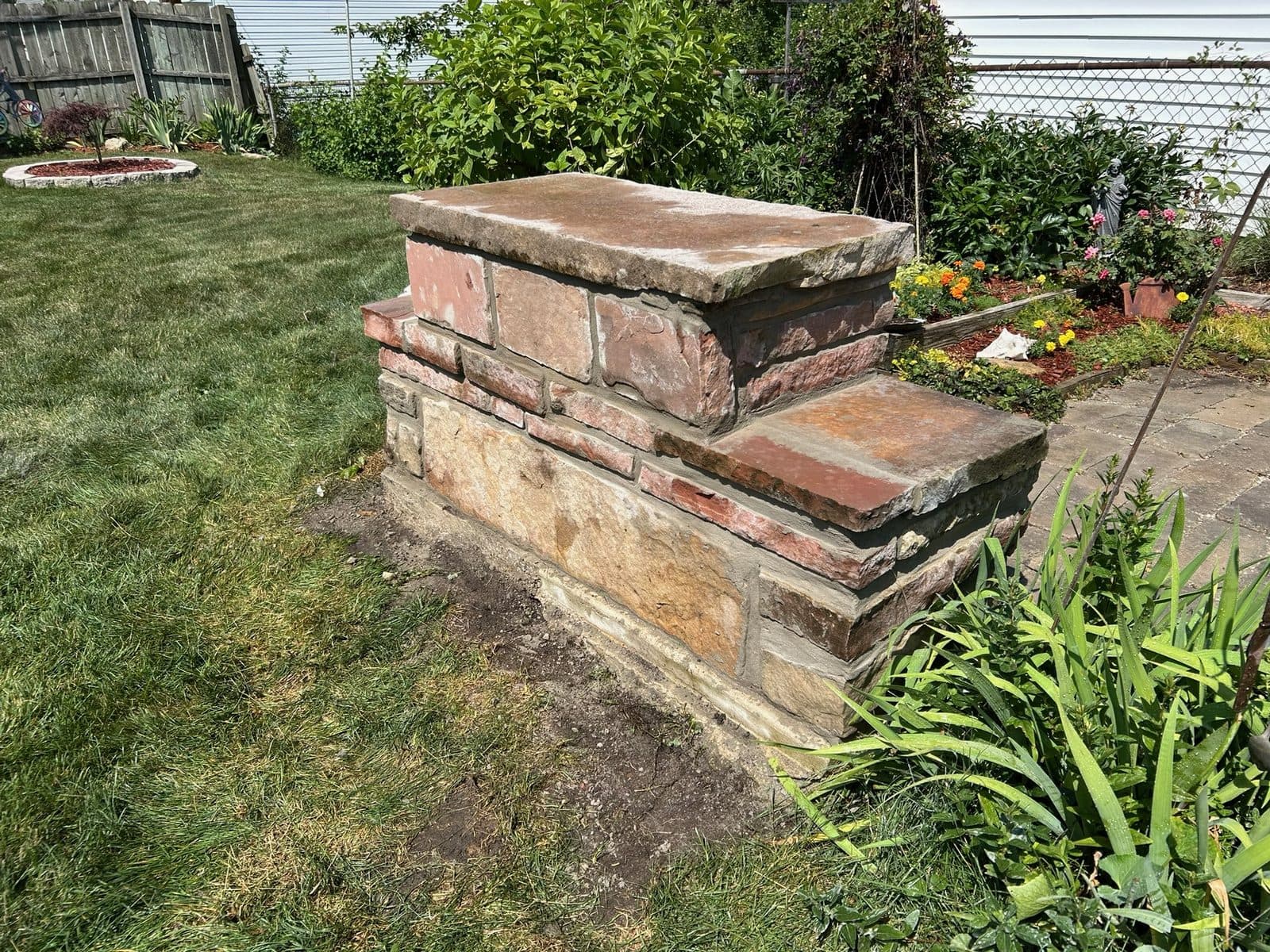
If you've noticed a crack snaking through the brick right above a window, a course of brick that looks like it's drooping over a doorway, or rusty streaks bleeding down your facade, there's a good chance you're looking at a failing lintel. It's one of the most common — and most misunderstood — masonry problems on older Chicago-area homes. Homeowners often assume the brick itself is the problem, when the real culprit is a piece of hidden steel doing exactly what steel does in our climate: rusting.
This guide walks you through what a lintel is, why it fails, the warning signs to watch for, and how a professional lintel replacement is actually done. Paul Lally's Masonry Inc. has been diagnosing and replacing failing lintels on Chicagoland homes since 1988, and the pattern is so consistent we can usually tell you what's happening before we're off the front walk.
What a lintel is — and the building science behind it
A lintel is the horizontal structural member that spans the top of an opening — a window, a door, a garage opening — and carries the weight of the masonry above it. On the overwhelming majority of brick homes around Chicago, that lintel is a steel angle iron: an L-shaped length of steel tucked behind the face brick, with one leg supporting the bottom of the brick course and the other hidden in the wall.
It's a simple, elegant piece of engineering. The brick over a window can't span an open gap on its own, so the steel angle iron lintel bridges it and transfers the load down into the brick on either side. When it's working, you never think about it. You can't even see it — it's behind the brick, painted to match or tucked under the sill.
The problem is what happens to steel when water reaches it. Steel rusts, and rust takes up far more volume than the original metal — by some estimates up to ten times as much. As a hidden lintel corrodes, the expanding rust has nowhere to go but outward and upward, against the brick it's supposed to be supporting. Masons call this rust jacking (or oxide jacking), and it's the single mechanism behind most cracked brick over windows in this region. The steel literally jacks the masonry apart from the inside.
Causes and warning signs
Lintels fail for one root reason — moisture reaching unprotected steel — but several conditions speed it along: failing mortar joints letting water in, missing or clogged weep holes, no flashing above the lintel, deteriorated caulking around windows, and decades of Chicago weather. Here's what that failure looks like from the outside.
Cracked or stepped brick above the opening
The hallmark sign. You'll see cracks in the brick or mortar directly above a window or door, often running horizontally along the line of the lintel or climbing diagonally in a step-crack pattern that follows the mortar joints. These cracks open as the rusting steel pushes the brick up.
Sagging or displaced brick
As jacking continues, the brick course over the opening can look like it's sagging, bowing, or stepping out of plane. Individual bricks may sit proud of the wall or feel loose to the touch. This is the steel losing its straightness and the masonry losing its support at the same time.
Rust staining
Reddish-brown rust streaks bleeding down the brick or the window frame are a dead giveaway that the steel behind the face is actively corroding. Where there's rust bleed, there's section loss happening out of sight.
A visibly bowed or drooping steel angle
On many homes the bottom edge of the lintel is partly visible above the window. If that steel looks bowed, drooping, flaking, or swollen with rust, the rusted lintel is well into failure.
Operational clues
Sometimes the first hint is a window that suddenly sticks or a frame that looks out of square — the opening is being distorted as the masonry above it shifts.
| Warning sign | What it usually means |
|---|---|
| Horizontal crack above a window | Lintel rust jacking has begun |
| Step cracks climbing from the corners | Load is redistributing as support fails |
| Rust stains on brick/frame | Active corrosion, section loss behind the face |
| Sagging or loose brick over opening | Advanced failure — falling-brick risk |
| Window suddenly sticking | Opening distorting under shifting masonry |
If you're seeing one of these, the next thing to understand is why you can't afford to wait.
The risks of waiting
A failing lintel only gets worse, never better — rust doesn't reverse itself. Left alone:
- Loose brick becomes falling brick. Over a doorway, porch, or walkway, that's a genuine safety hazard to people below.
- Water pours in. Every open crack is a path for rain and snowmelt into the wall cavity, soaking sheathing, framing, and interior finishes.
- Freeze-thaw multiplies the damage. Once water is in the masonry, Chicago's freeze-thaw cycle expands it on every hard night, spalling brick faces and widening cracks.
- A small fix becomes a big one. A single-opening lintel replacement caught early is straightforward. Ignored, it can spread into adjacent brick, the wall below, and a much larger rebuild.
How a professional lintel replacement is done
Replacing a lintel is structural masonry, and the sequence matters. Here's how Paul Lally's Masonry Inc. approaches a typical residential lintel:
- Inspect and confirm the diagnosis. We verify the lintel is the cause, check the opening for square, and look for related issues — failing mortar, missing flashing, water damage behind the brick.
- Shore and support the load. Before anything is cut, the weight of the masonry above the opening is temporarily supported so nothing shifts when the steel comes out. This is the step DIYers skip and the one that prevents collapse.
- Remove the affected brick courses. We carefully take down the brick over the lintel, salvaging matching brick where we can for reuse.
- Cut out the rusted lintel. The old, corroded steel is removed entirely — there's no rehabilitating a lintel that's already jacked the wall.
- Set the new lintel. A correctly sized galvanized (or primed-and-coated) steel lintel is installed with proper bearing on each end and the right end clearance so it can expand and contract without binding. Galvanizing is what keeps the new steel from repeating the cycle.
- Add flashing and weep holes. We install flashing above the lintel and weep holes in the course above so any water that gets in drains back out instead of sitting on the steel — the detail that makes the repair last.
- Rebuild and match the brick. The brick is relaid, the mortar color- and texture-matched to the surrounding wall, and the joints tooled to match the original profile.
- Repoint and seal as needed. We repoint the surrounding joints if they're failing and address any related waterproofing so the new work is protected.
Materials and techniques that make it last
The difference between a lintel replacement that lasts decades and one that fails again comes down to materials and details:
- Galvanized steel instead of bare steel — the zinc coating dramatically slows corrosion.
- Proper bearing length on each end so the load transfers correctly into the surrounding brick.
- Flashing and weep holes to manage water rather than trap it.
- Mortar matching — the right mortar type (commonly Type N for residential brick) color- and texture-matched so the rebuilt section blends into the original wall instead of standing out as a patch.
- Correct end clearance so the steel can move with temperature swings without cracking the masonry.
Paul Lally's Masonry Inc. is a family-owned, insured masonry contractor serving Chicago and the Chicagoland suburbs since 1988 — tuckpointing, brick repair and replacement, chimney repair and rebuilds, lintel replacement, masonry restoration, and waterproofing for residential and commercial properties. Built on Craftsmanship. Backed by Experience. Free on-site estimates — call (708) 448-8866.
What drives the cost of a lintel replacement
We never quote a lintel sight-unseen, and we don't publish prices — every opening is different. But it helps to understand the factors that move a lintel replacement up or down so you can read an estimate intelligently:
- Height and access. A ground-floor window worked from ladders is far simpler than an upper-story or above-a-porch opening that needs scaffolding or a lift.
- Number of openings. Several lintels at once share setup and usually cost less per opening than one-offs spread over time.
- Extent of brick damage. If jacking has spread well beyond the opening, more brick has to be removed, matched, and rebuilt.
- Brick matching difficulty. Discontinued or unusual brick takes more work to source and blend.
- Related repairs. Flashing, waterproofing, or tuckpointing of the surrounding wall may be warranted to protect the new lintel.
The only accurate number is a free on-site estimate, where we measure the opening, assess the surrounding masonry, and give you a written scope — call (708) 448-8866.
Why lintel replacement isn't a DIY job
It's tempting to treat a cracked-brick-over-a-window as a cosmetic patch, but lintel work is structural and unforgiving:
- The load above the opening must be supported before the steel is removed — get this wrong and the wall can come down.
- The new lintel has to be sized and bedded correctly, with proper bearing, or it'll deflect and crack the masonry again.
- Mortar matching and tooling are skilled work; a mismatched patch advertises itself forever.
- The water-management details — flashing, weep holes, galvanizing — are what separate a permanent fix from a repeat in ten years.
This is exactly the kind of job where a insured mason earns the call. Our name is on every job, so we build it to last.
Chicago and Chicagoland context
Greater Chicago is full of beautiful, durable masonry — and a lot of original steel lintels that are now decades past their prime. The brick bungalows of the Bungalow Belt, the greystones of the older city neighborhoods, and the two-flats scattered across Cook, DuPage, and Will Counties were largely built with bare steel angle-iron lintels that were never galvanized. After 80, 90, or 100-plus Chicago winters, that steel is rusting on schedule.
Our climate makes it worse on two fronts. Lake-effect moisture keeps walls damp, feeding corrosion, and the region's brutal freeze-thaw cycle drives water into every crack and expands it on each hard freeze. The result is a steady, predictable wave of lintel failures across Chicagoland's older housing stock — which is why this is such routine work for us in Palos Heights, Oak Lawn, Orland Park, Tinley Park, Homer Glen, and across the suburbs.
Maintenance and prevention
You can't stop a lintel from being steel, but you can dramatically slow its decline:
- Keep water out. Maintain caulking around windows, keep gutters and downspouts moving water away from the wall, and address grading that splashes the facade.
- Repoint failing mortar promptly. Open joints are how water reaches the steel — tuckpointing on schedule is cheap insurance for your lintels.
- Inspect annually. Walk your facade each spring and look above every window and door for cracks, sagging, or rust bleed.
- Catch surface rust early. If a partly visible lintel is just starting to show light rust, treating it early can buy years.
- Manage the whole water story. Flashing, weep holes, and masonry waterproofing all keep moisture away from the hidden steel.
Related services
Lintel replacement rarely travels alone. Depending on what we find, the right fix may include:
- Lintel Replacement — the core structural repair, done with galvanized steel and proper water management.
- Brick Repair & Replacement — for the brick courses damaged or displaced by jacking.
- Tuckpointing & Repointing — to close the failing joints that let water reach the steel in the first place.
The bottom line
When the brick above your windows is cracking, it's not the brick that's failing — it's the steel lintel hidden behind it, rusting and jacking the masonry apart. It's a structural problem that only grows, and the longer it sits, the more brick and water damage it takes with it. The good news is that a properly done lintel replacement — galvanized steel, correct bearing, flashing and weep holes, matched brick — solves it for decades.
Paul Lally's Masonry Inc. has been replacing failing lintels across Chicago and the suburbs since 1988. We're family-owned, insured, and we put our name on every job. If you're seeing cracks, sagging, or rust over a window or door, get it looked at before it spreads. Built on Craftsmanship. Backed by Experience. Call (708) 448-8866 or request a free on-site estimate today.
Frequently Asked Questions
What is a lintel and what does it do?
A lintel is the horizontal structural member — almost always a steel angle iron on Chicago brick homes — that spans the top of a window or door and carries the weight of the brick above the opening. Without it, the masonry over the window would have nothing to bear on. It's hidden behind the brick, so most homeowners never see it until it fails.
How do I know if my lintel is failing?
The clearest signs are cracks in the brick directly above a window or door, brick that looks like it's sagging or stepping apart over the opening, and rust staining bleeding down from the steel. You may also see a visibly bowed or drooping steel angle at the top of the window frame. Any of these means it's time for an inspection.
Is a cracked lintel dangerous?
It can become dangerous if ignored. As the steel rusts and lifts the brick, individual bricks loosen and can eventually fall — a real hazard over a doorway or walkway. Long before that, the open cracks let water into the wall, accelerating freeze-thaw damage. It's a structural issue, so it shouldn't wait.
Can a lintel be repaired, or does it have to be replaced?
Surface rust caught very early can sometimes be cleaned and treated, but once steel has rusted enough to crack and lift the brick, the lintel has lost section and must be replaced. Painting over a rusted, expanded lintel doesn't restore its strength or stop the jacking. Replacement with new galvanized steel is the lasting fix.
Why is the brick above my window cracking?
On a brick home it's almost always a rusting steel lintel. Trapped moisture corrodes the hidden steel, and rust occupies far more space than the original metal — so it expands and physically pushes the brick courses up and apart, opening cracks above the window. The cracks are the symptom; the rusting lintel is the cause.
What happens if I ignore a failing lintel?
The rust keeps expanding, the cracks widen, and more brick loosens until courses sag, displace, or fall. Water pouring through the open joints damages the wall behind the brick and feeds Chicago's freeze-thaw cycle. A repair that would have been a single opening can grow into a much larger rebuild.
How long does a lintel replacement take?
A single typical residential window lintel is often a one- to two-day job once we've shored the load, cut out the old steel, set the new lintel, and rebuilt the brick — plus curing time for the new mortar. Multiple openings, upper stories needing scaffolding, or extensive brick damage take longer. We give you a clear timeline with your free estimate.
Why can't I replace a lintel myself?
Lintel replacement is structural masonry: the brick load above has to be temporarily supported, the rusted steel cut out, a properly sized new lintel set with correct bearing, and the brick rebuilt and matched. Getting the support or sizing wrong risks collapse and injury. This is work for an insured mason — not a DIY repair.