
Masonry Restoration · Chicagoland, IL
Does Homeowners Insurance Cover Masonry Repair? What Chicago Homeowners Should Know
Insurance generally pays for masonry damage that happens suddenly — a storm, a lightning strike, a vehicle impact — and generally doesn't pay for masonry that simply wore out. Knowing which side of that line your chimney or wall falls on saves a lot of frustration before you pick up the phone.
2026-08-22
Quick Answer
Homeowners insurance generally covers masonry damage caused by a sudden covered peril — high wind, hail, lightning, fire, or vehicle impact — and generally excludes gradual deterioration such as crumbling mortar, spalling brick, freeze-thaw damage, and rusting lintels, which are treated as maintenance. Coverage depends on your specific policy and your insurer's determination. Paul Lally's Masonry provides written masonry assessments and repair scopes for Chicagoland homeowners — (708) 448-8866.
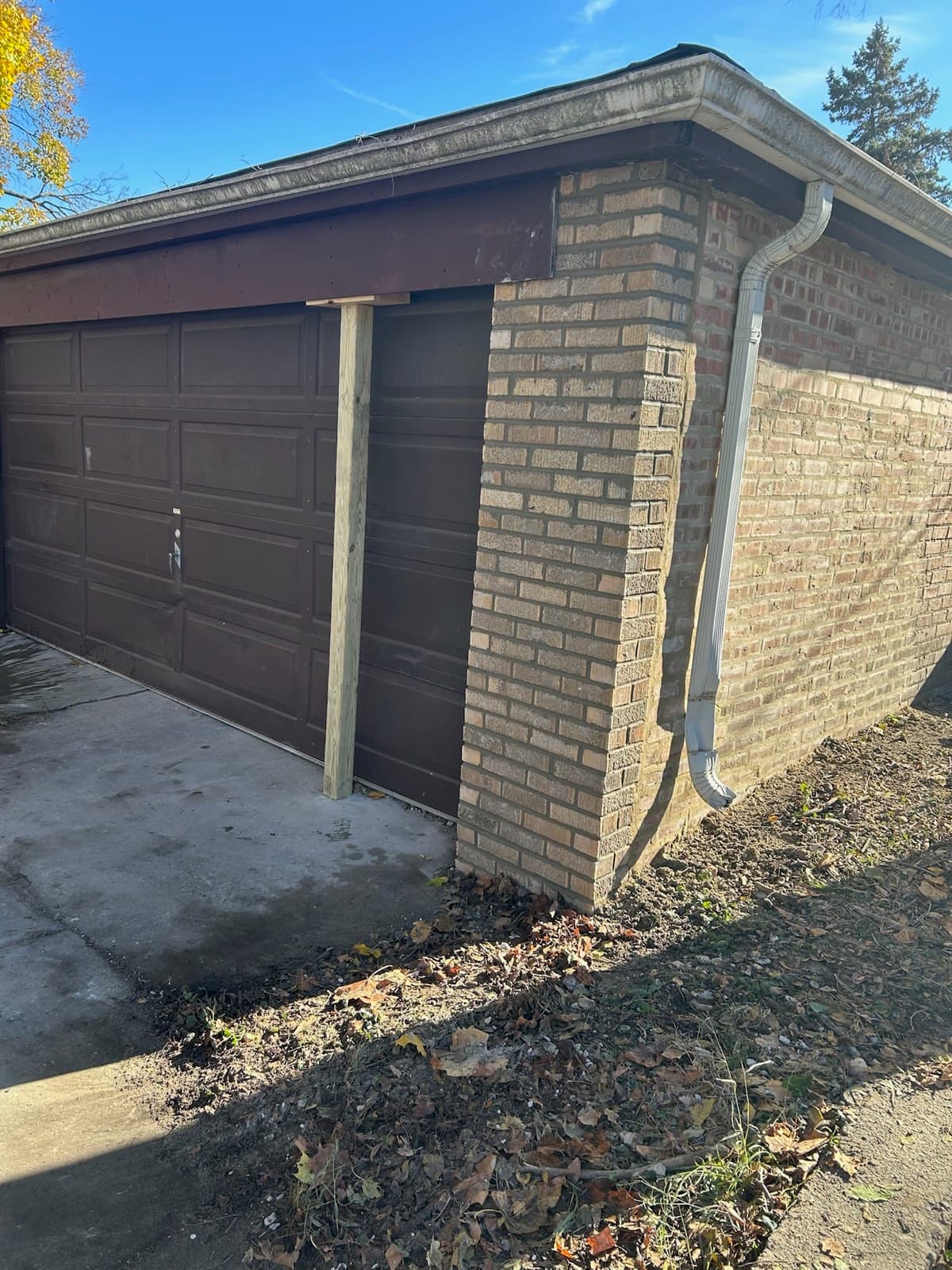
Every spring and every fall we get the same call. A storm comes through Chicagoland, someone walks out to find their chimney leaning, brick on the driveway, or a section of parapet on the roof — and the first question is not "how do we fix it," it is "will my insurance pay for this?"
The honest answer has a clear general shape, and it is worth understanding before you call anybody. Insurance is built to cover sudden, accidental damage. It is not built to cover things wearing out. Nearly every masonry coverage question comes down to which of those two things happened.
Paul Lally's Masonry has been repairing Chicagoland brick, stone, and chimneys since 1988. We are not an insurance company and we do not make coverage decisions — but we assess masonry damage every week, we write the documentation homeowners hand to their adjusters, and we can tell you plainly which side of that line your damage is likely to fall on. Free on-site assessment: (708) 448-8866.
One thing up front: what follows is general information about how homeowners policies commonly work, not advice about your policy. Your coverage is determined by your own policy language and by your insurer. Read the policy, and talk to your agent.
The line that decides almost every masonry claim
Standard homeowners policies cover damage caused by covered perils — specific events like:
- Windstorm and hail
- Lightning
- Fire and explosion
- Impact from a vehicle or aircraft
- Falling objects (a tree limb through a chimney, for instance)
- Weight of ice, snow, or sleet in some circumstances
They then exclude a list of things, and the exclusions that matter for masonry are almost always some version of:
- Wear and tear, deterioration, and marring
- Inherent vice — a material simply reaching the end of its life
- Settling, cracking, shrinking, and expansion of foundations, walls, and pavements
- Neglect — failing to maintain the property
- Earth movement
That is why the two most common masonry problems in Chicagoland — failing mortar joints and spalling brick — are typically not covered. Both are the product of many winters of water and freeze-thaw, and both are considered maintenance.
Where common masonry problems usually land
| The damage | Typically covered? | Why |
|---|---|---|
| Chimney toppled or cracked by high wind | Often yes | Windstorm is a covered peril |
| Chimney struck by lightning | Often yes | Lightning is a covered peril |
| Tree limb falls through a chimney or wall | Often yes | Falling object, sudden event |
| Vehicle hits a brick pillar, wall, or corner | Often yes | Vehicle impact; the driver's auto liability may respond first |
| Fire damage to a chimney or masonry wall | Often yes | Fire is a covered peril |
| Crumbling, receding mortar joints | Usually no | Wear, weathering, maintenance |
| Spalling, flaking brick from freeze-thaw | Usually no | Gradual deterioration over many seasons |
| Rusted lintel lifting brick above a window | Usually no | Long-term corrosion, maintenance |
| Bowing wall from long-term movement | Usually no | Settling/earth movement exclusions |
| Water damage inside from long-neglected joints | Usually no | Traced back to an excluded cause |
| Interior damage from a storm-opened chimney | Often yes | Consequential damage from a covered event |
Notice the pattern. Events are covered. Processes are not. A storm is an event. Thirty winters is a process.
There is a gray zone, and adjusters live in it: a chimney that was already deteriorating and then came down in a windstorm. Insurers may argue the pre-existing condition caused the loss, and that argument is much harder to make against a homeowner who can show the masonry was maintained.
What to do when masonry is damaged suddenly
- Make the area safe. Keep people and cars away from anything overhead that could still fall. Loose brick over a walkway or an entrance is a real hazard, not a theoretical one.
- Document before anything moves. Photograph and video the damage from multiple angles and distances, including debris where it landed and any interior damage. Once cleanup starts, that evidence is gone.
- Prevent further damage — but don't over-repair. Most policies require you to take reasonable steps to prevent additional loss: tarping an opened roof, temporarily covering or shoring an unstable section. Emergency stabilization is different from starting permanent repairs, and permanent repairs generally should wait until the claim is worked out.
- Save every receipt for emergency work and materials.
- Notify your insurer promptly. Policies contain notice requirements, and delays create problems.
- Get a real masonry assessment. An adjuster is a generalist. A written contractor scope explaining what failed, why, and what the correct repair is gives you something concrete to work from.
- Read anything before you sign it. Especially anything involving your claim benefits.
The storm-chaser problem
After every significant Chicago-area wind or hail event, out-of-area crews canvass the damaged neighborhoods. Some are legitimate. Many are not, and the pattern is consistent: high pressure at the door, a promise that "insurance will cover everything," and a document to sign right now.
A few things worth holding to:
- Nobody can promise you a claim outcome. Your insurer decides coverage.
- Understand any assignment of benefits before you sign it — it can transfer your rights in the claim to the contractor.
- Check that the contractor is established and insured, and that you can find them at an address that will still exist next spring.
- Be wary of anyone offering to "cover your deductible." That is not a favor, and it is a red flag about everything else they will tell you.
- Get the scope in writing — what work, on what areas, with what materials.
An established local company will still be here when a repair needs to be looked at again. That is most of the point.
Why Chicagoland sees so many masonry claims
Northeastern Illinois is hard on masonry, and it is hard in both of the ways that matter here.
Sudden events. The region gets straight-line wind events and derechos, spring and summer hail, and severe thunderstorms with damaging gusts. Chimneys and parapet walls take the worst of it, because they are the most exposed masonry on any building — freestanding above the roofline, unsupported on all sides, and often the oldest unmaintained masonry on the house.
Slow processes. Chicago cycles through freezing and thawing dozens of times a winter. Water gets into a joint or a brick, freezes, expands about nine percent, and forces the masonry apart — over and over, for decades. Add de-icing salt at grade and the region's large stock of century-old soft common brick, and you have the exact conditions the wear-and-tear exclusion was written for.
Most Chicagoland masonry damage is the second kind. Which brings us to the part homeowners have real control over.
Maintenance is the part you control
You cannot prevent a derecho. You can affect two things that matter to a claim:
First, whether deterioration gets blamed for your loss. A chimney that comes down in a storm after being maintained is a much cleaner claim than one that had visibly failing joints and an open crown for a decade.
Second, whether you need a claim at all. Nearly everything that is excluded is also preventable at a fraction of what the eventual repair costs:
- Tuckpointing before joints erode deep enough to let water into the wall
- Chimney repair — crown, cap, and flashing, the three details that keep water out of the stack
- Lintel replacement before rusting steel lifts the brick over your windows
- Brick repair while it is scattered units rather than a failed section
- Masonry waterproofing after repairs, to slow absorption on exposed elevations
- Water management — gutters, downspouts, grade, and window wells doing their jobs
Build a paper trail
Homeowners rarely think about this until they need it:
- Take dated photos of your masonry every year or two, all elevations plus the chimney
- Keep invoices and written scopes for every masonry repair
- Keep any written inspection report from a contractor
- Photograph the before condition after buying the house
If a storm ever does hit, that record is what establishes your masonry was in good condition beforehand.
What our assessment gives you
When we look at storm-damaged masonry, what a homeowner gets is a plain-language written account of:
- What failed, specifically, and where
- What caused it, and whether it is consistent with a sudden event or long-term deterioration
- Whether anything is unstable and needs immediate stabilization
- What the correct repair is — repair, partial rebuild, or full rebuild — and why
- Photographic documentation of the damage
- A written scope and estimate you can hand to your adjuster
What we do not do is tell you what your policy covers, or promise you an outcome. That is your insurer's determination. Our job is to make sure the masonry facts in front of them are accurate and complete, and then to do the repair right.
Repair or rebuild? A separate question worth asking
Insurance conversations often collapse into "fix the chimney," when the real question is whether the chimney should be repaired or rebuilt. A stack that lost a few courses in a storm but is sound below the roofline is a repair. A stack that is leaning, has open joints throughout, or has a failed crown letting water down the whole flue is usually a rebuild — and rebuilding a chimney that would need rebuilding within a couple of years anyway is often the better decision even when the storm only damaged the top.
We tell you which one your chimney actually is. We would rather give you the honest answer than the one that fits neatly into a claim.
Condo, two-flat, and commercial buildings
Multi-unit and commercial buildings add a wrinkle homeowners do not have: who owns the masonry.
In most Chicagoland condominium associations, exterior walls, parapets, and chimneys are common elements maintained by the association and insured under the association's master policy, while unit owners carry their own coverage for what is inside their walls. That means a storm-damaged parapet is usually an association claim, not a unit owner's — and a unit owner reporting water damage from it may be dealing with two policies at once. If you own a unit, find out what your association's master policy covers and what your own policy is expected to pick up before something happens.
Two-flats and small apartment buildings owned by an individual often fall under a landlord or dwelling policy with different terms than an owner-occupied homeowners policy, particularly around loss of rents when a building is unusable during repairs.
Commercial buildings raise the stakes further. Parapet walls are the most claim-prone masonry on any flat-roofed Chicago building — freestanding above the roofline, weathered on both faces, and directly over the sidewalk. When a storm damages one, the immediate issue is public safety and protecting the walkway below, and the repair scope usually needs to address the whole parapet rather than the damaged section alone. For occupied buildings, commercial masonry restoration also has to be phased around tenants, which is a scheduling conversation worth having early rather than after the adjuster's visit.
The short version
Insurance is for sudden events: wind, hail, lightning, fire, impact. It is not for masonry wearing out, and in Chicagoland most masonry damage is exactly that — freeze-thaw, failing joints, spalling brick, rusting lintels, all built up over decades. Document your masonry, maintain it, and if something sudden does happen, photograph it, secure it, report it, and get a real assessment before anyone starts making promises at your door.
Paul Lally's Masonry Inc. is a family-owned, insured masonry contractor serving Chicago and the Chicagoland suburbs since 1988 — tuckpointing, brick repair and replacement, chimney repair and rebuilds, lintel replacement, masonry restoration, and waterproofing for residential and commercial properties. Built on Craftsmanship. Backed by Experience. Free on-site estimates — call (708) 448-8866.
Storm damage, a leaning chimney, or masonry you want documented before something happens to it — request a free on-site estimate or call (708) 448-8866.
Frequently Asked Questions
Does homeowners insurance cover masonry repair?
Generally, it covers masonry damaged suddenly by a covered peril — high wind, hail, lightning, fire, explosion, or vehicle impact — and generally excludes masonry that deteriorated gradually. Every policy is different, so the definitive answer comes from your policy language and your insurer, not from a contractor.
Is tuckpointing covered by insurance?
Routine tuckpointing almost never is, because failed mortar joints are considered wear, weathering, and maintenance rather than sudden accidental damage. Repointing done as part of repairing storm damage to a specific area is a different matter and is sometimes included in that repair scope.
My chimney blew over in a storm. Is that covered?
Wind damage is a covered peril under most homeowners policies, so a chimney toppled or cracked by a documented storm is a common and often payable claim. Insurers may look at whether pre-existing deterioration contributed, which is one reason keeping your masonry maintained matters.
Why was my brick damage claim denied?
The most common reason is that the damage was classified as gradual deterioration — crumbling mortar, spalling brick, freeze-thaw damage, or a rusting lintel — rather than sudden accidental loss. Those are excluded as wear and tear in most standard policies.
Is freeze-thaw damage to my brick covered?
Usually not. Freeze-thaw spalling happens over many winters, which places it squarely in the wear-and-tear category rather than a sudden event. It is the single most common masonry problem in Chicagoland and the one homeowners are most often surprised to find excluded.
What should I do right after storm damage to my masonry?
Keep people away from anything that could fall, photograph everything before it is touched, arrange temporary protection to prevent further damage, and notify your insurer promptly. Save receipts for emergency work — most policies expect you to prevent further damage and account for what that cost.
Should I sign a contract with the first company that knocks on my door?
No. Storm events bring out-of-area operators who canvass damaged neighborhoods, and homeowners regularly sign documents that assign their claim benefits away before they understand what they signed. Take the time to get an established local contractor to look at it.
Does a masonry contractor handle my insurance claim?
A contractor's role is to assess the masonry and provide a clear written scope and documentation of the damage and the repair. Coverage determinations are made by your insurer and adjuster, and anyone promising a specific outcome on your claim is out over their skis.
Does deferred maintenance affect my claim?
It can. If an insurer concludes that pre-existing deterioration caused or worsened the loss, that can reduce or defeat a claim. Documented maintenance and periodic inspection reports help establish the condition of your masonry before an event.
Is a vehicle hitting my brick wall or pillar covered?
Impact by a vehicle is a covered peril under most homeowners policies, and if another driver was at fault their auto liability coverage may be the primary route. Photograph the scene, get a police report, and let your insurer advise on which policy responds.