
Homeowner Education · Chicagoland, IL
Getting a New Roof? Do the Chimney Masonry First — and Here's Why the Order Matters
Your roofer says the chimney needs work. Your mason says the flashing is the roofer's. Meanwhile the leak keeps coming back, because chimney flashing is the one detail on a house where two trades have to meet — and when nobody owns the seam, nobody fixes it.
2026-08-26
Quick Answer
When a roof is being replaced, chimney masonry should be repaired first, because the flashing that seals the chimney to the roof is installed as part of the roofing and gets built into the masonry joints. Repointing or rebuilding a chimney after new shingles go on means cutting back into finished work. Paul Lally's Masonry Inc. coordinates chimney masonry with roof replacement across Chicagoland. Family-owned since 1988, insured. Call (708) 448-8866.
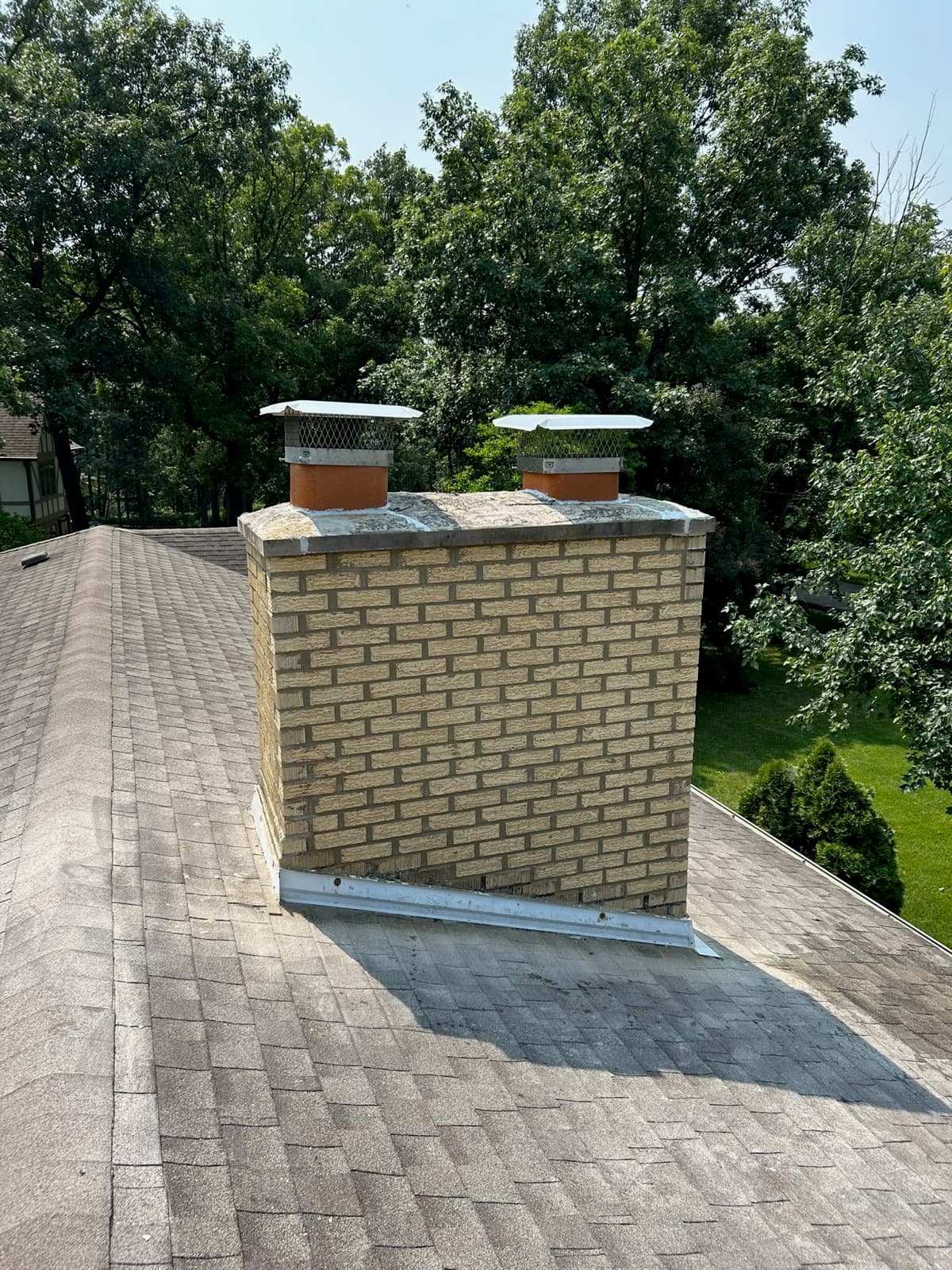
The One Detail Two Trades Have to Share
Almost everything on a house belongs clearly to one trade. The roof is the roofer's. The brick is the mason's.
Chimney flashing belongs to both, and that is precisely why it is the most persistently mishandled detail on Chicagoland homes.
The assembly that keeps water out where a chimney passes through a roof is not one piece. It is two systems that have to interlock: metal woven into the shingles by the roofer, and metal let into the mortar joints by the mason. When each trade assumes the other has it, nobody does — and the homeowner pays for a new roof that does not stop the leak.
The fix is not complicated. It is a matter of sequence and ownership, decided before either trade starts.
Paul Lally's Masonry Inc. coordinates chimney and roof-edge masonry with roof replacement throughout Chicago and the Chicagoland suburbs. Family-owned since 1988, insured, free on-site estimates. Call (708) 448-8866.
The Rule: Masonry First
If your chimney needs repointing, a crown, or a rebuild, that work goes in before the shingles do.
Three reasons, all practical.
The flashing is installed as part of the roofing, and it ties into the masonry. Counterflashing is set into a cut groove in the mortar joint. If the masonry is going to be repointed or rebuilt, that has to happen before the metal is set into it — otherwise the mason is cutting back into flashing that was just installed, and the roofer's warranty is now involved in someone else's work.
Tear-off is rough on weak masonry. Stripping a roof around a chimney whose joints are already crumbling can take material with it. Sound masonry tolerates the process; deteriorated masonry sometimes does not.
Access is already paid for once. Staging, roof jacks and fall protection set up for one trade can often serve the other. Doing chimney work as a separate visit months later means mobilising all of it again.
The exception is emergency work. If the roof is actively leaking and failing, it gets replaced now and the masonry follows — but even then, plan the flashing detail so it can be redone properly rather than pretending it will not need touching.
How the Flashing Assembly Actually Works
Worth understanding, because it explains why the shortcut version fails.
Step flashing — L-shaped metal pieces, one per shingle course, woven into the shingles as they are laid up along the sides of the chimney. Each piece laps the one below it, so water running down the roof is carried over the top of the next piece rather than behind it. This is roofing work.
Base and apron flashing — the metal at the downhill face of the chimney, shedding water from the chimney onto the roof.
Counterflashing — the piece that makes the whole thing work. It is set into a cut groove in the mortar joint of the chimney (a reglet), mechanically secured, sealed, and bent down to lap over the top of the step flashing. Its job is to catch water running down the face of the brick and throw it out onto the step flashing below, so it never gets behind the assembly. This half is masonry work.
A cricket or saddle — on the uphill side of a wider chimney, a small peaked structure diverting water and snow around the masonry rather than letting it pond against it.
The failure everybody has seen: flashing simply smeared onto the face of the brick with roof cement or caulk, with no groove cut and nothing mechanically holding it. It looks sealed on day one. Sealant is a wear item, the brick face is not a bonding surface, and within a few seasons water is running straight behind it.
Sealant is the second line of defence in this assembly. It is never supposed to be the first.
Why "New Roof, Still Leaking" Is So Common
Because most chimney leaks are not flashing leaks at all — and a roofer replacing a roof has no reason to address the masonry above it.
There are three separate water paths into a chimney, and only one of them is at the roof line:
- Through the top. A cracked, spalled or missing crown, or a missing cap over the flue, lets water straight down into the chimney's core. New shingles are irrelevant to it.
- Through the walls. Open mortar joints and spalled brick let water into saturated masonry, which then runs down inside the chimney and appears well below where it entered.
- At the flashing, where the chimney meets the roof.
A homeowner sees a stain on the top-floor ceiling, assumes roof, and buys a roof. If the actual path was one or two, the stain comes back — and now they think they were sold a bad roof.
Water enters at the top of a chimney and appears at a ceiling twenty feet away. That is why this gets misdiagnosed so consistently.
What to Look At Before You Book Either Trade
Take binoculars and look at the chimney from the ground:
- A cracked, spalled or missing crown — or a thin mortar wash sloped off the flue tile instead of a proper crown
- Mortar joints receding, dark or open in the top courses
- Spalling brick — faces flaked or sheeted off
- Missing brick or visible gaps in the upper courses
- A missing, rusted or dislodged cap over the flue
- Clay flue tile cracked or sitting proud of a broken crown
- Dark saturation staining or white efflorescence on the stack
- Rust staining at the flashing line
- Flashing that is lifted, rusted, or clearly just caulked to the brick face
- A visible lean, or a gap between chimney and house — treat this as urgent
Inside, check the attic where the chimney passes through. Staining shows up there long before it reaches a finished ceiling.
How the Two Trades Should Be Sequenced
- Get both assessments before committing to either. A mason tells you how far down sound masonry begins; a roofer tells you what the roof needs. Neither can answer the other's question.
- Decide who owns the counterflashing, in writing. This is the single most valuable sentence in the whole project. Cut reglet and counterflashing set by the mason, step flashing by the roofer, is the cleanest split.
- Do the masonry. Repoint, rebuild to sound masonry, form a proper crown with an overhang and drip edge, and address the flue.
- Cut the reglet into a mortar joint at the correct height and set the counterflashing.
- Roof it, with step flashing woven into the courses and a cricket where the chimney width calls for one.
- Lap and seal the counterflashing down over the step flashing.
- Fit the cap and check the crown once more.
- Look at it together before staging comes down — this is the last easy moment to catch anything.
What Else on the House Follows the Same Logic
Chimneys are the common case, but the same masonry-before-roofing principle applies wherever masonry meets a roof.
Flat roofs and parapets. The membrane terminates against parapet masonry with counterflashing set into the wall, and the coping above it has to be sound. Repointing or rebuilding a parapet after the membrane is down means working over brand-new roofing. See parapet wall repair.
Roof-to-wall junctions, where a lower roof — a porch, an addition, a garage — meets a taller masonry wall. This is also where kickout flashing belongs: the small diverter at the bottom of the junction that throws roof runoff into the gutter instead of down the wall. Missing kickouts are a common, and quietly destructive, omission.
Dormer cheeks and masonry gable ends, where the same interlocking logic applies.
Materials
Flashing metal should be a durable, non-corroding material appropriate to the exposure — and not bare galvanized left to rust, which is what we find on a lot of older installations.
Mortar matched for hardness, colour, sand and texture, and always softer than the brick it sits against. Type N for most twentieth-century chimney brick; lime-rich, softer mixes for the soft brick on pre-1900 greystones, Victorians and older two-flats.
The crown deserves emphasis, because it is the single highest-value item on a chimney. A properly formed sloped crown with a bond break at the flue tile and an overhang with a drip edge past the face of the brick outlasts a mortar wash troweled flush by decades. It is a small share of the cost and most of the service life.
Sealant at the counterflashing is a wear item and should be specified and maintained as one.
Related services: chimney repair and rebuilds, tuckpointing, brick repair and brick replacement, caulking and joint sealant, and masonry restoration.
What Drives the Cost
- How far down sound masonry is found — nobody can determine this from the ground
- Roof pitch, height and access, and whether staging or roof jacks are required
- Chimney size — a tall multi-flue stack is a different job than a single flue
- Crown and cap scope
- Flue condition
- Brick matching, particularly on historic or unusual material
- Whether a cricket is being added
- Coordination and scheduling between trades
- Season, since mortar has curing temperature limits
Doing chimney masonry while roofing access is already in place usually reduces the total compared with two separate mobilisations. We do not price chimney work over the phone — the look is free and the estimate is written.
DIY vs. Hiring a Pro
Looking at your chimney with binoculars and checking your attic are absolutely worth doing yourself, and they will tell you whether you need to make any calls at all.
Beyond that, this is roof-height work involving a structure that vents combustion gases. Cutting a reglet without damaging brick, forming a crown that will actually last, determining rebuild depth by sounding the masonry, and lapping metal so water is shed rather than trapped are all skill-dependent — and the failure mode of getting them wrong is water inside your walls for years before you notice.
The most useful thing a homeowner can do here is not the work. It is asking the two trades, before either starts, who is cutting the reglet and who is setting the counterflashing — and getting the answer in writing.
Chicagoland Context
This region makes the sequencing question sharper than most.
Freeze-thaw frequency. Chicagoland cycles above and below freezing many times each winter rather than freezing once, and every cycle works on saturated chimney masonry. That is why the top of a stack deteriorates so much faster than the wall below it — four exposed faces, no roof above, no heated interior behind.
Ice dams. On older homes with modest insulation and ventilation, meltwater backing up at the eaves and in valleys reaches the chimney flashing from below, which is exactly the direction the assembly is least able to handle.
The housing stock. Brick bungalows, greystones, two-flats and three-flats, post-war ranches and Georgians across Cook, DuPage and Will County — nearly all of them carrying masonry chimneys, and a great many now venting little or nothing after high-efficiency furnaces were installed and vented out sidewalls. An under-used flue stays cooler and wetter, which accelerates deterioration from the inside while weather works on the outside.
Roof replacement cycles. Most homes here re-roof every couple of decades, which means most homeowners get exactly a handful of opportunities in a lifetime to do this coordination well — and it is worth taking one of them.
The Bottom Line
If you are getting a new roof and your chimney needs work, do the masonry first. Repoint or rebuild it, form a proper crown, then cut the reglet and set the counterflashing, then let the roofer weave step flashing into the shingles and lap the counterflashing over it.
And before either trade sets foot on the roof, settle the one question that causes most of the trouble: who is cutting the groove in the brick, and who is setting the metal into it?
Get that answered in writing and you will not be the homeowner with a two-year-old roof and a returning ceiling stain.
Paul Lally's Masonry Inc. is a family-owned, insured masonry contractor serving Chicago and the Chicagoland suburbs since 1988 — tuckpointing, brick repair and replacement, chimney repair and rebuilds, lintel replacement, masonry restoration, and waterproofing for residential and commercial properties. Built on Craftsmanship. Backed by Experience. Free on-site estimates — call (708) 448-8866 or request an estimate online.
Frequently Asked Questions
Should chimney masonry be done before or after a new roof?
Before, in almost every case. The flashing that seals the chimney to the roof is installed during the roofing and its upper leg is set into the masonry joints, so doing masonry afterward means cutting back into brand-new work. Repointing, rebuilding and crown repair all belong ahead of the shingles.
Who is responsible for chimney flashing — the roofer or the mason?
It is genuinely shared, which is exactly why it gets missed. The roofer installs the step flashing woven into the shingles; the counterflashing above it is set into a cut in the masonry joint and sealed, which is masonry work. Agree in writing who is doing which half before either trade starts.
My roof is new and the chimney still leaks. What happened?
Most often the masonry was never addressed. Water entering through a cracked crown, open mortar joints or saturated brick runs down inside the chimney and appears at the ceiling regardless of how good the new roof is. New shingles do not fix masonry above them.
What is counterflashing and why does it matter?
Counterflashing is the metal set into a cut groove in the masonry joint that laps down over the step flashing below it, so water running down the brick is shed onto the roof rather than behind the flashing. Without it, or with it merely surface-caulked to the brick, water gets behind the assembly.
Is flashing supposed to be caulked or cemented to the brick?
Sealant has a role as a secondary defence, but it is not the primary attachment. Counterflashing should be let into a cut in the mortar joint and mechanically secured, then sealed. Flashing simply smeared onto the brick face with roof cement is a temporary fix that fails within a few seasons.
What is a chimney cricket and do I need one?
A cricket is a small peaked structure built on the up-slope side of a chimney to divert water and snow around it instead of letting it pile against the masonry. It is generally called for on wider chimneys, and on a low-slope roof its absence is a common cause of persistent chimney-side leaks.
Can the roofers damage my chimney during a tear-off?
It can happen, particularly on a chimney whose mortar is already deteriorated — tear-off is rough work at close quarters. That is another argument for repointing beforehand: sound masonry tolerates the process far better than crumbling masonry does.
My roofer says the chimney needs rebuilding. Should I trust that?
It is worth an independent look from a mason, not because roofers are wrong but because they are looking at a different thing. A mason will tell you how far down sound masonry actually begins, which decides whether it is a repoint, a partial rebuild or everything above the roofline.
How much does chimney work cost alongside a re-roof in Illinois?
The main drivers are how far down sound masonry is found, roof pitch and access, chimney size, whether the crown and flue need work, and brick matching. Doing it while access is already set up usually reduces the total. Paul Lally's Masonry Inc. looks at it on site and puts the estimate in writing — call (708) 448-8866.
Does this apply to flat roofs and parapets too?
Yes, and arguably more so. On a flat roof the membrane has to terminate against parapet masonry with counterflashing set into the wall, and coping joints above it need to be sound. The same coordination principle applies — masonry first, then the membrane tied into it.