
Homeowner Education · Chicagoland, IL
What Is Your Foundation Actually Made Of? Identifying Stone, Brick, Clay Tile and Block
Go stand in your basement and look at the wall. Whether that's rubble limestone, common brick, hollow clay tile or concrete block tells you roughly when your house was built, how the wall will fail, what mortar belongs in it, and which repairs would quietly destroy it. Five minutes of looking answers most of the question.
2026-08-27
Quick Answer
Chicagoland foundations are built from four common masonry materials — rubble limestone, common brick, hollow clay tile and concrete block — and each tracks a build era, fails in a characteristic way, and needs a different mortar and repair approach. Identifying which one you have is the first step in any foundation masonry repair. Paul Lally's Masonry Inc. repairs foundation masonry across Chicagoland. Family-owned since 1988, insured. Call (708) 448-8866.
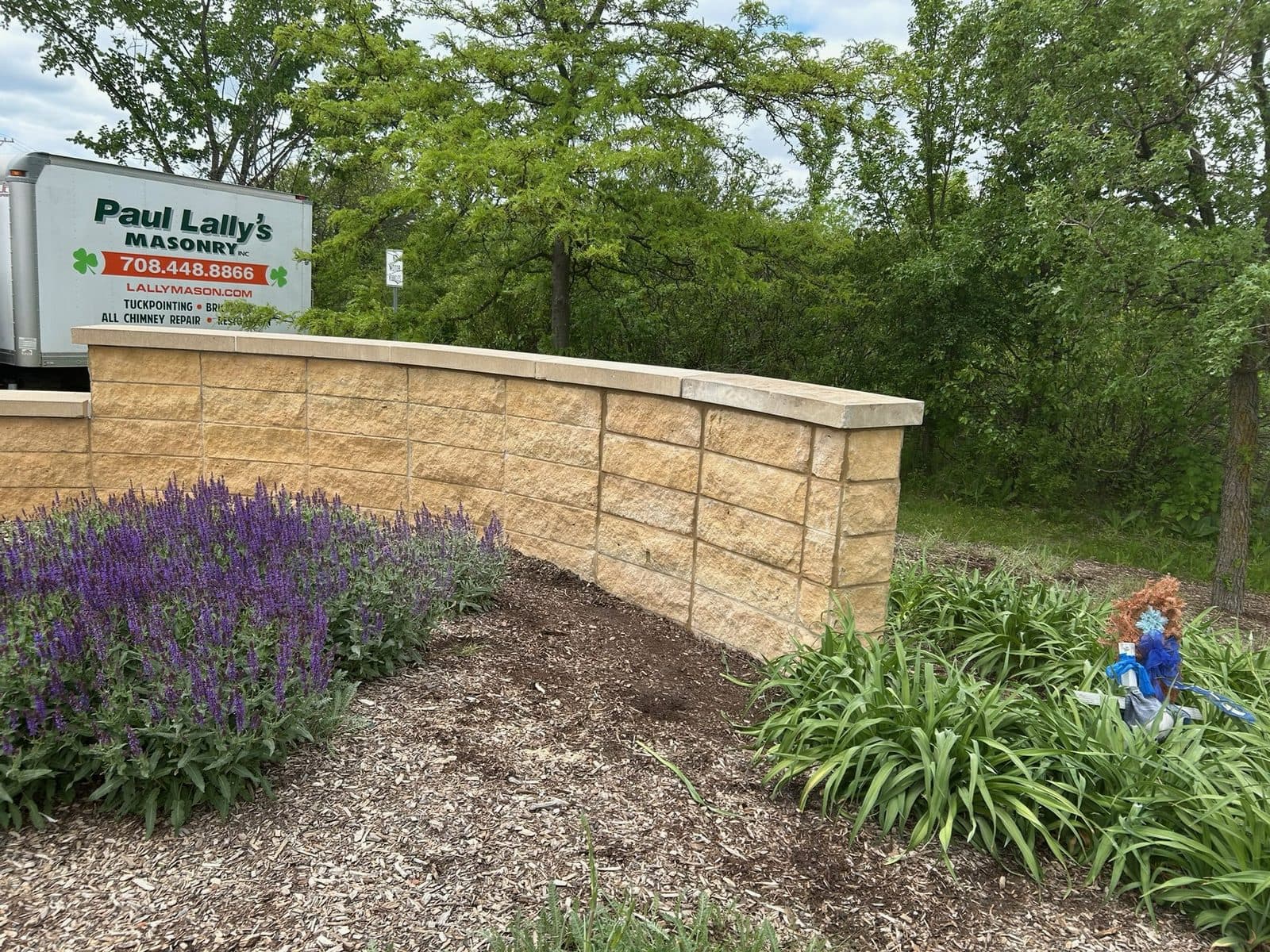
Five Minutes in Your Basement Answers Most of It
Homeowners call about foundations describing symptoms — crumbling mortar, a damp patch, grit on the floor — and almost never mention the one fact that determines everything about the repair.
What the wall is made of.
Chicagoland foundations come in four common masonry materials, plus poured concrete. Each one tracks a build era, fails in a characteristic way, needs a different mortar, and is ruined by a different well-meaning repair. Telling them apart takes a work light and five minutes.
Paul Lally's Masonry Inc. repairs foundation masonry throughout Chicago and the Chicagoland suburbs. Family-owned since 1988, insured, free on-site estimates. Call (708) 448-8866.
The Four Materials, and How to Recognise Them
Rubble limestone
What it looks like: irregular quarried stones of varying size and shape, fitted together with mortar filling the gaps between them. No repeating pattern. The stones are often grey to buff and the joints are wide and uneven.
Era: generally pre-1900. Common under Chicago's oldest housing — greystones, worker cottages, early two-flats — and the older cores of the surrounding villages.
How it fails: the lime mortar erodes. It was soft by design, and a century of moisture wears it out of the joints. Sound stone with empty joints is the classic picture. Stones shifting or the wall bulging is a different and more serious condition.
What ruins it: hard Portland mortar and cement parging. Both are harder and less permeable than what is around them, so they trap moisture and concentrate stress in the stone.
Brick
What it looks like: recognisable brick units in regular courses, usually multiple wythes thick, often the same common brick used above grade.
Era: commonly early twentieth century, and on some older buildings alongside stone.
How it fails: below-grade brick faces spall where the wall stays wet, and joints wash out. Because brick below grade holds moisture longer than brick in the open air, freeze-thaw does more damage per winter.
What ruins it: the same two things — hard mortar and a cement parge skin.
Hollow clay tile
What it looks like: large blocks, noticeably bigger than brick, with visible hollow cells and internal webbing — you can often see the openings at a broken unit or at the top of the wall. Usually a reddish or buff terracotta colour.
Era: roughly the 1910s through the 1930s.
How it fails: it is brittle. Dry and intact it performs fine, but once water gets into the hollow cells and freezes, the internal webs crack and the unit loses strength from the inside. Face shells spall off.
What ruins it: aggressive grinding and heavy-handed work that fractures the webs, and anything that keeps water inside the cells. This is the material most often misidentified as concrete block, and it needs a gentler hand.
Concrete block (CMU)
What it looks like: uniform grey rectangular units in regular courses — the familiar eight-by-sixteen module — with consistent mortar joints.
Era: post-war through modern, and by far the most common foundation material in the region's mid-century suburbs.
How it fails: mortar joint deterioration, spalling faces at the grade line, stepped cracking at corners, and — the one that matters — horizontal cracking at mid-height from lateral soil pressure. That last one is a movement condition, not a mortar condition.
What ruins it: less than the others, honestly. Block is more tolerant. But sealing a wet block wall without finding the water still traps moisture in it.
And poured concrete
Not masonry, but worth naming so you can rule it out: a continuous wall with no unit joints at all, sometimes with faint horizontal form lines or tie holes. Cracks in poured concrete are a different subject and often a structural one.
Quick Identification Table
| What you see | Material | Typical era | Characteristic failure |
|---|---|---|---|
| Irregular stones, uneven wide joints | Rubble limestone | Pre-1900 | Lime mortar erodes out of joints |
| Regular brick courses | Brick | Early 1900s | Below-grade faces spall, joints wash out |
| Large blocks with hollow cells | Hollow clay tile | 1910s–1930s | Webs crack from trapped water; brittle |
| Uniform grey 8×16 units | Concrete block | Post-war onward | Joint deterioration; horizontal mid-height crack |
| No joints, occasional form lines | Poured concrete | Later | Cracking — often a structural question |
The Rule That Applies to All of Them
Mortar must be softer than the unit it sits against.
Mortar is the sacrificial component of any masonry wall. It is meant to be the part that gives, because a joint can be raked out and replaced while a stone or brick face cannot.
That rule is violated below grade more often than anywhere else on a house, usually with good intentions — someone repoints a hundred-year-old rubble wall with a strong modern mix, or trowels a hard cement parge coat over it to "seal" it. Both make the masonry the sacrificial part instead of the mortar.
On a century-old foundation, "stronger" is usually the wrong direction.
Practically: lime-rich and Type O mixes on historic stone and soft brick; Type N for most general work; Type S where below-grade loading or structural conditions genuinely call for it — which is one of the few places it is the right default rather than an over-specification.
Erosion vs. Movement — the Distinction That Matters Most
Whatever your wall is made of, the first real question is not the material. It is this:
Is the wall wearing out, or has it moved?
Erosion — mortar crumbling and receding, faces spalling, grit collecting on the floor, but the wall still straight and true with courses in line. This is masonry deterioration. It is repairable, and it is the most common thing we find.
Movement — the wall bowing inward, a horizontal crack running along a block wall, courses displaced out of line, doors and windows out of square upstairs, or a crack that keeps widening. This is structural, and it needs a structural engineer to assess it before anyone quotes masonry.
Straight wall with bad mortar: a mason. A wall that has moved: an engineer first. Any contractor who will not make that distinction for you is not doing you a favour.
Warning Signs Worth Acting On
- Mortar you can rake out of a joint with a screwdriver or a key
- Sand or grit accumulating on the floor along the base of the wall
- Stones, brick or block faces flaking, spalling or crumbling
- Efflorescence — white powdery bloom, proof water is moving through the wall
- Parge coat blistering, sounding hollow, or falling off in sheets
- Damp patches that never fully dry, or a musty smell
- Open joints where a stoop, slab, patio or window well meets the house
- Active water entry at a specific joint or crack
Signs for an engineer first: bowing or leaning, a horizontal crack in a block wall, displaced courses, openings out of square, or a marked crack that keeps growing.
Why These Walls Get Wet in the First Place
Almost every foundation masonry problem we are called to has a water source, and it is usually one of a short list:
- Downspouts discharging at the wall — the most common single cause
- Negative grade, where decades of mulch, raised beds and settled soil have reversed the slope toward the house
- Window wells without working drainage, holding a column of water against the wall
- Sump discharge looped back beside the foundation
- Heavy clay soils across Cook, DuPage and Will County, which drain slowly and hold water against the wall
- Mature trees, drawing moisture unevenly under one side of a footing
Then Chicagoland freeze-thaw finishes the job — many cycles a winter rather than one long freeze, each one levering apart whatever is saturated.
Fix the water before the masonry, always. Repointing a wall that is still being fed is buying the same repair twice.
How the Repair Is Actually Done
- Identify the material and test how hard the existing mortar is.
- Find the water — downspouts, grade, window wells, sump, gutters, irrigation.
- Judge erosion versus movement and say so plainly.
- Correct the water source where it is in scope, and name it clearly where it is not.
- Rake the joints back to sound material — without over-cutting soft stone or fracturing hollow tile webs.
- Repoint with a compatible mix, packed in lifts rather than skimmed across the surface.
- Rebuild deteriorated sections, resetting displaced units on a sound bed.
- Replace spalled brick or block at the grade line with matched units.
- Parge only where the wall warrants it, with a coating compatible with the substrate.
- Address the transitions at stoops, slabs, window wells and utility penetrations.
- Walk the finished work and flag what still needs watching.
DIY vs. Hiring a Pro
Clearing window wells, extending downspouts and correcting grade are genuinely homeowner jobs, and they prevent more foundation masonry damage than any repair does.
Where it stops: material identification and mortar selection. The most expensive mistakes we undo below grade were made by people who assumed all foundations are the same — a hard mix in a soft stone wall, a cement parge over a wet one, a grinder taken to hollow clay tile. Those are not cosmetic errors; they accelerate the deterioration they were meant to stop, and undoing them is hand work.
Chicagoland Context
The region gives you an unusually wide spread of foundation materials within a few blocks, because it built out in distinct waves that each brought their own standard practice.
Chicago's greystones, worker cottages and early two-flats sit on rubble limestone. The early-century stock brought brick and then hollow clay tile. The enormous post-war suburban build-out across the southwest and western suburbs is overwhelmingly concrete block, often with a brick ledge carrying veneer above it. Later subdivisions moved to poured concrete.
Add heavy clay soil that swells and shrinks seasonally, a freeze-thaw pattern that cycles many times a winter, and a lot of century-old drainage that was never designed for today's roof areas — and foundation masonry here works harder than it does in most of the country.
Related Services
- Foundation masonry repair
- Tuckpointing and repointing
- Brick repair and brick replacement
- Waterproofing and masonry sealing
- Masonry restoration
The Bottom Line
Take a work light down to the basement and look at the wall. Irregular stones, brick courses, big hollow blocks, or grey eight-by-sixteen units — that single observation tells you roughly when your house was built, how the wall is likely to fail, what mortar belongs in it, and which "helpful" repairs would make it worse.
Then ask the second question: is the wall straight? If it is, you have a masonry problem worth doing properly. If it is not, that is a call to an engineer before it is a call to anyone else.
Paul Lally's Masonry Inc. is a family-owned, insured masonry contractor serving Chicago and the Chicagoland suburbs since 1988 — tuckpointing, brick repair and replacement, chimney repair and rebuilds, lintel replacement, masonry restoration, and waterproofing for residential and commercial properties. Built on Craftsmanship. Backed by Experience. Free on-site estimates — call (708) 448-8866 or request an estimate online.
Frequently Asked Questions
How do I tell what my foundation is made of?
Look at the exposed wall in your basement. Irregular quarried stones of varying size mean rubble limestone; uniform brick courses mean a brick foundation; large blocks with visible hollow cells mean clay tile; and regular grey eight-by-sixteen units mean concrete block. Poured concrete has no joints at all, just occasional form lines.
What does the material tell me about my house's age?
It tracks the era closely. Rubble limestone generally means pre-1900, brick foundations are common in the early 1900s, hollow clay tile shows up roughly through the 1910s to 1930s, concrete block dominates post-war construction, and poured concrete is mostly later.
Is a crumbling stone foundation a structural emergency?
Usually not by itself. Rubble stone foundations were laid in soft lime mortar that erodes over a century, and eroding joints are a maintenance issue. What matters is whether stones have shifted, whether the wall bulges, and whether water is running through it.
What is hollow clay tile and why does it matter?
It is a large hollow block with internal webbing, used widely in the early twentieth century. It performs fine while dry and intact, but it is brittle and once water gets inside the cells and freezes, the webs crack — which is why it needs gentler handling than block.
Should I parge or seal my foundation wall?
Only if it is the right wall for it. A hard cement parge coat over soft rubble stone or older brick traps moisture behind it and spalls off in sheets, taking material with it. Parging suits sound block; it is not a fix for a wall that is wet for an unaddressed reason.
What does a horizontal crack in a block wall mean?
Usually lateral soil pressure pushing on the wall, most often around mid-height. That is movement rather than simple mortar deterioration, and it should be evaluated by a structural engineer before anyone quotes masonry work.
Is water in my basement a masonry problem or a drainage problem?
Frequently both, and drainage comes first. If a downspout discharges at the wall, grade slopes toward the house, or a window well holds water, repointing the interior face will not stop it and may just move the leak.
Can foundation masonry be repaired from inside?
Often yes. Interior repointing, rebuilding deteriorated sections and appropriate parging are done from inside on many homes. Exterior work becomes necessary when the outer face has failed or when grade and flashing must be corrected.
Do different foundation materials need different mortar?
Yes, and this is where a lot of damage gets done. The governing rule is that mortar must be softer than the unit it sits against, so a century-old rubble stone or soft brick wall needs a lime-rich mix, while block can take a stronger mortar where conditions warrant it.
How much does foundation masonry repair cost in Illinois?
It depends on the material, how much wall is deteriorated, whether it is reachable from inside or needs excavation, whether sections must be rebuilt, and whether drainage has to be corrected first. Paul Lally's Masonry Inc. assesses on site and puts the estimate in writing — call (708) 448-8866.