
Homeowner Education · Chicagoland, IL
Window Wells and Areaways: The Masonry Holding Back Earth Right Against Your House
A window well or a basement areaway is a retaining wall built inches from your foundation, sunk below grade, with a drain nobody has checked in twenty years. When it stops draining, you're storing a column of water against the one wall you least want wet — and most homeowners never think of it as masonry at all.
2026-08-26
Quick Answer
A window well or basement areaway is a small retaining wall built inches from the foundation and sunk below grade, and it depends entirely on a drain most homeowners have never checked. When that drain clogs, the well holds a column of water directly against the foundation wall and the basement window. Paul Lally's Masonry Inc. repairs and rebuilds window wells, areaways and basement entry masonry across Chicagoland. Family-owned since 1988, insured. Call (708) 448-8866.
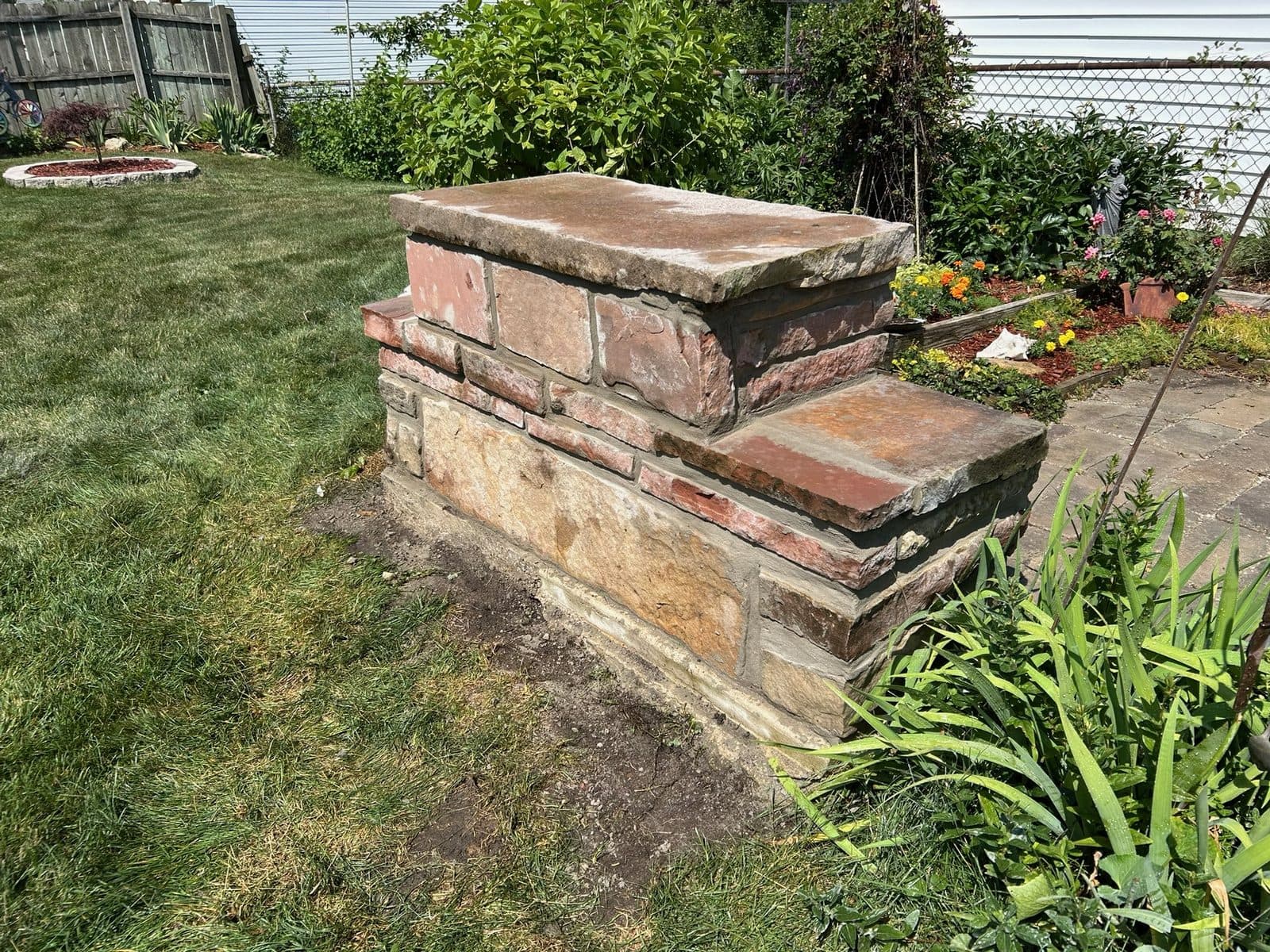
The Retaining Wall Nobody Calls a Retaining Wall
Go outside and look down into one of your basement window wells.
What you are looking at is a small retaining wall, built a few inches from your foundation, sunk below grade, holding back earth on one side with an open void on the other. In an areaway — the walled-out space giving access to a basement door or stairway on a great many Chicago buildings — it is the same thing at a considerably larger scale.
Now ask yourself when anyone last checked whether the bottom of it drains.
For most homeowners the honest answer is never, and that single unchecked detail is the reason this piece of masonry causes so much trouble. A window well that has stopped draining is a bucket, set permanently against the one wall in your house you least want holding water.
Paul Lally's Masonry Inc. repairs and rebuilds window wells, areaways and basement entry masonry throughout Chicago and the Chicagoland suburbs. Family-owned since 1988, insured, free on-site estimates. Call (708) 448-8866.
How These Are Supposed to Work
A correctly built well or areaway does three things at once.
It holds back earth. The walls resist soil pressure from behind, exactly as any retaining wall does.
It admits light and access to a basement window, door or stairway, and on an egress window it provides a legally required escape route.
It drains. This is the part that matters most and the part most often failed. Water reaching the well — rain falling straight in, runoff from the surrounding grade, and moisture moving through the soil — has to have somewhere to go. In a properly built well that means gravel at the bottom over a drain that either ties into the foundation drainage system or discharges where water can actually leave.
Remove the drainage and the other two jobs stop mattering, because the well becomes a reservoir with your foundation wall as one side of it.
Why Water in a Window Well Is Worse Than It Looks
Standing water in a well is not just an inconvenience at the glass.
It presses on the foundation. Water is heavy and it pushes outward in all directions. A well full of water is applying pressure directly to the foundation wall at exactly the depth where the wall is least able to shrug it off — that is hydrostatic pressure, the same force that ruins retaining walls.
It gets in at the window. If the water level rises above the window sill, it will find a way through the frame, the seal or the masonry around it, no matter how good the window is.
It saturates the masonry. Below-grade brick and block that stays wet spalls, its joints wash out, and the salts moving through it leave efflorescence behind.
It freezes. In a Chicagoland winter, water in and around that well freezes and expands many times over a season, levering apart both the well wall and the foundation masonry beside it.
It undermines the well. Water moving through the soil behind the wall carries fine material with it, which is how a well wall starts to lean.
Why Areaway Masonry Is in Worse Shape Than the Rest of the Building
If you have an areaway on an older Chicago building — and greystones, two-flats, three-flats and worker cottages are full of them — you have probably noticed its masonry looks rougher than anything above grade.
That is not neglect. It is a genuinely harder environment:
- It is below grade, so it holds earth on one side permanently.
- It is shaded and slow to dry, often getting little direct sun at any point in the day.
- It collects water — rain falls in, runoff reaches it, and snow gets shovelled into it.
- It gets salted. De-icer on basement stairs goes directly onto the masonry, and salt crystallizing inside the units flakes their faces off from within.
- It is trafficked, with people, bikes, bins and deliveries hitting the walls and steps.
- Its drain is the most-clogged drain on the property.
- Nobody looks at it. It is out of sight from the street and from inside the house.
Warning Signs Worth Acting On
Drainage failure
- Standing water in the well after rain, or a persistent damp bottom
- The gravel gone — silted over, or replaced by soil and debris
- A drain you cannot find or that visibly does not accept water
- Water rising above the window sill
- Silt lines on the well wall showing how high it has stood
- Water entering the basement at or near the window
Masonry deterioration
- Mortar you can rake out with a screwdriver
- Spalling, flaking brick or block on the well or areaway walls
- White efflorescence on the masonry
- Parge coat blistering or coming off in sheets
- Deteriorated stair treads and risers in an areaway
- Rust staining from a corroding metal well liner or an embedded steel element
Movement — act promptly on these
- The well wall leaning inward toward the window
- A bulge in the wall face
- Courses displaced or stepped out of line
- A gap opening between the well wall and the foundation
- Soil settling or a depression in the ground beside the well
Risks of Waiting
The failure sequence is predictable and it feeds itself. A blocked drain lets water stand, standing water saturates the masonry and presses on the wall, freeze-thaw opens the joints, open joints let more water through, and water passing through the wall carries fines out of the soil behind it — which lets the wall move.
Meanwhile that same water is against your foundation. A window well problem that goes unaddressed long enough stops being a window well problem and becomes a foundation masonry problem, and those cost considerably more to put right.
There is also a safety dimension. On an egress window, the well is a required escape route — a well that has partially collapsed, filled with debris, or lost its ladder is a life-safety issue. And deteriorated areaway steps are a fall hazard on a surface people use in the dark.
How a Repair Is Actually Done
- Assess the whole assembly — well walls, foundation wall behind, drain, window or door, steps, cover, and the grade above.
- Find where the water comes from. Downspouts discharging nearby, grade sloping toward the well, a roof valley overhead, a missing cover.
- Excavate the bottom and locate the drain. This is the step that answers the real question.
- Determine repair versus rebuild. A plumb, true wall with eroded joints is repointed; a leaning or displaced wall is rebuilt.
- Re-establish drainage — clear or replace the drain, and rebuild the gravel bed above it so water can actually reach it.
- Repair or rebuild the walls in matched material and compatible mortar, with proper footing depth where a rebuild is needed.
- Repair the adjacent foundation masonry, which is often in worse shape than the well itself and is easiest to reach right now.
- Address the window or door and the masonry around its opening.
- Repair areaway steps and treads where present.
- Correct the grade above so surface water runs away from the well rather than into it.
- Fit a cover where appropriate, sized so it does not trap moisture against the building.
Materials
Mortar must be softer than the unit it sits against — the rule holds below grade as much as above it. Type N covers most well and areaway masonry; Type S has a genuine role here, since this is below-grade work resisting soil pressure, and it is one of the few residential situations where it is the right choice rather than an over-specification.
Gravel at the bottom is washed and free-draining, not the soil that came out of the hole. Drainage is a real outlet, not a hopeful void. Parging, where used, has to be compatible with what is underneath — a hard cement skin over masonry that is already holding moisture traps it and comes off in sheets, taking material with it.
Metal well liners, common on post-war homes, are a different assembly: when a corrugated steel liner rusts through at the bottom it stops retaining soil and stops holding its shape, and replacement or conversion to masonry is the fix.
Related work commonly runs alongside: foundation masonry repair, brick repair and brick replacement, tuckpointing, waterproofing, and caulking and joint sealant at the window perimeter.
DIY vs. Hiring a Pro
Clearing leaves and debris out of a well, adding a cover, and extending a downspout away from it are genuinely homeowner jobs, and doing them regularly prevents most of what this article describes.
Where it stops being DIY: anything involving the drain or the wall. Excavating a well bottom means working in a confined space beside a foundation; re-establishing a drain means knowing where it is supposed to go; and rebuilding a well wall means holding back earth immediately against the building. Get the last one wrong and you have moved a soil problem onto your foundation.
The honest line: keep it clean and keep water out of it yourself. Once it is holding water, leaning, or the masonry is failing, that is when it is worth doing properly.
Chicagoland Context
This is a very regional problem, for three reasons.
The housing stock. Chicago's greystones, two-flats, three-flats and worker cottages were built with basement areaways as standard, and the region's brick bungalows, post-war ranches and split-levels across Cook, DuPage and Will County almost all have basement window wells. There are a great many of these assemblies, most of them decades old.
The soil. Heavy clay across the region drains slowly and holds water against foundations, so a well with a marginal drain fails sooner here than it would in sandy ground.
The winter. Chicagoland cycles above and below freezing many times each season rather than freezing once, and every one of those cycles works on water sitting in a well. Add the volume of de-icing salt used on basement stairs and walks, and below-grade masonry takes more punishment than any other part of the building.
Maintenance That Actually Helps
- Clear the well every autumn. Leaves are what start the whole sequence.
- Test the drain. Run a hose into the well and watch whether the water goes anywhere. This single check tells you more than anything else here.
- Keep gravel visible at the bottom, not buried under soil and silt.
- Extend downspouts well away from any well or areaway.
- Check the grade above the well so surface water is directed away from the building.
- Fit and maintain covers, and clear snow off them rather than into the well.
- Keep salt out of areaways where you can, and shovel before you treat.
- Sight along the well walls each spring for lean or bulge.
- On egress wells, keep the escape route genuinely clear and the ladder sound.
Related Services
- Foundation masonry repair
- Brick repair and brick replacement
- Tuckpointing and repointing
- Waterproofing and masonry sealing
- Masonry restoration
The Bottom Line
A window well is a retaining wall with a drain, built inches from your foundation. When the drain works, it is one of the least troublesome things on your property. When it stops, it quietly becomes a reservoir pressing on your foundation wall and your basement window, and the masonry around it deteriorates faster than anything else on the building.
The good news is that the highest-value maintenance here costs nothing: clear it out, and run a hose in to see whether the water actually leaves. If it does not, deal with that before it becomes a foundation conversation.
Paul Lally's Masonry Inc. is a family-owned, insured masonry contractor serving Chicago and the Chicagoland suburbs since 1988 — tuckpointing, brick repair and replacement, chimney repair and rebuilds, lintel replacement, masonry restoration, and waterproofing for residential and commercial properties. Built on Craftsmanship. Backed by Experience. Free on-site estimates — call (708) 448-8866 or request an estimate online.
Frequently Asked Questions
Why does my window well fill with water?
Almost always a blocked or failed drain at the bottom of the well. Leaves, silt and debris fill the gravel and the drain over years until water has nowhere to go, and once that happens every heavy rain leaves a standing column of water against your foundation and your basement window.
Is a window well supposed to have a drain?
Yes — a properly built well has gravel at the bottom over a drain that either ties into the foundation drainage system or discharges somewhere water can actually go. A well with a solid bottom and no outlet is a bucket set against your foundation wall.
Water is coming in through my basement window. Is that a window problem?
Usually not the window itself. If the well is holding water above the window sill, water will find its way in regardless of how good the window is. Fix the drainage in the well first, then judge whether the window or the surrounding masonry still needs attention.
What is an areaway?
It is the open, below-grade space giving access to a basement door or stairway, walled with masonry to hold back the surrounding earth. Chicago's greystones, two-flats and older buildings are full of them, and they are effectively small retaining walls immediately against the building.
Can a crumbling window well wall be repaired or does it need rebuilding?
If the wall is still plumb and true and only the mortar joints or a few faces have deteriorated, it can be repointed and repaired. Once it leans inward, bulges, or has courses displaced, the earth behind it has moved it and rebuilding with proper drainage is the durable answer.
Should I just put a cover on the window well?
A cover helps keep leaves and rain out and is worth having, but it is not a substitute for a working drain. Water still reaches the well from the soil around it, so a covered well with a blocked drain can still hold water.
Is this a masonry job or a waterproofing job?
Frequently both, and the drainage comes first. Repointing a well wall while the drain is still blocked treats the visible damage and leaves the cause running. We identify the water path as part of the assessment rather than pointing over an active problem.
Why is the masonry in my areaway worse than the rest of the building?
Because it is below grade, shaded, slow to dry, holding earth on one side and collecting water on the other, and it gets winter salt tracked or shovelled into it. That combination is harder on masonry than anything happening on the walls above.
Can I fill in an unused areaway or window well?
Sometimes, but it is not simply a matter of adding dirt. Basement egress requirements, the window or door being enclosed, drainage, and how the fill loads the foundation wall all matter. It should be planned rather than improvised.
How much does window well or areaway repair cost in Illinois?
It depends on whether it is a repoint or a rebuild, how deep the well is, whether the drain has to be re-established, access for materials, and whether foundation masonry behind it needs work too. Paul Lally's Masonry Inc. looks at it on site and puts the estimate in writing — call (708) 448-8866.