
Masonry Restoration · Chicagoland, IL
When Does Masonry Repair Become Urgent? A Homeowner's Guide
Masonry repair becomes urgent when there's a safety risk — a leaning wall, loose brick over a walkway, a leaning chimney — or when water is actively getting into the structure before a Chicago winter. This guide ranks the warning signs from urgent to monitor.
Quick Answer
Masonry repair is urgent when there is a safety risk — a leaning or bowing wall, loose brick above a walkway, or a leaning chimney that could shed brick — or when water is actively entering the structure right before a freeze-thaw winter. Receding mortar and minor cracks are less urgent but shouldn't be left through a Chicago winter. Paul Lally's Masonry Inc. assesses urgency for free across Chicagoland — family-owned since 1988. Call (708) 448-8866.
The short answer
Masonry repair is urgent when there's a safety risk or when water is actively getting into the structure right before winter. A leaning wall, loose brick over a walkway, or a leaning chimney is urgent today. Active water intrusion is urgent before the freeze-thaw cycle multiplies it. Receding mortar and hairline cracks matter, but they can usually wait for the next dry-season window — not for years. Paul Lally's Masonry Inc. — family-owned and serving Chicagoland since 1988 — assesses urgency honestly and for free. Call (708) 448-8866.
Urgency, ranked
| Sign | Urgency | Why | |---|---|---| | Leaning / bowing / bulging wall | Urgent — safety | Structural failure risk; can collapse | | Loose brick over a walkway or door | Urgent — safety | Falling-brick hazard to people below | | Leaning chimney or parapet | Urgent — safety | Can shed brick or topple | | Daylight through a chimney; cracked crown | Urgent — before winter | Water path; freeze-thaw accelerates fast | | Active water in the wall / interior staining | Soon — before freeze | Each freeze cycle widens the damage | | Receding, sandy, or cracking mortar | Plan it — next dry window | The open door; leads to spalling if ignored | | Hairline step cracks (stable) | Monitor + assess | May be settling or early movement | | Light efflorescence (white powder) | Investigate | Cosmetic itself, but flags a water path |
Urgent — fix now (safety)
These aren't "watch and see." They're risks to people and to the structure:
- Bowing, bulging, or leaning brick walls — the masonry has lost integrity, often from corroded wall ties or water behind the brick, and can fail. See brick repair.
- Loose or displaced brick over a walkway, entrance, or driveway — a falling-brick injury hazard.
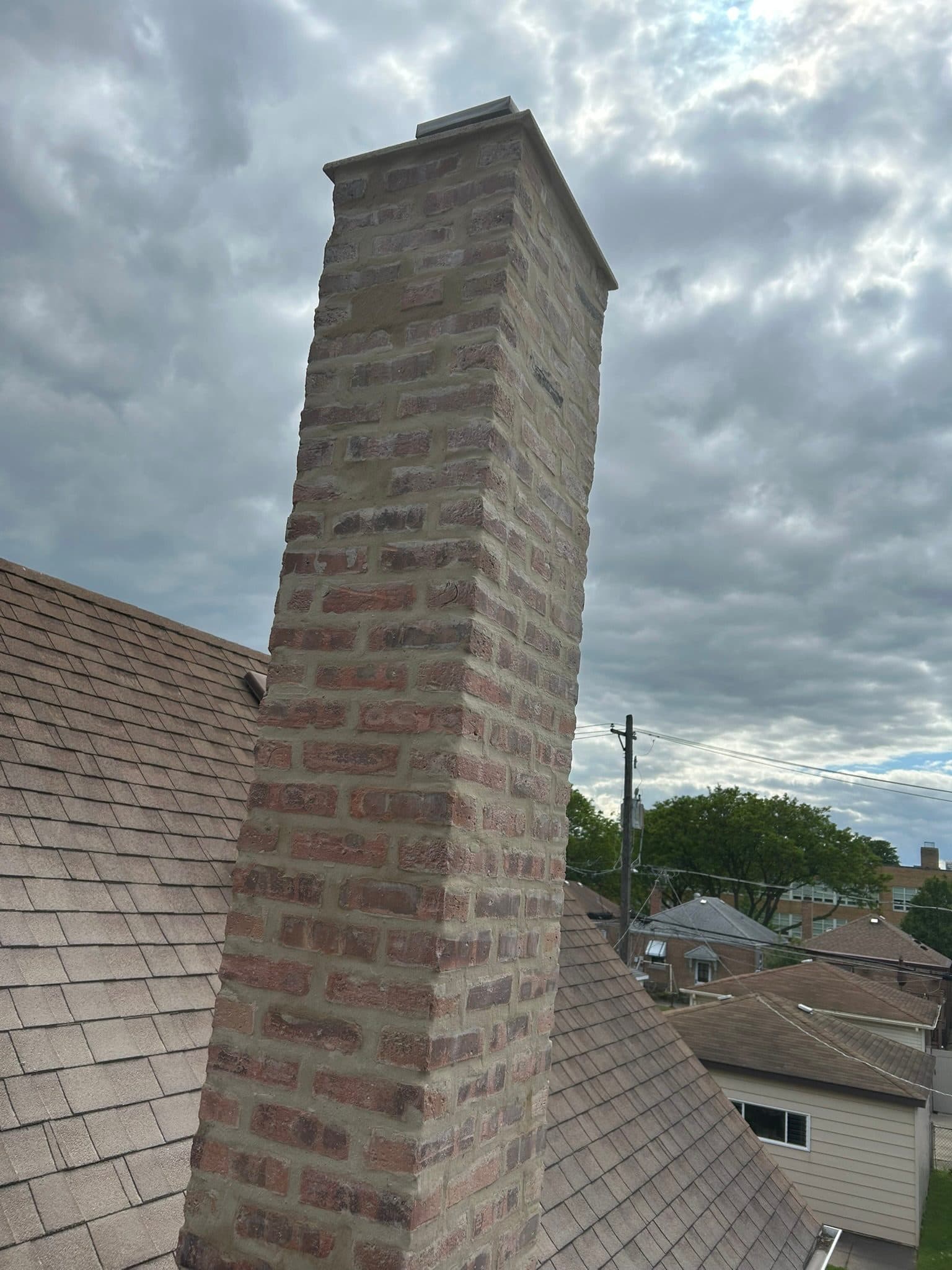
- Leaning chimney or parapet wall — exposed on multiple sides, these fail first and can shed brick onto the sidewalk below. A chimney that's tilting is urgent in any season.
If you're seeing any of these, get a same-week assessment.
Urgent before a Chicago winter
Chicago's freeze-thaw cycle is the multiplier. Water finds a gap, freezes, expands, and makes the gap bigger — every single cold snap. So problems that are merely "developing" in fall become serious by spring:
- Daylight visible through a chimney, a cracked crown, or loose flashing — water is pouring in. Fix before the cold.
- Active water intrusion — interior staining near exterior walls, damp masonry, peeling paint at brick — means the wall is taking on water now.
- A failing lintel cracking the brick above a window — rust expands over winter.
Getting ahead of winter here is the difference between a contained repair in fall and a much larger one in spring.
Plan it — don't ignore it
Less urgent, but the open door to everything above:
- Receding, soft, or sandy mortar → tuckpointing in the next dry-season window. Left for years, it leads to spalled brick.
- Hairline step cracks that aren't widening → have them assessed; could be old settlement or early movement.
- Efflorescence (white powder) → cosmetic on its own, but it tells you water is moving through the wall.
The honest principle behind all of it
Masonry damage accelerates — it doesn't hold steady. Water plus freeze-thaw means every season you wait, the repair gets bigger and more expensive. The cheapest masonry is almost always the masonry you fix early. That's why a free on-site assessment is worth making the call: even if the answer is "this can wait until spring," you'll know what you're dealing with.
Paul Lally's Masonry Inc. is a family-owned, insured masonry contractor serving Chicago and the Chicagoland suburbs since 1988 — tuckpointing, brick repair and replacement, chimney repair and rebuilds, lintel replacement, masonry restoration, and waterproofing for residential and commercial properties. Built on Craftsmanship. Backed by Experience. Free on-site estimates — call (708) 448-8866.
Related services
- Brick Repair — bowing walls, cracked and loose brick
- Chimney Repair & Rebuilds — leaning chimneys, crowns, flashing
- Parapet Wall Repair — the most exposed, most urgent wall
- Tuckpointing — the early repair that prevents the urgent ones
Not sure how urgent it is?
That's exactly what a free on-site assessment answers. Call Paul Lally's Masonry Inc. at (708) 448-8866 or request a free estimate — and if it's a safety issue, say so when you call. Family-owned since 1988.
Masonry Restoration in Chicagoland, IL — Frequently Asked Questions
How do I know if my masonry damage is urgent?
It's urgent if it's a safety risk or if water is actively entering the structure before winter. A leaning or bowing wall, loose brick over a walkway, a leaning chimney, or a section of parapet that could fall are immediate safety issues. Active water intrusion is urgent before a freeze-thaw cycle multiplies the damage. Receding mortar and hairline cracks should be addressed but can usually wait for the next dry-season window.
Is a bowing or leaning brick wall dangerous?
Yes — treat it as urgent. A bowing, bulging, or leaning brick wall has lost structural integrity and can fail, sometimes suddenly. It usually signals corroded wall ties, water damage, or foundation movement behind the brick. Stop wondering and have it assessed promptly; this is not a watch-and-wait situation.
Should I repair my chimney before winter?
If you can see daylight through it, the crown is cracked, flashing is loose, or it's leaning, yes — before winter. Chicago's freeze-thaw cycle drives water into every gap, freezes it, and pries the masonry apart, so a small fall problem becomes a big spring one. A leaning chimney is also a falling hazard and is urgent regardless of season.
Can receding mortar wait, or do I need tuckpointing now?
Receding or sandy mortar isn't an emergency, but it is the open door that lets water in — and a Chicago winter turns that water into spalled brick. It's best handled in the next dry-season window rather than left for years. The longer failing mortar sits, the more likely a tuckpointing job becomes a brick-replacement job.
What masonry problems are an immediate safety hazard?
Loose or displaced brick above a walkway or entrance, a leaning chimney or parapet, a bowing or bulging wall, and any masonry actively shedding pieces. These can injure someone or fail structurally and should be assessed right away. Paul Lally's Masonry Inc. provides free on-site assessments across Chicagoland.
Why is timing so important with masonry in Chicago?
Because freeze-thaw is relentless. Every cycle of water getting into a gap, freezing, and expanding makes the gap bigger — so damage accelerates over winter, not pauses. Catching problems before the cold means a smaller, cheaper repair; waiting almost always means a larger one in spring.
Masonry Restoration in Nearby Areas
Learn more about our masonry restoration services across Chicagoland, or view all service areas.
Free on-site estimates across Chicagoland.