
Commercial Masonry · Chicagoland, IL
Commercial Site Masonry in Chicagoland: Monument Signs, Entry Walls, Screen Walls and Dumpster Enclosures
The freestanding masonry around a commercial property (the monument sign, entry piers, screen walls, planters and dumpster enclosure) takes more weather and more abuse than the building itself. Here's how it fails, what a proper repair looks like, and when to rebuild.
2026-10-19
Quick Answer
Commercial site masonry repair in Chicagoland covers the freestanding brick, block and stone around a property: monument signs, entry walls and piers, screen walls, planters and dumpster enclosures. It means repointing, resetting or replacing caps and coping, replacing salt- and impact-damaged units, and rebuilding leaning walls. Paul Lally's Masonry, family-owned and insured since 1988, gives free estimates: (708) 448-8866.
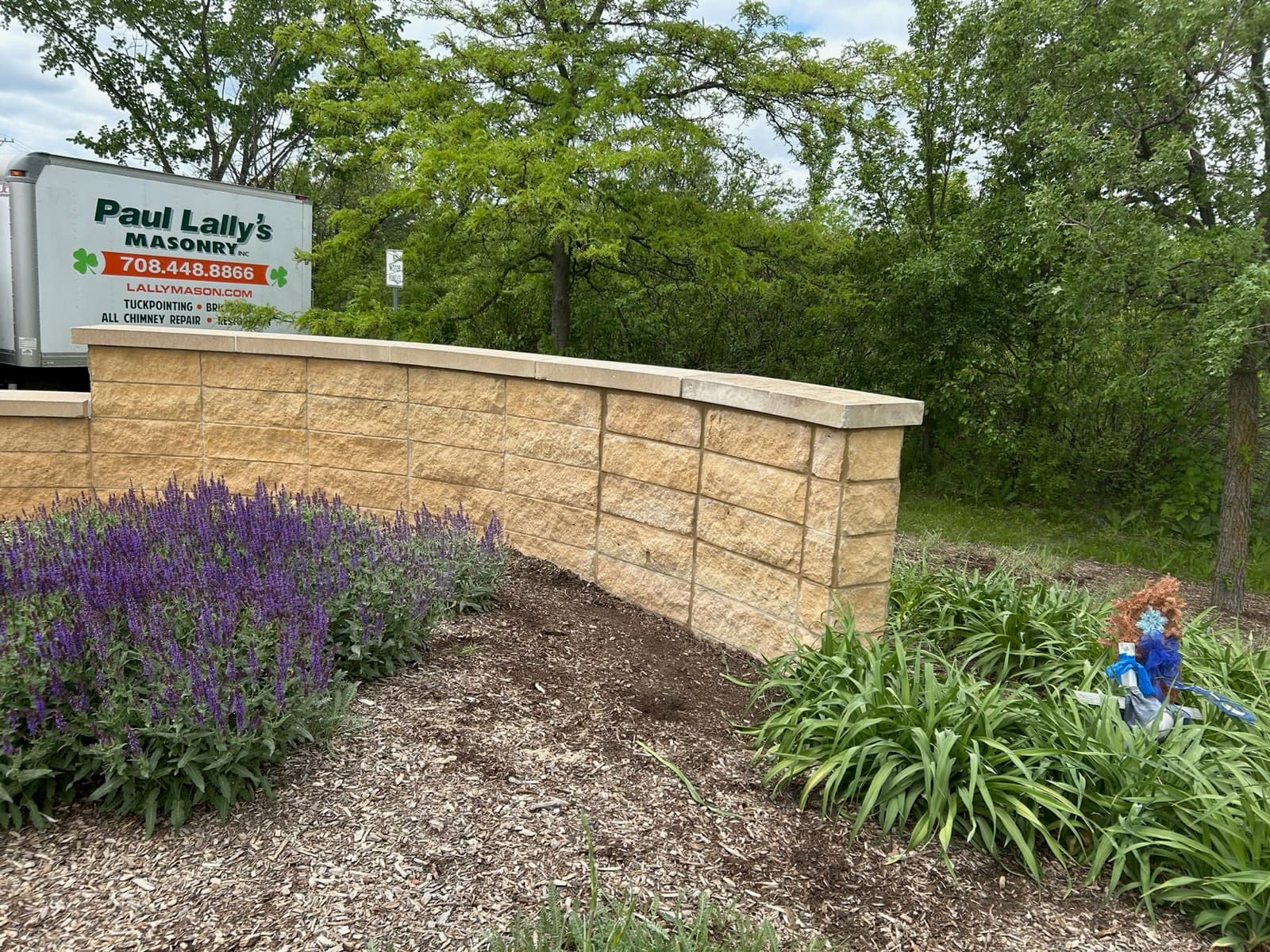
Commercial Site Masonry in Chicagoland: Monument Signs, Entry Walls, Screen Walls and Dumpster Enclosures
Commercial site masonry repair in Chicagoland covers the freestanding brick, block and stone around a property, rather than the building itself: the monument sign at the drive, the entry walls and piers, the screen walls in front of mechanical units and loading areas, the planters, and the dumpster enclosure out back. Paul Lally's Masonry, a family-owned, insured masonry contractor serving Chicago and the suburbs since 1988, repoints, recaps, repairs and rebuilds all of it for property managers, condo and HOA associations, churches, schools, office parks and retail owners. Call (708) 448-8866 for a free on-site estimate.
These are usually the first pieces of masonry a customer, tenant or visitor sees, and the last ones anyone budgets for. They also take more punishment than any wall on the building. This guide explains why they fail, how to read the damage, what a proper repair involves, and how to decide between repairing and rebuilding.
A freestanding wall has no building to protect it and no heat to dry it. It weathers on every side, sits in the plow pile and gets backed into. That's why the monument sign looks twenty years older than the building it names.
What counts as commercial site masonry
| Element | What it's usually made of | What it's there to do |
|---|---|---|
| Monument sign | Brick or stone base and piers, limestone or precast cap, sign panel or cut lettering | Identify the property at the drive or corner |
| Entry walls and piers | Brick or stone wing walls and piers with caps, sometimes with lighting | Mark the entrance to an office park, subdivision, school or church campus |
| Screen walls | Brick, split-face block or block faced with brick | Hide mechanical units, transformers, loading docks and parking |
| Planters and seat walls | Brick or block with stone or precast coping | Landscape and seating at entrances and plazas |
| Dumpster enclosures | Concrete block, sometimes brick-faced, with steel gates | Contain trash and recycling and screen them from view |
| Low retaining and site walls | Brick, block or stone | Hold grade at walks, drives and plantings |
All of them are freestanding or nearly so. That one fact explains most of their problems.
Why freestanding masonry fails faster than building walls
A building wall gets weather on one face. Heat from inside dries it, the roof overhang or parapet protects its top, and the foundation below it sits under frost depth. A freestanding wall has none of that.
- Weather on all sides. Rain, snow and wind hit both faces and the top.
- No drying heat. The wall stays cold and wet for months at a time.
- More freeze-thaw cycles. Chicagoland walls see dozens of freeze-thaw swings a winter, and wet masonry is the material that suffers from it.
- Salt. Monument signs and entry walls sit right beside salted drives and walks, and plows bank salty snow against them. Salt pulled into brick and mortar crystallizes and breaks the face off.
- Impact. Plows, delivery trucks, garbage trucks and cars hit them.
- Shallow footings. Many site walls were built on footings that don't reach below frost, so the ground heaves them.
Causes and warning signs
Open, sandy or missing mortar joints
Joints wear fastest at the top courses under the cap and at the base where salt and splash hit. Open joints let water into the core of the wall, where it freezes and pushes units apart.
Cracked, loose or shifted caps and coping
The cap is the wall's roof. Cracked limestone, open joints between cap pieces, caps with no overhang or drip, and caps set with no flashing beneath are the most common root cause of a crumbling site wall.
Spalling brick at the base
Faces popping off the bottom few courses, especially on the side facing the drive, is salt and freeze-thaw damage. It spreads upward if the wall stays wet.
Efflorescence and staining
White salt deposits mean water is moving through the wall. On a monument sign it's usually coming in from the top.
Leaning, bowing or rotating walls and piers
A pier that tips, a wall that's out of plumb or a sign that has rotated off its base points to frost heave, a failed footing or impact damage. This is a rebuild, not a repair.
Vertical cracks and separation
Cracks through the full height at regular spacing, or a wall pulling away from a pier or building, usually mean there's no control joint where the wall needs one.
Impact damage
Broken corners on dumpster enclosures, sheared piers at entrances and knocked-out units on screen walls are the work of trucks and plows.
Rust staining
Rust running out of joints comes from corroding reinforcing, anchors, light fixtures or gate hinges embedded in the masonry.
Quick reference: what you see and what it usually means
| What you see | What's usually happening | Typical fix |
|---|---|---|
| Open joints just below the cap | Water getting under or between cap pieces | Reset or replace caps on flashing, repoint top courses |
| Crumbling brick at the base on the drive side | Salt and freeze-thaw | Replace spalled units, repoint, breathable water repellent |
| Cap cracked through | Freeze-thaw in a cap with open joints or no slope | Replace cap with sloped, drip-edged stone or precast |
| Pier leaning out | Frost heave, shallow footing or impact | Rebuild pier, often on a new footing |
| White staining down the face | Water entering from the top | Fix the cap and joints first, then clean |
| Broken enclosure corners | Truck and container impact | Rebuild corners with filled, reinforced cores, add bollards |
| Full-height vertical crack | No control joint | Cut in a proper control joint, repoint, rebuild if offset |
How professional site masonry repair is done: step by step
- Assess the whole wall, not just the visible damage. We check plumb, the cap, the base, the joints, the footing where it shows, and what's embedded in it: sign panels, lettering, lights and wiring.
- Protect what stays. Sign panels, cut lettering, lighting, landscaping and pavers get covered or removed and stored.
- Make it safe. Loose caps and units that could fall or be hit are removed right away.
- Remove the cap where it's cracked, loose or unflashed.
- Grind out failed mortar to a proper depth without damaging the brick edges.
- Replace damaged units with brick, block or stone matched for size, color and texture, toothed into the existing courses.
- Rebuild where necessary. Leaning piers and walls come down to a sound course or the footing. Where the footing has heaved, it's replaced below frost.
- Install flashing under the cap, then set a new or reset cap that's sloped, overhangs both faces and has a drip.
- Repoint with mortar matched to the strength and color of the original.
- Reinstall panels, lettering and lights, clean the wall and walk it with the owner.
Materials and techniques
| Material or detail | What we use and why |
|---|---|
| Mortar | Type S for most freestanding brick and block walls exposed on all sides; Type N or softer lime-rich mortar on older, softer brick so the mortar stays sacrificial to the brick |
| Caps and coping | One-piece or tightly jointed limestone or precast, sloped, with overhang and drip edge on both faces |
| Flashing | Through-wall flashing under the cap so water that gets past a cap joint doesn't run down the core |
| Block | Solid-grouted and reinforced at corners and gate posts on dumpster enclosures |
| Control joints | Sealed vertical joints on long runs so the wall can move without cracking |
| Water repellent | Breathable penetrating repellent on salt-exposed faces, never a film-forming coating that traps water |
| Bollards | Steel bollards in front of enclosure gates and exposed corners, so the masonry isn't the bumper |
Tuckpointing vs repointing: on site walls we're almost always repointing, which means grinding out and replacing worn mortar for structure and weather-tightness. True tuckpointing, a decorative fine joint, is rare on this kind of work.
What drives the cost of site masonry repair
We don't publish prices, because site walls vary enormously. What changes the number:
- Size and height of the sign or wall, and how many piers, planters or enclosures are involved.
- Repair versus rebuild: repointing and unit replacement cost less than taking a wall down to the footing.
- Caps and coping: reset, replace, and the material and profile.
- Matching brick, block, stone and mortar on older or discontinued materials.
- Signs and lighting: protecting, removing and reinstalling panels, lettering and fixtures.
- Footings: whether a heaved footing needs replacing.
- Access and traffic: working at a busy drive entrance, in a parking lot or around trash collection.
Call (708) 448-8866 for a free on-site estimate and an itemized written scope.
Why site masonry isn't a handyman job
Site walls look simple, and that's why they get patched badly. The usual mistakes:
- Caulking or foaming the cap joints instead of resetting the cap on flashing. It fails within a season or two.
- Hard Portland-heavy mortar in soft old brick, so the brick spalls instead of the mortar.
- Mismatched brick and mortar on the most visible piece of masonry on the property.
- Painting or sealing with a film coating, which traps salt and water and makes the face spall faster.
- Pushing a leaning pier back instead of rebuilding it.
- Rebuilding an enclosure with unreinforced, unfilled block that the next truck knocks over.
The Chicagoland context
Chicagoland is one of the hardest climates in the country for freestanding masonry. Winters bring repeated freeze-thaw cycles, wet springs and heavy salt use on every commercial drive. Office parks along the I-88 and I-55 corridors, retail centers on LaGrange Road, Harlem Avenue and Route 30, subdivision entrances in Will County, and church and school campuses across the southwest suburbs all have monument signs and entry walls built in the 1980s, '90s and 2000s that are now on their first or second repair cycle. Many were built with decorative caps that had no drip edge and no flashing beneath them. That detail is behind most of the damage we see.
Dumpster enclosures take a beating everywhere, but especially at restaurants, grocery-anchored centers and multi-family buildings with daily pickups.
Maintenance and prevention
- Look at caps every spring. Open joints, cracks and loose pieces are the first sign of trouble and the cheapest to fix.
- Keep plow piles off the wall where possible, and use calcium chloride or sand near masonry rather than heavy rock salt.
- Keep sprinklers off monument signs and entry walls.
- Add bollards at enclosure gates and exposed corners.
- Repoint before it's urgent. Repointing a sound wall costs far less than rebuilding a wet one.
- Apply a breathable water repellent to salt-exposed faces after repairs, and renew it on schedule.
Related services
- Commercial masonry restoration for full commercial scopes.
- Tuckpointing and repointing for worn joints.
- Brick replacement for spalled and broken units.
- Limestone and sill repair for caps and stone trim.
- Masonry waterproofing for breathable water repellents.
- Our guides to warehouse and industrial building masonry repair, church masonry repair and commercial tuckpointing for property managers.
The bottom line on commercial site masonry
Monument signs, entry walls, screen walls and dumpster enclosures fail faster than the building because they're exposed on every side, salted and hit. Most of the damage starts at the cap and the base. Fix the cap and flashing, repoint with the right mortar, replace what's spalled, and rebuild what's leaning. A wall that's maintained on that schedule can last decades, and one that's patched won't.
Paul Lally's Masonry Inc. is a family-owned, insured masonry contractor serving Chicago and the Chicagoland suburbs since 1988. We handle tuckpointing, brick repair and replacement, lintel replacement, parapet repair, masonry restoration and waterproofing for commercial and residential properties. Built on Craftsmanship. Backed by Experience.
Request a free on-site estimate or call (708) 448-8866. Our name is on every job.
Frequently Asked Questions
Who repairs monument signs and site walls on commercial properties near Chicago?
Paul Lally's Masonry, a family-owned, insured masonry contractor serving Chicagoland since 1988, repairs and rebuilds brick, block and stone monument signs, entry walls and piers, screen walls, planters and dumpster enclosures for property managers, associations, churches, schools and business owners across Cook, DuPage and Will County. Call (708) 448-8866 for a free on-site estimate.
Why does our monument sign fall apart faster than the building?
A freestanding wall gets rain and snow on every side and the top, has no heated building behind it to dry it out, and usually sits right where plows pile salted snow. It goes through more freeze-thaw cycles than any wall on the building, so its joints, caps and base fail first.
Can a leaning entry wall or pier be straightened?
Not really. Masonry that has rotated or leaned off a failed footing or from frost heave has to be taken down to a sound course or to the footing and rebuilt. Trying to push it back cracks it further.
What is the cap on top of a site wall, and why does it matter so much?
The cap or coping is the wall's roof. It should be one piece or tightly jointed, sloped, overhang both faces with a drip, and sit on flashing. When caps crack, loosen or have open joints, water goes straight down into the wall and destroys it from the inside.
Can you match the brick and stone on our sign?
Usually, yes. We match brick by size, color and texture, match mortar color to the existing joints, and source limestone or precast caps cut to the profile you have. On older or discontinued brick we may salvage units from a less visible part of the wall.
Should dumpster enclosures be block or brick?
Most are concrete block, sometimes faced with brick to match the building. Either way, they need to be built to take hits: filled and reinforced cores, protected corners and steel bollards in front of the gate posts. A plain unreinforced block enclosure gets knocked apart quickly.
How much does monument sign or site wall repair cost?
It depends on the size and height of the wall, how much of it is repointed versus rebuilt, the cap or coping material, brick and stone matching, any lettering or panels that need protecting, and access around traffic. We don't publish prices; you get a written scope after a free on-site estimate.
When is the best time to repair site masonry?
Spring through fall, when mortar can cure properly. Loose caps or brick that could fall or be hit should be secured right away, even in winter, with the permanent repair scheduled when the weather allows.
Do we need a permit to rebuild our monument sign?
Often, especially if the sign is being rebuilt rather than repaired, or the size or location is changing. Rules vary by village, so we'll tell you when a rebuild is likely to need one and coordinate with whoever handles your sign panels.