
Masonry Restoration · Chicagoland, IL
Should You Power Wash or Sandblast Brick? What Aggressive Cleaning Does to Chicago Masonry
Sandblasting and high-pressure washing are the fastest way to permanently ruin a Chicago brick or limestone building — and the damage cannot be undone. Here's what those methods actually remove, what safe masonry cleaning looks like, and how to match the method to the stain. Free on-site estimates from Paul Lally's Masonry Inc.
2026-08-15
Quick Answer
Sandblasting brick or limestone permanently strips the hard fired face and weathered stone skin, and high-pressure washing does the same at lower speed — both leave the masonry porous and accelerate spalling. Safe masonry cleaning uses low pressure, appropriate cleaners matched to the stain, and adequate dwell and rinse. Paul Lally's Masonry has cleaned and restored Chicagoland masonry since 1988. Free on-site estimates: (708) 448-8866.
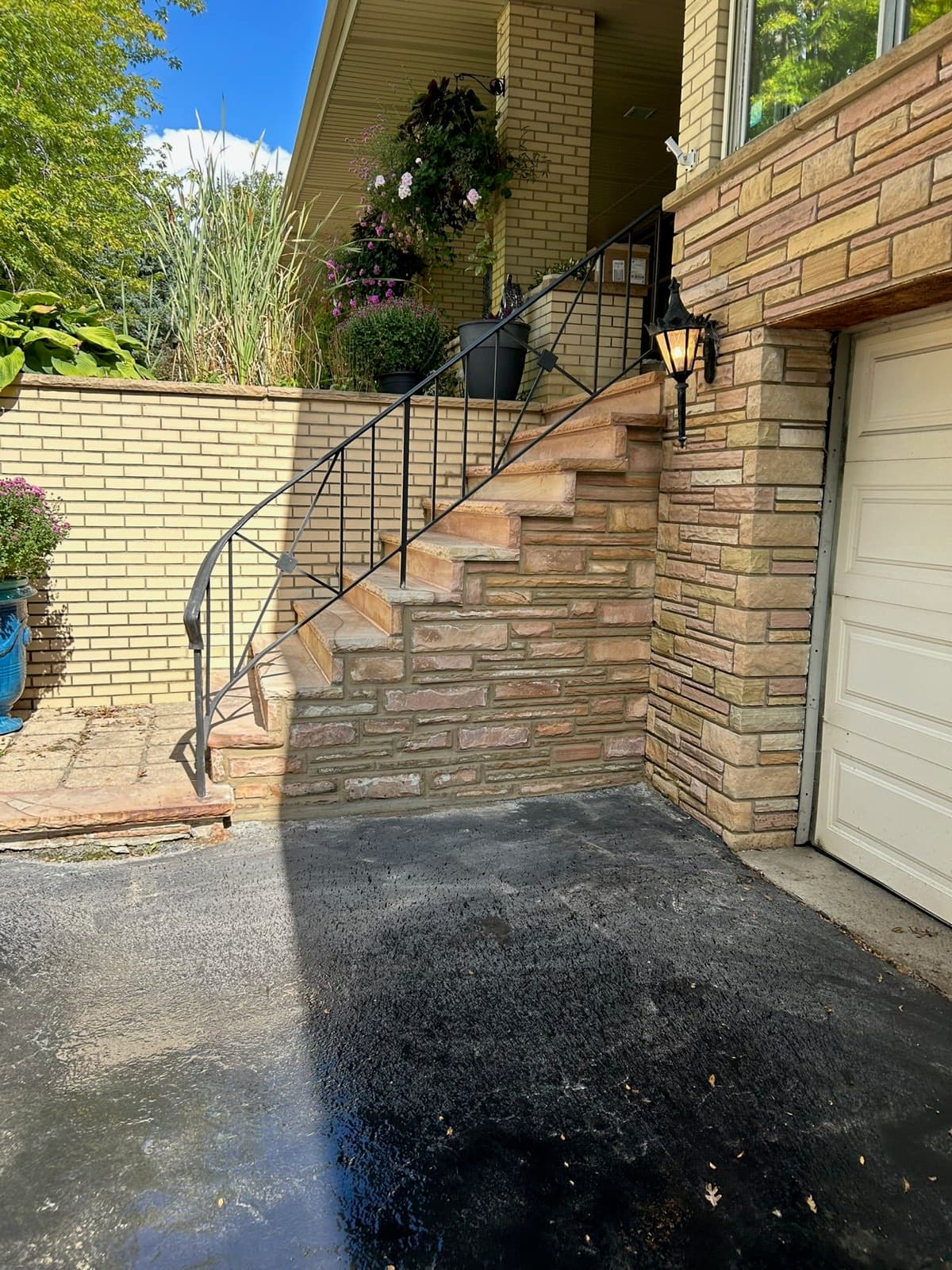
Somebody is going to knock on your door this summer and offer to make your brick look new again. They'll have a pressure washer on a trailer, they'll quote you fast, and they'll be done in a day.
Here's what you need to know before you say yes: the fastest ways to clean masonry are the ways that permanently destroy it, and unlike almost every other mistake you can make on a brick building, this one cannot be repaired. You cannot put the fired face back on a brick. You cannot restore the weathered skin of a limestone. Paul Lally's Masonry Inc. has been cleaning and restoring Chicagoland masonry since 1988, and this is the damage we get called to assess more often than any other — always after the fact. Free on-site estimates: (708) 448-8866.
What you're actually cleaning: the fired face
A brick is not uniform material. When clay is fired in a kiln, the outer layer vitrifies — it becomes denser, harder, and far less absorptive than the interior. That thin outer shell is called the fired face, and it is doing nearly all the work of keeping water out of your wall.
Behind it, the body of the brick is comparatively soft and porous. It's supposed to be. That porosity lets the wall breathe.
Limestone works on a similar principle. Freshly quarried limestone is soft and open; over decades of exposure the surface develops a denser, harder weathered skin — sometimes called a case-hardened surface — that protects the softer stone beneath it. Chicago's greystones and the limestone trim on thousands of homes across the region all depend on it.
Remove that outer layer, on either material, and you have permanently converted a weather-resistant surface into a sponge.
Sandblasting: irreversible, in minutes
Abrasive blasting fires sand, grit, or another media at the wall under pressure. It removes whatever is on the surface — paint, soot, coating — and it removes the surface itself, because it has no way to distinguish between them.
What happens after a facade is blasted:
- The fired face is gone. The porous brick body is now the exposed surface.
- Absorption goes up dramatically. The wall takes on far more water in every rain than it was designed to.
- Freeze-thaw damage accelerates. More water inside the brick means more expansion every time it freezes. Spalling that would have taken eighty years now takes fifteen.
- Mortar joints are eroded along with everything else, opening the wall further.
- Limestone loses its weathered skin and begins to sugar — that granular, crumbling surface you see on badly treated stone — and it does not stop.
- The texture changes visibly and permanently. Blasted brick reads rough, matte, and slightly fuzzy, with the crisp edges softened.
And there is no undo. Sealing blasted masonry doesn't restore it; at best it slows the bleeding, and a film-forming sealer on blasted stone makes things worse by trapping the extra moisture the blasting invited in. The only real remedy for badly blasted masonry is replacing units — which is restoration work at a scale nobody plans for.
If you own a building whose brick is chronically wet, efflorescing, and spalling across whole elevations with no obvious water source, past abrasive cleaning is one of the first things we look for.
High-pressure washing: the same damage, more slowly
Pressure washing feels gentler because it's water. It isn't inherently gentler — it's the same mechanism at a different rate.
The variables that matter are pressure, tip, distance, and dwell. A narrow zero-degree tip held four inches off the wall at 3,000 PSI is functionally a cutting tool. Most rental and consumer units run between 2,000 and 4,000 PSI, well above what older masonry tolerates.
What high pressure does to a Chicago brick wall:
- Cuts mortar out of the joints. You'll see the evidence at the base of the wall: sand and mortar crumbs on the ground. That material came out of your building.
- Erodes the fired face, especially on softer common brick.
- Drives water deep into the wall through joints and any opening it finds — into a masonry assembly that then has to dry out through a face you've just made more porous.
- Blows out already-marginal joints entirely, so a wall that needed spot repointing now needs a full elevation.
- Damages sealant joints, flashing, and window perimeters.
Restoration practice runs the opposite way: low pressure, wide fan, well back from the wall. On historic or soft masonry that often means pressure in the low hundreds of PSI. The pressure's job is to rinse, not to strip. The stain comes off chemically, with the right cleaner and enough dwell time.
The principle worth memorizing: if the cleaning method is removing the stain by force, it is removing masonry along with it.
Chicago's masonry is unusually vulnerable
Three things make this a bigger risk here than in most cities.
Our older brick is soft. Chicago common brick — the buff and salmon brick that makes up the side and rear walls of most bungalows, two-flats, three-flats, and courtyard buildings, and the whole structure of a great deal of pre-1930s housing — was made from local clay and is genuinely soft and absorptive. Its fired face is a thinner margin of protection than modern brick offers, and losing it matters more.
Our stone is porous. Greystone limestone facades and the limestone sills, lintels, and trim on homes across Chicagoland depend entirely on their weathered surface. Once it's abraded away, the stone sugars and keeps sugaring.
Our winters cycle hard. Chicagoland runs through dozens of freeze-thaw cycles a year with lake-influenced moisture and heavy de-icing salt at grade. A wall that absorbs more water doesn't just look worse — it fails faster, in a measurable way, every single winter.
There's also the reason so many Chicago buildings are dark in the first place: a century of coal soot. That grime is genuinely stubborn, which is exactly why aggressive methods get proposed for it, and exactly why they've done so much damage to this city's building stock.
Match the method to the stain
Good masonry cleaning isn't one process. It's diagnosis, then the mildest method that works, tested on an inconspicuous area first.
| Stain / condition | What it is | Appropriate approach | Never |
|---|---|---|---|
| Efflorescence | White salt bloom carried out by moisture in the wall | Dry brushing first; masonry cleaner and thorough rinse if persistent; find and fix the water source | Blasting; heavy acid on soft brick |
| Algae, moss, lichen | Biological growth on chronically damp walls | Biocidal masonry cleaner, dwell time, soft brush, low-pressure rinse; reduce the moisture keeping it there | High pressure; wire brushing |
| Carbon soot / atmospheric grime | Century-old airborne carbon | Specialty masonry cleaners with dwell time, low-pressure rinse, repeat cycles; poultices on stone | Sandblasting; high pressure |
| Mortar smears from past work | Cured mortar residue on brick faces | Appropriate masonry cleaner, careful hand work, mild acid only where the brick tolerates it and always pre-wet | Grinding; aggressive scraping |
| Rust staining | Corroding steel — lintel, anchor, tie, or fastener | Specific rust remover for masonry — and fix the corroding steel, or it returns | Cleaning alone and calling it done |
| Paint | Coating, sometimes applied to hide deterioration | Chemical stripper or poultice suited to masonry, tested first, patient | Blasting; high pressure; heat guns near soft brick |
| Salt damage at grade | De-icing salt crystallizing inside the masonry | Gentle rinsing, poulticing where warranted; redirect salt exposure | Aggressive anything on already-compromised stone |
| Honest patina | A hundred years of weather | Frequently, leave it alone | Cleaning it because it looks old |
That last row matters. Not every dark building needs cleaning. Patina is not damage, and on historic masonry an over-cleaned facade can look wrong permanently. We tell people to leave it more often than they expect.
What safe masonry cleaning looks like
- Identify the substrate. Soft common brick, hard face brick, limestone, cast stone, terra cotta — each has different tolerances and different appropriate chemistries.
- Identify the stain. Different soiling requires entirely different cleaners, and the wrong chemistry can set a stain permanently.
- Test a small, inconspicuous area and let it dry fully. Wet masonry lies about its color; the honest result shows up a day later.
- Pre-wet the wall. Saturating the masonry first keeps cleaners on the surface instead of drawing them deep into the pores.
- Apply the cleaner and let it dwell. Chemistry does the work; time is the ingredient people skip.
- Gentle agitation with a soft or natural-bristle brush where needed.
- Low-pressure rinse, wide fan, well back from the wall, working top to bottom.
- Rinse thoroughly. Cleaner residue left in masonry causes its own staining and salt problems later.
- Protect everything else — windows, trim, landscaping, adjacent surfaces, and anything metal.
And a sequencing note: clean before repointing, not after. Cleaning first shows the mason the true condition of brick and joints. Repointing follows. A light cleandown at the end removes new mortar residue. Sealing, where it's appropriate at all, is last — and only ever a breathable, penetrating repellent, never a film-forming coating.
DIY versus hiring a mason
Renting a pressure washer is easy and cheap, which is exactly the problem. The gap between "cleaned my siding" and "cleaned my brick" is enormous, and it's invisible until the following spring.
Doing it yourself is reasonable when: you're dry-brushing efflorescence, you're washing a modern hard-fired brick veneer at genuinely low pressure with a wide tip, or you're spot-treating a small area of algae with an appropriate cleaner.
Get a mason involved when: the building is pre-1940s, any limestone or greystone is involved, you're dealing with paint or heavy soot, the joints are already receding, the staining is a symptom of something structural like a rusting lintel, or the wall is above the first floor.
The asymmetry is the whole argument. A cleaning done too gently costs you a second pass. A cleaning done too aggressively costs you the building's weather resistance, permanently.
Prevention: keep the wall from needing it
Most of what people want cleaned off a Chicago building is a moisture symptom. Fix the moisture and the cleaning stops being an annual problem.
- Gutters and downspouts working, with discharge carried well away from the wall
- Grade sloping away from the masonry
- Vegetation trimmed back — shrubs and vines against a wall keep it damp and feed algae and moss
- Sound mortar joints, which stop water getting into the wall in the first place
- Sills with slope and a working drip edge, so runoff clears the brick below
- Sound caulking at window and door perimeters, and intact flashing
- De-icing salt kept off limestone steps, stoops, and lower courses where you can manage it
- An annual look at the wall each spring — receding joints, spalling faces, new staining, and where it's concentrated
Related services
- Historic masonry restoration — greystone, soft brick, and pre-1930s stock
- Tuckpointing & repointing — with mortar matched to the masonry, not to a bag
- Brick repair and brick replacement — for units already lost
- Limestone & sill repair — stone that's cracked, spalling, or sugaring
- Masonry waterproofing — breathable protection, after repairs
- More on stains specifically: efflorescence, algae, and mold on Chicago brick
The bottom line
Sandblasting a Chicago brick or limestone building is one of the few decisions in property maintenance that is genuinely irreversible, and high-pressure washing is the same mistake at a slower speed. The hard outer surface of your masonry is the part doing the work, and no amount of sealer, coating, or later repair replaces it.
If your building needs cleaning, it should be cleaned with the mildest method that works — the right chemistry, enough dwell, low pressure, and a test patch before anyone commits an elevation. And a fair share of the time, the honest answer is that it doesn't need cleaning at all; it needs its gutters fixed and its joints pointed.
Paul Lally's Masonry Inc. is a family-owned, insured masonry contractor serving Chicago and the Chicagoland suburbs since 1988 — tuckpointing, brick repair and replacement, chimney repair and rebuilds, lintel replacement, masonry restoration, and waterproofing for residential and commercial properties. Built on Craftsmanship. Backed by Experience.
If someone has offered to blast or power wash your brick, call us first. That conversation is free, and it's a lot cheaper than the one that comes after.
Free on-site estimates across Chicagoland — call (708) 448-8866 or request an estimate.
Frequently Asked Questions
Is sandblasting brick ever a good idea?
For historic and residential masonry, essentially never. Sandblasting removes the hard fired face of brick and the weathered outer skin of limestone, exposing the soft, porous interior permanently. The building absorbs far more water afterward, and spalling accelerates. The damage cannot be reversed by sealing, coating, or anything else.
Can I pressure wash my brick house?
Low pressure with an appropriate cleaner is fine; high pressure is not. Above roughly 500 to 800 PSI on older masonry you begin cutting mortar out of the joints and eroding brick faces, and holding a narrow tip close to the wall does damage in seconds. Most homeowner units run far hotter than masonry tolerates.
What pressure is safe for cleaning brick?
Restoration practice generally keeps pressure low — often in the low hundreds of PSI on historic or soft masonry — using a wide fan tip held well back from the wall, with the cleaning done chemically rather than mechanically. The pressure's job is rinsing, not stripping. Any method that removes the stain by force is removing masonry with it.
How do I know if my brick has already been sandblasted?
Sandblasted brick looks rough, matte, and uniformly abraded, often with a pitted or fuzzy texture and softened mortar joint edges. Sound brick has a slightly denser, smoother fired face with sharper arrises. If your brick is chronically damp, efflorescing, and spalling across a whole elevation with no obvious water source, past abrasive cleaning is a common cause.
What is the right way to remove efflorescence from brick?
Start with dry brushing, since much of it comes off mechanically without any liquid. Persistent deposits can be treated with an appropriate masonry cleaner and thorough rinsing. More importantly, efflorescence is a symptom — salts are being carried out by moisture moving through the wall — so the water source has to be found and corrected or it returns.
How do you clean green algae or moss off brick?
A biocidal masonry cleaner appropriate to the substrate, adequate dwell time, gentle agitation with a soft brush, and a low-pressure rinse. The growth needs moisture to survive, so the durable fix is reducing what keeps that wall wet — trimming vegetation back, correcting downspout discharge, and improving air movement and light.
Should I remove paint from my brick?
Sometimes, and only by chemical means with a poultice or gel stripper suited to masonry — never by blasting or high pressure. Paint removal from brick is slow, requires testing on a small area first, and is not always fully achievable. On brick that was painted because it was already deteriorated, removal can reveal problems the paint was hiding.
Does cleaning brick damage the mortar joints?
Aggressive cleaning does. Pressure that cuts into joints erodes mortar out of the wall and opens direct paths for water, which is why cleaning is normally sequenced before repointing rather than after. Any cleaning that leaves sand and mortar crumbs at the base of the wall is taking your joints with it.
Should brick be cleaned before or after tuckpointing?
Usually clean first, so the mason can see the true condition of the brick and joints, then repoint, then do a final light cleandown to remove new mortar residue. Cleaning a freshly pointed wall aggressively can damage mortar that has not fully cured. Sealing, if it's appropriate at all, comes last.
Does my brick actually need to be cleaned?
Often it doesn't. A century of honest weathering is not damage, and the darkened patina on old Chicago brick and greystone is part of what the material is. Cleaning is warranted for biological growth holding moisture against the wall, for staining that signals an active problem, or before an assessment — not simply because the building looks its age.