
Brick Repair · Chicagoland, IL
Mailboxes, Pillars, and Garden Walls: Why Freestanding Masonry Fails Fastest
A brick mailbox pillar has no roof, no building behind it, and no interior warmth — it's weathered on every surface at once and sits right where the snowplow throws salt. Here's why it deteriorates faster than your house, and what a proper rebuild involves.
2026-08-15
Quick Answer
Freestanding masonry — mailbox pillars, entry columns, garden walls, and posts — deteriorates faster than a house wall because it is exposed on every face, has no interior warmth to dry it, sits at grade in the salt zone, and is often built without a proper cap or footing. Paul Lally's Masonry has rebuilt Chicagoland pillars and freestanding masonry since 1988 — (708) 448-8866.
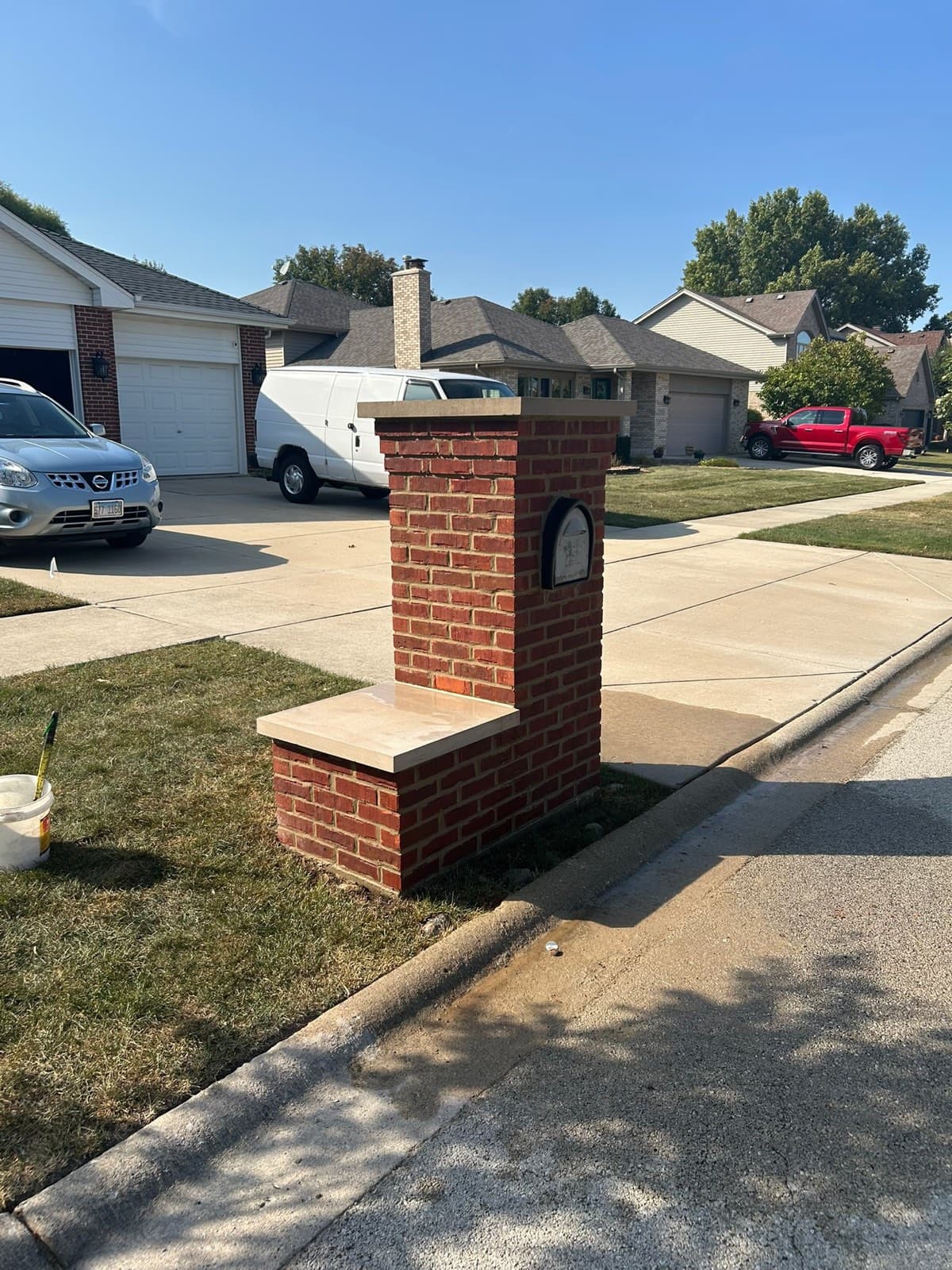
Look at almost any brick mailbox pillar in Chicagoland that's more than fifteen years old. The bottom courses are sandy and eroded, the joints have washed out, the cap is cracked or missing, and the whole thing has a lean to it.
Meanwhile the brick house forty feet behind it is fine.
That isn't bad luck or bad brick. Freestanding masonry is the hardest job in the trade to make last — because everything that protects a house wall is missing. Paul Lally's Masonry has been rebuilding Chicagoland pillars, mailboxes, and garden walls since 1988, and here's why they go, and what a rebuild that survives actually involves.
Everything that protects a wall, a pillar doesn't have
No interior
A house wall is sheltered on one face by the building itself, and warmed by it. A pillar is exposed on all four faces plus the top. Rain hits every side. There's no warm side to drive moisture outward, so it stays saturated far longer than any wall on your house — and every hour it stays wet is an hour it can freeze.
No roof
No overhang, no gutter, no roofline shedding water clear. Rain lands directly on the top and runs down every face.
Sitting in the salt zone
This is the big one. A mailbox pillar stands at the curb, which is precisely where the plow throws salted slush all winter. Entry pillars flank a driveway apron. Garden walls edge salted walks.
Salt draws into porous brick and mortar in solution, then crystallizes and expands as the masonry dries — mechanically similar to ice forming, but it works whenever the masonry dries out, not just when it freezes. Salt that soaked in during January keeps cycling through spring.
A shallow footing, or none
Nobody sees the footing, so it's the first thing skipped. A pillar set on fill or a thin pad will heave with seasonal ground movement in Chicagoland's clay soils — which is why so many of them lean.
A bad cap, or no cap
The single most common construction fault. A flat mortar wash across the top instead of a proper capping stone with an overhang. It cracks within a few years and water goes straight into the core.
What actually fails, in order
The bottom courses. Salt, splashback, standing meltwater, and snow piled against it. Sandy eroded mortar and spalled brick faces, usually worst on the street side.
The cap and top courses. Cracked or missing cap, then water entering the core from above.
The joints throughout. Washed out faster than any wall joint, because water runs down every face.
Plumb. A lean, a tilt, or a visible bow — footing movement or frost heave.
The core. Many pillars are a masonry shell around a fill or block core. Once water is in there and freezing, the facing starts pushing off in sections — and what looked like a few loose bricks turns out to be a rebuild.
Impact damage. Vehicles, plows, and mowers. A pillar at the curb takes hits nothing else on the property does.
Signs yours needs work
- Sandy, washed-out mortar joints, especially low down
- Spalled brick — faces flaking, powdering, popped off
- A cracked, loose, or missing cap
- A visible lean or tilt
- Loose or rocking units you can move by hand
- Facing pushing away from the core in sections
- Efflorescence — white chalky bloom, worst near the base
- Debris — sand and chips collecting at the bottom
- Standing water pooling at the base after rain
- The mailbox door binding because the surround has shifted
Repair or rebuild?
| Condition | Usually |
|---|---|
| Joints washed out, units sound, plumb | Repoint |
| A few spalled or loose units | Replace units + repoint |
| Cracked or missing cap, structure sound | New cap + repoint |
| Bottom courses eroded, upper sound | Rebuild the base courses |
| Facing pushing off the core | Rebuild — water is inside |
| Leaning or tilted | Rebuild on a proper footing |
| Vehicle impact | Rebuild the damaged portion or the whole pillar |
The honest dividing line: if the problem is the surface, it's a repair. If the pillar has moved or water is in the core, it's a rebuild — and patching a pillar that's still heaving just buys a season.
The good news: a pillar is a compact structure, so a full rebuild is a considerably smaller undertaking than the phrase suggests.
How Paul Lally's Masonry rebuilds a pillar
- Work out why it failed. Salt and water at the base, a bad cap, a shallow footing, or impact. Rebuilding without addressing the cause repeats the failure.
- Check the footing. If the pillar has moved, the footing is the reason, and it gets addressed — set below frost depth on undisturbed ground.
- Salvage what's sound. Original brick or stone from the pillar itself is the best possible match, cleaned of old mortar and relaid.
- Take down what's failed back to sound material.
- Rebuild plumb, with full bed and head joints, correct coursing, and a solid core rather than loose fill.
- Use mortar suited to the exposure — see below.
- Fit a proper cap. A capping stone or purpose-cast cap that overhangs the masonry and sheds water clear, not a flat mortar wash.
- Detail the base. Grade sloping away, and where possible a little separation from where salted slush lands.
- Clean down and walk it with you.
Materials — and the one place a stronger mortar earns its place
Across most of our work we argue hard that mortar must be softer than the masonry — and on soft century-old house brick, reaching for the strongest mix causes permanent damage.
Freestanding masonry at grade is a genuine exception, in the same way foundations and exterior steps are. A pillar faces high moisture, direct salt exposure, freeze-thaw from every face, and sometimes impact. Type S mortar is frequently the correct specification here where the units can take it.
But it's still decided per job. On salvaged soft antique brick or original limestone, a hard mix will still spall the material regardless of exposure — those get softer, matched mortars and stone repair mortars. The exposure argues for strength; the units have the final say.
Otherwise: salvaged and matched brick, matched limestone with tinted stone repair mortars, purpose-fit capping stones, and breathable penetrating sealers only where sealing is warranted at all — never a film-forming coating on something that gets wet from every direction.
What drives the cost
- Size and height of the pillar or wall
- Repair versus full rebuild, and whether the core is involved
- Footing work — the invisible part that decides longevity
- Material — brick, stone, or a mix, and how hard it is to match
- Cap — reusing a sound one versus sourcing or fabricating a new one
- Impact damage and how much has to be reconstructed
- Access — kerbside working, traffic, and where material can be staged
- Matching on older or unusual units
There's no flat rate for pillar work. Paul Lally's Masonry gives a free on-site estimate in writing.
Chicagoland context
Two regional realities make freestanding masonry harder here than in most of the country.
The salt load. Municipal plowing plus every driveway and walk. A curbside mailbox pillar is standing in the target zone for four months a year, and salt crystallization works year-round once it's soaked in.
Freeze-thaw intensity. Repeated hard cycles, sometimes several a week, on a structure that never gets a warm side to dry from.
Add clay soils that swell and shrink seasonally — which is what heaves an under-footed pillar — and you have a structure being attacked from the base, the top, and every face simultaneously.
You'll find this masonry all over the region: mailbox and entry pillars across the subdivisions of Orland Park, Tinley Park, Homer Glen, Mokena, New Lenox, Frankfort, and Palos Heights; garden and low boundary walls in the older western suburbs; porch and gate piers on the city's two-flats and bungalows; and freestanding brick and stone columns at drives and entrances everywhere.
Maintenance that genuinely extends their life
- Keep salted slush and piled snow off the base where you can — the single most valuable habit
- Don't pile shoveled snow against a pillar or garden wall
- Keep the cap sound. It's the cheapest component and it protects everything below
- Repoint before joints wash out, which is the cheap moment before water reaches the core
- Grade away from the base so water doesn't pond there
- Look at it each spring, when the salt-and-freeze season has just shown you what it did
- Watch for a developing lean — that's the footing talking
See protecting masonry through a Chicago winter and the masonry maintenance checklist.
Related services
Freestanding masonry work draws on brick repair, brick replacement, tuckpointing and repointing, limestone and sill repair where stone caps or columns are involved, foundation masonry repair for footing-related work, and residential masonry restoration.
Closely related: masonry steps, stoops, and porches — the same grade-level salt-and-water problem on a different structure.
The bottom line
A pillar has no roof, no interior, no warm side, and it stands where the plow throws salt. It's the most exposed masonry you own, and it fails first for entirely predictable reasons.
Three things decide whether a rebuild lasts: a footing below frost depth, a cap that genuinely overhangs and sheds water, and mortar matched to the exposure. None of those are visible on the finished job — which is exactly why cheap pillar work looks fine for two winters.
And the free version: stop putting the shoveled snow against it.
Paul Lally's Masonry Inc. is a family-owned, insured masonry contractor serving Chicago and the Chicagoland suburbs since 1988 — tuckpointing, brick repair and replacement, chimney repair and rebuilds, lintel replacement, masonry restoration, and waterproofing for residential and commercial properties. Built on Craftsmanship. Backed by Experience.
Mailbox and entry pillars are regular work for us, and we'd rather rebuild one properly once than repoint it every few years. Our family name is on every job — including the small ones at the end of the driveway.
Free on-site estimates — call (708) 448-8866 or request an estimate online.
Frequently Asked Questions
Why does my brick mailbox fall apart faster than my house?
Because it's exposed on every single face with no interior behind it to warm or shelter it, so it stays saturated far longer and cycles through freeze-thaw from all directions. It also sits at grade right where snowplows throw salted slush, and it's frequently capped badly or not at all.
Can a leaning brick pillar be straightened, or does it need rebuilding?
A pillar that's genuinely leaning has usually moved at its base, so straightening the masonry without addressing the footing just puts it back on the same path. Most leaning pillars get taken down and rebuilt on a proper footing — which is a smaller job than it sounds, because the structure is compact.
How much does a brick mailbox pillar rebuild cost?
There's no flat rate. Cost depends on size and height, whether it's a repair or a full rebuild, what the footing situation is, how difficult the brick or stone is to match, and whether a cap needs fabricating. Paul Lally's Masonry provides a free on-site estimate in writing.
Why does the cap matter so much on a pillar?
Because it's the only thing stopping water entering the top of a structure that's open on all sides. A proper cap overhangs the masonry and sheds water clear; a flat mortar wash cracks and lets water straight into the core, which then freezes and pushes the pillar apart from the inside.
Does a mailbox pillar need a real footing?
It should have one below frost depth. A pillar set on shallow fill or a thin pad will heave with seasonal ground movement, and heaving is the usual reason a pillar leans or cracks through. It's the part nobody sees and the part that decides whether the rebuild lasts.
Is road salt really the problem?
It's a major one. Salt draws into porous brick and mortar, then crystallizes and expands as the masonry dries — a mechanism much like freeze-thaw that works whenever it dries out, not only when it freezes. A mailbox pillar sits exactly where salted slush gets thrown, which is why the bottom courses go first.
Can you match the brick on an older pillar?
Usually. Sound units from the pillar itself are salvaged and relaid first, which is the best match available, and reclaimed stock covers the rest on older brick. On an unusual unit we'll show you how close the match will be before committing.
Do you repair stone pillars and garden walls too?
Yes — stone pillars, entry columns, garden and low boundary walls, and the piers that carry porches and gates. Stone fails differently than brick, delaminating along its bedding planes rather than spalling, so it's patched or Dutchman-repaired rather than simply replaced.
Who repairs brick mailboxes and pillars in Chicagoland?
Paul Lally's Masonry Inc. is a family-owned, insured masonry contractor serving Chicago and the Chicagoland suburbs since 1988, and pillar and mailbox rebuilds are regular work for us alongside tuckpointing, brick repair, and restoration. Free on-site estimates at (708) 448-8866.