
Homeowner Education · Chicagoland, IL
How Long Do Masonry Repairs Last? A Service-Life Guide for Chicagoland
Every masonry repair has a service life, and they are wildly different — sealant is measured in a handful of years, a rebuilt wall in generations. Knowing which is which is how you budget a house instead of reacting to it.
2026-09-08
Quick Answer
Masonry repairs have very different service lives: joint sealant lasts a handful of years, penetrating sealers a few years longer, tuckpointing decades, and a properly rebuilt wall or chimney generations. Service life depends on exposure, workmanship, and whether the water source was fixed. Paul Lally's Masonry has worked Chicagoland masonry since 1988 — insured, family-owned, free estimates, (708) 448-8866.
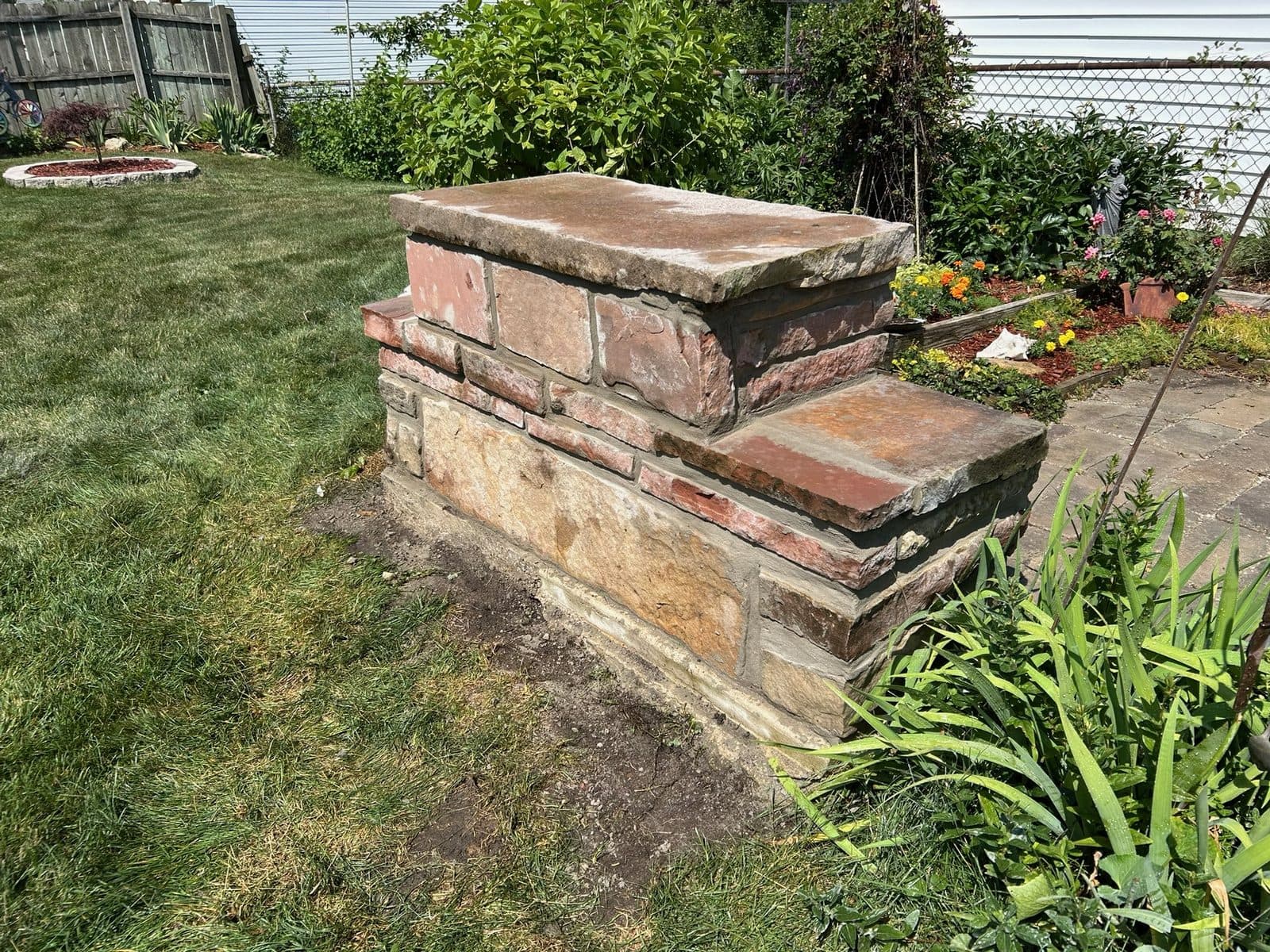
A homeowner asked us a question a few years ago that we have thought about ever since: "If I do this, how long before I have to do it again?"
It is the right question, and almost nobody asks it. People ask what something costs. Far fewer ask what they are buying in years — which is the only way to compare two repairs honestly, or to plan a building instead of reacting to it.
So here is the answer, repair by repair. How long masonry repairs last in Chicagoland varies by more than an order of magnitude across the work in this trade, and knowing the spread changes how you budget.
Paul Lally's Masonry Inc. is a family-owned, insured masonry contractor serving Chicago and the Chicagoland suburbs since 1988 — tuckpointing, brick repair and replacement, chimney repair and rebuilds, lintel replacement, masonry restoration, and waterproofing for residential and commercial properties. Built on Craftsmanship. Backed by Experience. Free on-site estimates — (708) 448-8866.
The three things that set service life
Before the list, the variables — because the same repair on two houses can differ by a factor of two or three.
Exposure. Which way the wall faces, how much weather it takes, whether it dries between rains. In Chicagoland the south and west elevations take driving rain and the strongest sun-driven wet-dry cycling, and they come due years ahead of the north and east faces. A shaded north wall under mature trees has the opposite problem — it dries slowly and stays biologically wet. Neither is the "good" wall; they fail differently.
Workmanship and materials. Joints cut to proper depth so mortar can key in. Mortar softer than the units it surrounds. Matched, compatible materials. Correct preparation. A repointing job done to a schedule rather than to a standard can fail in a fraction of the time it should serve.
Whether the source was fixed. This one is decisive. Every masonry failure is ultimately a water failure. If the cracked crown, the failed sill, the rusting lintel, or the gutter running behind the fascia was not addressed, the repair beneath it is on a clock from the day it was finished.
The service-life spread
| Repair | Roughly how long it should serve | What actually ends it |
|---|---|---|
| Joint sealant / caulking | Shortest — a handful of years | UV, heat cycling, movement |
| Penetrating masonry sealer | Several years | Weathering off; needs renewal |
| Stone patching | Medium | Bond line, freeze-thaw |
| Brick replacement (units) | Long | Only the surrounding joints |
| Tuckpointing / repointing | Decades | Weathering of the new joints |
| Lintel replacement | Long, if flashed | Water reaching the new steel |
| Chimney rebuild | Generations | Crown, cap, flashing come first |
| Wall rebuild | Generations | Movement or water source |
Read that table as relative rather than absolute — no responsible mason gives a guaranteed number for a specific wall sight-unseen. But the ordering is reliable, and the ordering is what matters for planning.
The short-life items, and why that is fine
Joint sealant
Exterior caulking at window and door perimeters, expansion and control joints, and material transitions is the shortest-lived thing in masonry. UV and heat cycling harden it, movement tears it, and south and west elevations go first.
That sounds like a weakness. It is not. Sealant is also usually the smallest line on any masonry estimate and one of the highest-return ones, because a failed perimeter bead is a very common water entry point. Renewing sealant on a cycle is cheap insurance against repairs that cost far more.
The failure to avoid is caulking over old caulk — new sealant will not adhere to a weathered bead, so it fails almost immediately. Proper work removes the old material, cleans the joint, installs backer rod, and tools a new bead.
Penetrating sealers
A breathable penetrating sealer on sound masonry protects for several years and then wants renewal. Exposure drives the number.
The critical caveat: a sealer applied over failing mortar joints has essentially no service life as a solution, because it was never addressing the water path. It only reduces the wall's ability to dry. Repointing comes first, curing comes second, sealing comes third.
The long-life items
Tuckpointing and repointing
The workhorse of masonry maintenance, and on a properly executed job it serves for decades. Not forever — mortar is the sacrificial element by design, meant to take the weathering so the brick does not have to. It is supposed to be renewed periodically. That is the system working.
What shortens it dramatically:
- Joints not cut deep enough, so the new mortar has nothing to key into and sheets off
- Mortar harder than the surrounding brick, which transfers stress into the units and spalls their faces — the most common way a well-intentioned repair damages an old Chicago building
- Smearing rather than pointing, leaving a surface skim over failed joints
- Working in the wrong conditions, so the mortar never properly cures
Our guide to why masonry repairs fail covers each of these in detail.
Brick replacement
Individual replacement units, properly bedded and matched, last as long as any brick in the wall. What comes due first is the mortar around them, on the same cycle as the rest of the elevation.
The honest caveat is appearance, not durability: matching a hundred-year-old Chicago common brick is genuinely hard, and a new unit will read slightly different for a long time. Our post on why brick repairs look different explains what can and cannot be achieved.
Lintel replacement
New protected steel, correctly sized and bedded, is a long-life repair — provided the water path was addressed. Flashing and a drip edge above the opening are what separate a lintel that serves for decades from one that starts corroding on the same clock as the one it replaced.
This is the clearest example in the trade of a repair whose service life is set by a detail, not by the main component.
Chimney and wall rebuilds
A chimney rebuilt plumb with matched brick and mortar, a properly formed crown with slope and overhang, a cap, and real flashing should serve for generations. What comes due sooner are the crown, cap, and flashing — the cheap components — which is exactly why they deserve attention rather than being the afterthought on a rebuild scope.
Same for a rebuilt wall section: the masonry is generational, provided the movement or the water that caused the failure was actually resolved.
Stone repair and patching
Stone sits in the middle of the range and splits by method. Repointing the joints around a sill or a stone course serves on roughly the same cycle as any other repointing. Patching a spalled area with a tinted repair mortar is shorter-lived, because the bond line between patch and stone is the weak point and freeze-thaw works on it directly. A Dutchman repair — cutting out the failed portion and letting in a matched piece of stone — is far longer-lived than a patch, because it is stone doing stone's job rather than mortar imitating it. Full replacement of the unit is generational.
The variable that governs all of them is whether the stone still sheds water. A sill that has lost its slope or had its drip edge bridged by paint or a bead of caulk will destroy any repair applied to it, because water keeps arriving at the same place.
Flashing, crowns, and copings
Worth calling out separately, because they are the components most often left out of a scope and most often responsible for a shortened service life somewhere else.
A chimney crown is the cheapest part of a chimney and the thing that determines how long the stack beneath it lasts. Coping does the same job on a parapet. Through-wall and step flashing decides whether water that enters a wall has a designed route back out or simply soaks downward.
None of these are the expensive part of a job. All of them shorten everything below them when they fail. If an estimate for a chimney rebuild or a parapet does not name the crown, cap, coping, and flashing explicitly, that is worth a question before signing.
Chicagoland is harder on all of it
Everything above compresses in this climate.
Freeze-thaw cycling. A Chicago winter does not freeze once and hold — it thaws and refreezes dozens of times a season. Each cycle is an expansion event inside wet masonry, and it is the single biggest determinant of service life here.
Lake-effect moisture. More wetting, slower drying, particularly on shaded elevations.
De-icing salt at grade level, attacking the bottom courses of every wall, step, and stoop.
Century-old housing stock. Chicago brick bungalows, greystones, two-flats, and workers' cottages built with soft common brick and lime-rich mortar. That masonry is not fragile — it has lasted a hundred years — but it is intolerant of hard modern mortar and aggressive cleaning, both of which shorten the life of any repair applied to it.
Newer veneer construction in the outer suburbs has a different clock: less repointing, but sealant renewal, weep hole maintenance, and flashing attention arriving right around the twenty-five to thirty-five year mark.
How to use this when you plan
Group by access, not by category. The expensive part of upper-elevation work is getting up there. If a chimney needs repointing and a second-floor lintel needs replacing, doing both while the staging is up is meaningfully cheaper than doing them two years apart.
Sequence by priority, not by budget. Structural and overhead first, active water entry second, deterioration third, appearance last. Phasing across years is entirely reasonable; phasing in the wrong order means paying twice for the same wall. Our guide to masonry repair priorities on a limited budget lays that out.
Treat the cheap short-life items as maintenance, not projects. Sealant and crown work are small, recurring, and disproportionately protective.
Look once a year. Chimney, joints, sills, lintels, and whether anything has changed. Nearly every expensive masonry job we do started as something inexpensive that nobody noticed for a decade. The masonry maintenance checklist is a reasonable starting point.
What drives the cost of any of it
Scope and square footage. Height and access, including staging. The ratio of repointing to rebuilding. Extent of damage. Whether brick or stone must be matched or sourced. Whether related repairs can share the same access.
We publish no prices, because a number that means anything requires seeing the building. Free on-site estimate, in writing, with the scope broken out — call (708) 448-8866.
The honest bottom line
Nobody can promise you a specific number of years on a specific wall, and be wary of anyone who does. What a good mason can tell you is which repairs are short-life maintenance and which are generational, whether the source of the damage has actually been addressed, and what would shorten the life of the work they are proposing.
That conversation is worth more than a warranty document, and it is the one we would rather have with you before the work than after it.
Paul Lally's Masonry Inc. is family-owned, insured, and has been doing this in Chicagoland since 1988. Our name is on every job. Related services: tuckpointing and repointing, brick repair, lintel repair and replacement, chimney repair and rebuilds, caulking and joint sealant, and masonry sealing and waterproofing.
Built on Craftsmanship. Backed by Experience. Get a free on-site estimate or call (708) 448-8866.
Frequently Asked Questions
How long does tuckpointing last?
On a properly prepared wall with matched mortar, repointing is measured in decades rather than years — commonly a generation or more on a sheltered elevation. A south or west elevation taking driving rain and full sun will come due meaningfully sooner than a protected north wall on the same house.
What is the shortest-lived masonry repair?
Joint sealant. Exterior caulking at window perimeters and expansion joints has a service life measured in a handful of years, especially on south and west elevations where UV and heat cycling do the damage. It is also the cheapest line on most estimates, which is a good trade.
How long does a masonry sealer last?
A quality breathable penetrating sealer on sound, properly prepared masonry generally protects for several years before renewal, with exposure driving the number. A sealer applied over failing joints does not last at all, because it was never solving the problem.
How long should a rebuilt chimney last?
A chimney rebuilt plumb with matched materials, a properly formed crown, a cap, and correct flashing should serve for generations, with periodic repointing along the way. The components that come due sooner are the crown, cap, and flashing — not the masonry itself.
Why did my last masonry repair fail so quickly?
Usually one of three things: the water source was never fixed, the mortar was harder than the surrounding units, or the joints were not cut deep enough for the new mortar to key in. All three are workmanship or diagnosis failures rather than material failures.
Does the direction a wall faces really change how long a repair lasts?
Substantially. In Chicagoland the south and west elevations take the prevailing weather and the strongest sun-driven wet-dry cycling, and they routinely need attention years ahead of the north and east faces on the same building.
How often should I have my masonry looked at?
An annual visual check of the chimney, joints, sills, and lintels catches nearly everything while it is still small, and a closer look every few years is sensible on an older building. Most expensive masonry work started as something cheap that nobody noticed.
Is it cheaper to do everything at once or spread it out?
Doing related work together avoids paying for the same access twice, which is real money on upper elevations. But phasing across years is perfectly sensible provided the phasing follows priority — urgent and water-entry items first, appearance last.
How much does masonry work cost in Chicago?
It depends on scope, height and access, the ratio of repointing to rebuilding, extent of damage, and whether brick or stone must be matched. Paul Lally's Masonry provides a free on-site estimate in writing rather than a figure that would not survive contact with your building.
Does a masonry repair come with a warranty?
Reputable contractors stand behind their workmanship, and what that covers should be in writing before work starts. Ask specifically what is covered, for how long, and what would void it — a clear answer is itself a signal.