
Masonry Sealing / Waterproofing · Westmont, IL
Masonry Waterproofing in Westmont, IL — Seal It Right, or Don't Seal It At All
Sealing brick is the easy part. Knowing whether your wall should be sealed at all — and what has to be repaired first — is the part that decides whether it works or makes things worse.
Quick Answer
Masonry waterproofing in Westmont, IL is the application of a breathable penetrating sealer to sound, properly repointed brick and block so water is repelled while trapped vapor can still escape. Sealing over failed mortar joints traps moisture and accelerates damage. Paul Lally's Masonry has served Chicagoland since 1988 — free on-site estimates, (708) 448-8866.
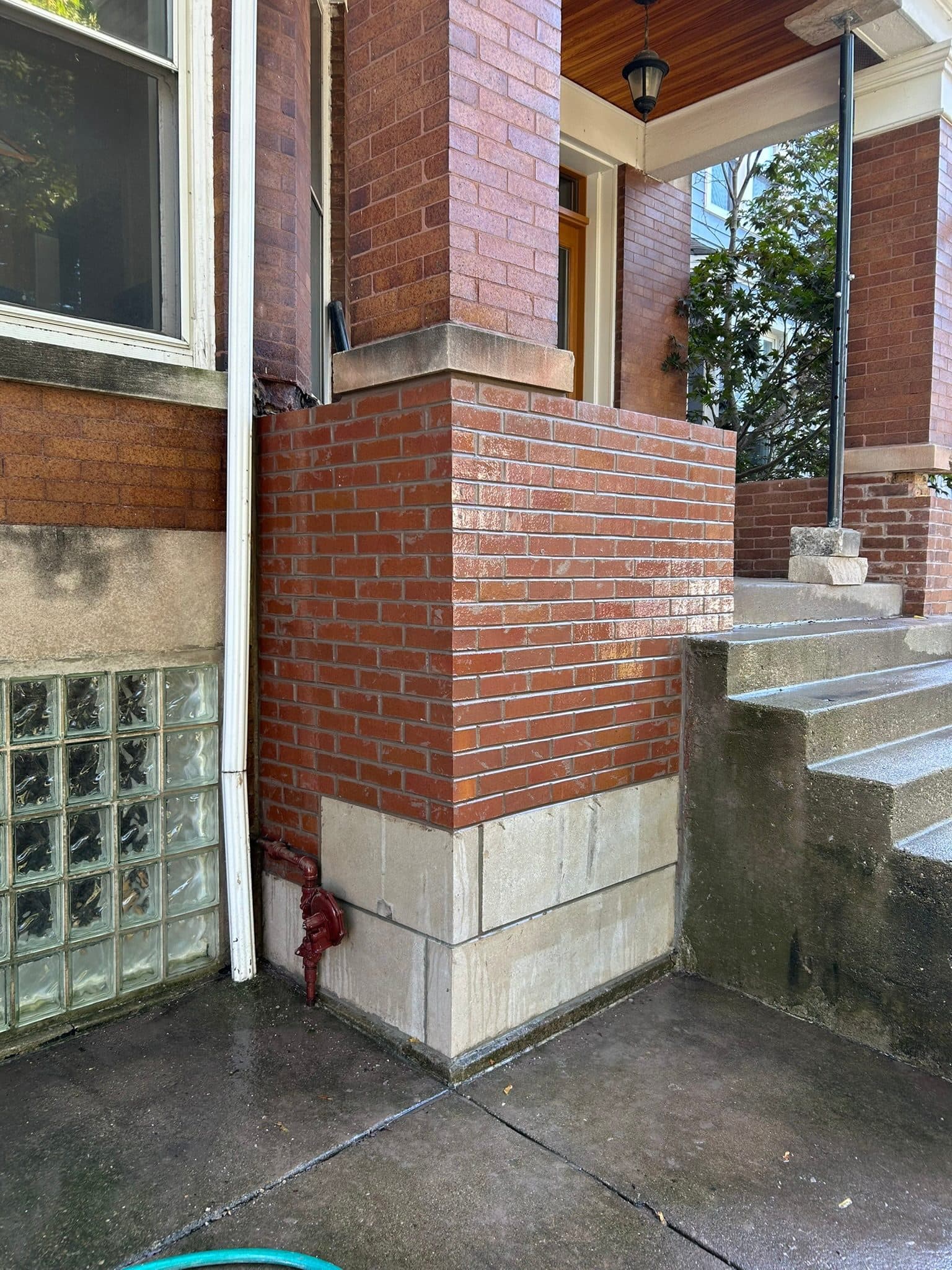
Here is the most useful sentence anyone in this trade can say to a Westmont homeowner: a sealer applied over failing mortar joints will make your wall worse, not better.
That is not a sales position. It is physics. A brick wall is a system that gets wet and dries out again, over and over, for a hundred years. Masonry waterproofing in Westmont, IL works when it helps that system shed liquid water while still letting vapor escape. It fails — badly, and expensively — when it seals moisture inside a wall that is still taking water in through open joints.
Paul Lally's Masonry Inc. is a family-owned, insured masonry contractor serving Chicago and the Chicagoland suburbs since 1988 — tuckpointing, brick repair and replacement, chimney repair and rebuilds, lintel replacement, masonry restoration, and waterproofing for residential and commercial properties. Built on Craftsmanship. Backed by Experience. Free on-site estimates — call (708) 448-8866.
What masonry waterproofing actually is
Two very different products get sold under the same word, and the difference decides everything.
Penetrating sealers — silane and siloxane chemistries — soak into the masonry and line the pores. Liquid water beads and runs off. Water vapor still passes through. The wall looks essentially unchanged, and it keeps its ability to dry.
Film-forming coatings — masonry "waterproof paints," heavy acrylics, and elastomeric films — sit on top of the surface. They block liquid water and they also block vapor. On a Chicagoland wall, that is the problem. Moisture that gets in behind the film through any joint, crack, or opening cannot get out, and when it freezes it pushes the face of the brick off. That is spalling, and coatings cause a great deal of it.
Proper masonry waterproofing in Westmont, IL means the first kind, over masonry that has been repaired first.
Why the sequence matters more than the product
Mortar joints are the most permeable part of a brick wall. They are softer than the units by design — mortar is meant to be the sacrificial element, taking the movement and the weathering so the brick does not have to.
So when joints recede, crack, or go sandy, they become the water path. And here is the trap: a sealer on the face of the brick does not close an open joint. It reduces the wall's ability to dry, while the wall continues to take water in.
The correct order, every time:
- Diagnose the water path. Where is water actually getting in — joints, a cracked lintel head, a spalled sill, a chimney, a flashing detail?
- Repair it. Repointing, brick replacement, sill or lintel work, whatever the wall needs.
- Let the new mortar cure.
- Then seal, if the wall benefits from it.
Any scope that goes straight to step four should raise a question.
Signs a Westmont wall needs attention
- Receding or crumbling mortar joints — you can rake a joint with a key and sand falls out
- Spalling or flaking brick faces, especially low on the wall or under a leaking gutter
- Efflorescence — the white chalky bloom that means water is actively moving through the masonry and depositing salts on the surface
- Damp interior walls or a musty finished basement on a wall that faces prevailing weather
- Dark, slow-drying patches on one elevation after rain
- Step cracks through the mortar joints
- A previously painted or coated wall where the coating is blistering and lifting
Westmont, specifically
Westmont is a DuPage County village with a housing stock heavy on the postwar decades — brick and brick-veneer ranches, Cape Cods, and split-levels from the 1950s through the 1970s, along with older frame and masonry near the downtown and the BNSF line, and newer construction filling in on teardown lots.
That mix produces a specific set of waterproofing problems.
Brick veneer over frame behaves differently than solid masonry. A veneer wall is designed to let water in and drain it back out through weep holes at the base. Seal the wrong way and you interfere with a drainage system rather than a barrier. If the weeps are painted shut, mortar-plugged, or buried by regrading — extremely common on houses of this era — the wall is holding water regardless of what goes on the face.
Postwar mortar is at the end of its first life. A 1958 ranch has joints that have been through roughly seventy Illinois freeze-thaw seasons. That is exactly the point where repointing stops being optional.
Grade and drainage. Decades of added mulch and soil have raised grade against a lot of Westmont foundations. Water sitting against a wall is a masonry problem that no sealer solves.
Exposure. The south and west elevations take the driving rain and the sun-driven wet-dry cycling. On most Westmont houses those two walls are visibly ahead of the others in deterioration, and they are usually where the money should go first.
Materials we use
Breathable penetrating sealers appropriate to the substrate — brick, block, or stone — chosen for vapor permeability rather than for how glossy the wall looks afterward. Mortar matched to the existing joints in type, color, and texture, so repointed sections read as part of the wall rather than as a repair. Where a wall genuinely needs repair before it can be sealed, we say so, and we would rather tell you the sealer should wait than take money for a product that will not perform.
What drives the cost
Wall square footage. The condition of the existing masonry and how much repointing or brick replacement has to happen first. Height and access — a two-story elevation with tight side-yard clearance takes staging that a one-story ranch does not. Substrate type and porosity, which changes how much material a wall absorbs. Whether an old coating has to be dealt with.
We do not publish rates, because a number that means anything requires seeing the wall. Paul Lally's Masonry provides a free on-site estimate in writing so you know exactly what is included and in what order.
What we will tell you honestly
Sometimes the answer is that your wall does not need sealing. A sound, well-pointed brick wall with working drainage and clean weep holes is already doing its job, and adding a product to it is optional maintenance rather than a repair.
Sometimes the answer is that sealing is the wrong line item entirely — that the water is coming from a chimney crown, a rusting lintel, or a gutter running behind the fascia, and no amount of surface product will touch it. Our name is on every job, and we would rather be right about that than sell a wall a coat of something.
Serving Westmont and the surrounding DuPage suburbs
We work throughout Westmont and the communities around it — Downers Grove, Clarendon Hills, Darien, Hinsdale, Willowbrook, and Lisle. Related work often runs alongside sealing: tuckpointing and repointing, brick repair, limestone and sill repair, and masonry sealing and waterproofing.
If you are trying to decide what your wall needs first, our guide to how water gets through a brick wall walks the whole path.
Get an honest answer about your wall
Family-owned since 1988, insured, and straightforward about what a wall does and does not need. Built on Craftsmanship. Backed by Experience.
Get a free on-site estimate — or call (708) 448-8866.
Masonry Sealing / Waterproofing in Westmont, IL — Frequently Asked Questions
Should I seal my brick house in Westmont?
Only if the masonry underneath is sound. A penetrating sealer on repointed, structurally solid brick is genuinely useful protection against freeze-thaw damage. On a wall with open or eroded mortar joints, sealing is worse than doing nothing — it slows drying without stopping entry.
Will a sealer stop water already coming through my wall?
Usually not. Active water entry almost always has a path — a failed joint, a cracked lintel head, a bad sill, an open flashing detail — and a surface product does not close a path. Find and repair the entry point first; the sealer is the last step, not the fix.
What is the difference between a breathable sealer and a waterproof coating?
A breathable penetrating sealer soaks into the masonry, lines the pores so liquid water beads off, and still lets water vapor pass out of the wall. A film-forming coating or waterproof paint sits on the surface and blocks vapor both ways, which traps moisture inside the brick where it freezes and spalls the face.
Does sealing brick cause spalling?
The wrong product does. Film-forming coatings and many masonry paints trap moisture behind the face of the brick, and when that moisture freezes it pushes the face off. That is why breathability is the single most important property of any sealer going onto a Chicagoland wall.
How long does masonry sealer last?
A quality penetrating silane or siloxane sealer on properly prepared masonry generally protects for several years before it needs renewal, and the exposure of the wall drives the number — a south and west elevation in Westmont weathers faster than a sheltered north wall.
Do I need tuckpointing before sealing?
If any joints are receding, cracked, sandy, or open, yes. Mortar joints are the most permeable part of a brick wall, and sealing over failing joints locks moisture into the wall. Repoint first, let the new mortar cure, then seal.
How much does masonry waterproofing cost in Westmont, IL?
It depends on the square footage of wall, the condition of the masonry, whether repointing or repairs are needed first, the height and access, and the substrate. Paul Lally's Masonry gives a free on-site estimate in writing so you can see exactly what is included.
Can you seal brick in the fall in Illinois?
Yes, provided the masonry is dry, temperatures stay above the product's minimum for application and cure, and there is no rain in the window. Fall is a common time to seal in DuPage County because it gets the wall protected before the first freeze-thaw cycles.
Masonry Sealing / Waterproofing in Nearby Areas
Other Masonry Services in Westmont, IL
Learn more about our masonry sealing / waterproofing services across Chicagoland, or view all service areas.
Free on-site estimates across Chicagoland.