
Chimney Repair · Chicagoland, IL
Your Furnace Doesn't Use the Chimney Anymore. Now What? Repair, Reduce, or Remove
High-efficiency furnaces vent out the side wall, leaving thousands of Chicago chimneys with no job and no maintenance. That masonry keeps weathering — and keeps leaking. Here's how to decide between repairing it, taking it down to the roofline, or removing it entirely.
2026-07-31
Quick Answer
When a high-efficiency furnace vents out a side wall, the old masonry chimney often becomes unused — but it keeps weathering and leaking. The three options are repairing and capping it, taking it down to the roofline and roofing over, or removing it entirely. The right choice depends on whether any appliance still vents through it, its condition, and whether it is structural. Paul Lally's Masonry has handled Chicagoland chimneys since 1988 — (708) 448-8866.
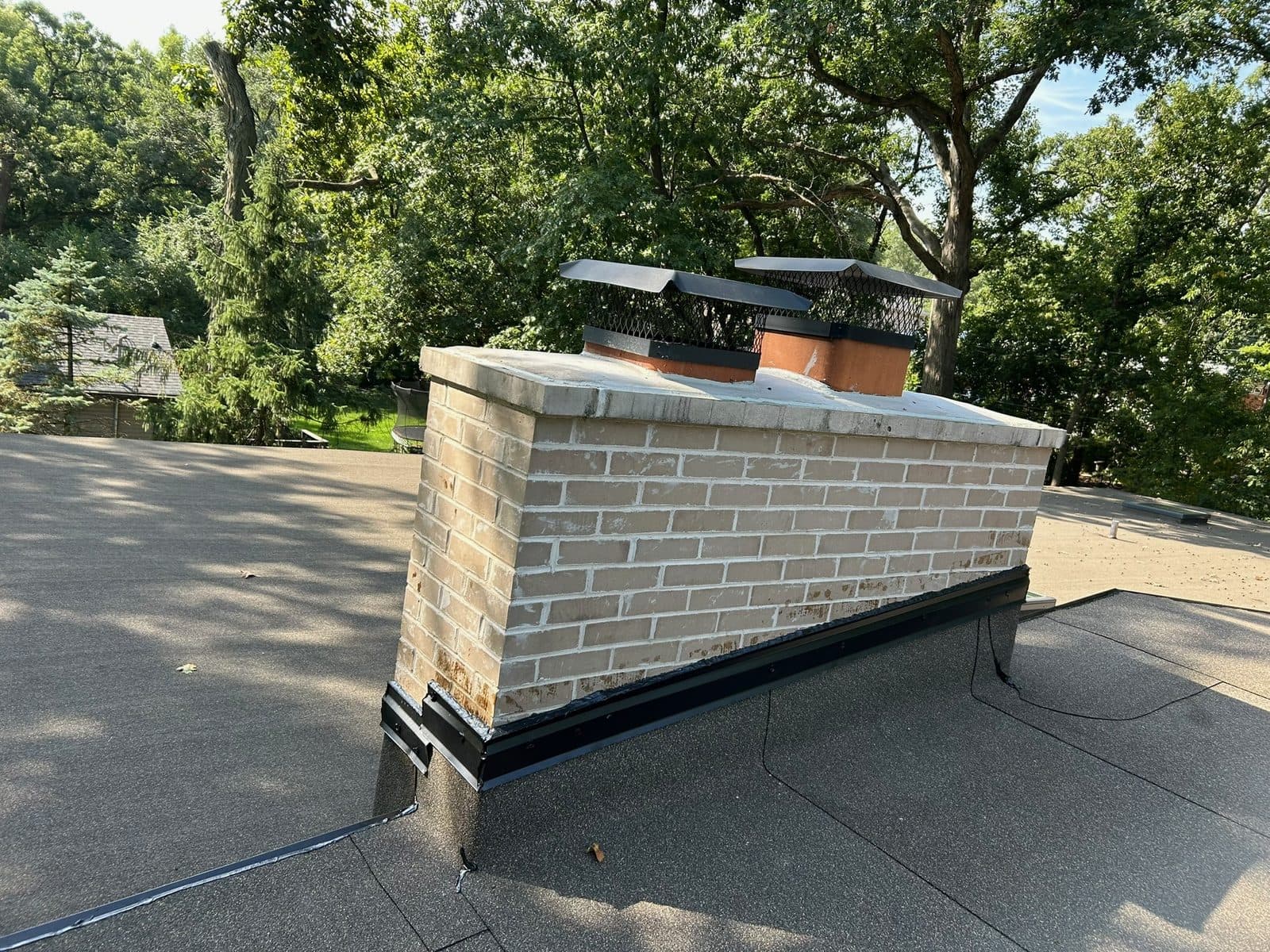
Somewhere around the time your old furnace was replaced with a high-efficiency one, a PVC pipe appeared coming out the side of your house. That was the moment your chimney stopped having a job.
It didn't stop being there. It's still standing above your roofline, still taking weather from four directions, still with a crown on top that's cracking and flashing at its base that's aging — and now with nobody paying it any attention, because it doesn't do anything.
Thousands of Chicago-area homes are in exactly this position, and the unused chimney is one of the most common sources of mystery roof leaks we get called about. Paul Lally's Masonry has been working on Chicagoland chimneys since 1988. Here's how to think about whether yours should be repaired, reduced, or removed.
First: make sure it's actually unused
Before anything else, confirm nothing still vents through that flue. This matters and it's easy to get wrong.
When a furnace is converted to high-efficiency direct venting, the water heater frequently stays behind — an atmospheric, natural-draft unit still venting into the old masonry flue. That's the "orphaned water heater" situation, and it's extremely common in Chicago housing. The flue was originally sized for a furnace and water heater venting together; with only the water heater left, the flue can be oversized for the load, which affects how well it drafts and can allow condensation inside the chimney.
Other things that may still use it: a fireplace, a boiler, a second-floor unit's appliance in a two-flat, or a decorative gas log set.
Have a heating professional confirm what vents where before you make any decisions about the masonry. This is a safety question — combustion appliances need proper venting, and it's outside what a mason should be guessing about. We'll always ask, and if we can't get a clear answer we'll tell you to sort that out first.
If something still vents through it: the chimney needs to be maintained, not removed. Skip to the repair section.
Why an unused chimney keeps causing problems
A chimney is the most punished masonry on any house, and being unused doesn't help it at all.
It's exposed on four sides. Every other wall on your home is protected on one face by the building's interior. A chimney above the roofline isn't — it takes wind-driven rain, sun, and freeze-thaw cycling from every direction, and it stays wet longer than anything else on the house.
It has three separate water paths, any one of which will leak:
- The crown — the concrete cap across the top. Crowns crack, and a cracked crown lets water directly into the body of the chimney.
- The sides — mortar joints and brick faces. Failed joints and spalled brick let water into the masonry itself.
- The flashing — where the chimney passes through the roof. Deteriorated flashing and counterflashing is a classic leak source, and it's often blamed on the roof.
And an uncapped, unused flue is an open pipe pointed at your house. Rain goes straight down it. So does snow. So do birds and animals. Water sitting in a disused flue soaks the masonry from the inside and, in a chimney that no longer gets warm, never really dries out.
Add Chicagoland freeze-thaw — absorbed water expands about nine percent when it freezes, prying the masonry apart — and an unmaintained chimney deteriorates noticeably faster than the walls below it.
This is why "the roof is leaking" so often turns out to be the chimney. A new roof membrane or new shingles don't address a cracked crown, failed joints, or an open flue.
Your three options
Option 1: Repair and cap it
Keep the chimney, make it sound, and cap the flue.
What's involved: repointing failed mortar joints, replacing spalled brick, repairing or rebuilding a cracked crown, installing a proper cap over the flue, and addressing the flashing where it meets the roof. Where deterioration runs deeper, rebuilding the courses above the roofline.
Choose this when:
- Anything still vents through it (then cap only the unused flues, not the working one)
- You have a fireplace you use or want to keep usable
- The chimney is in reasonable condition
- It's architecturally important to the house — on a bungalow, greystone, or period home the chimney is often part of the design
- You may want the flue available in the future
- It's structural, or its role is uncertain
The advantage: it's the least invasive option, keeps your options open, and preserves the look of the house.
The catch: you're maintaining masonry that has no function. That's a legitimate choice — plenty of homeowners make it for appearance or resale — but it's worth naming.
Option 2: Take it down to the roofline
Remove the masonry above the roof and roof over the opening.
What's involved: dismantling the above-roof masonry by hand, removing the debris, properly sealing off the flue below, then framing and decking over the opening and tying the new roofing into the existing roof so it's watertight.
Choose this when:
- Nothing vents through it and nothing will
- The above-roofline masonry is genuinely deteriorated
- You want the leak source gone rather than maintained
- You don't want to keep re-repairing a chimney with no purpose
- The chimney below the roofline is undisturbed and possibly structural
The advantage: this is usually the practical sweet spot. It removes the exposed, failing, leak-prone portion — which is the part causing all the trouble — without touching anything inside the house. No interior demolition, no plaster repair, no framing questions in your living space.
The catch: the chimney stack remains inside the house, taking up the same space it always did. And the roof tie-in is what decides whether this stays dry, so it has to be done properly, not patched.
Option 3: Full removal
Take the chimney out entirely, from the roof down through the house.
What's involved: everything in option 2, plus removing the stack through the attic, the upper floors, and down to the basement or its base — then repairing framing, floors, walls, and ceilings where it passed through, and addressing whatever the chimney was sitting on.
Choose this when:
- Nothing vents through it and nothing ever will
- You want the floor space back — often meaningful in a Chicago bungalow or a tight two-flat
- You're already renovating those rooms, so the finish work is happening anyway
- The chimney is genuinely free-standing and carries no structure
The advantage: the problem is gone permanently, and you recover usable space.
The catch — and it's a real one: this is the most invasive and most involved option by a wide margin. Whether the chimney is structural is the critical question, and in older Chicago homes you often can't tell from the outside. Some stacks are entirely freestanding masonry; others are tied into or help carry framing. Where there's any doubt, that's a question for a licensed structural engineer, not something to guess at — and we'll tell you so plainly rather than start swinging.
Full removal is also rarely worth doing purely to stop a leak. If leaks are the problem, option 2 solves them for far less disruption.
The three options compared
| Repair & cap | Down to roofline | Full removal | |
|---|---|---|---|
| Stops roof-level leaks | Yes, with maintenance | Yes, permanently | Yes, permanently |
| Keeps flue available | Yes | No | No |
| Interior work required | None | None | Substantial |
| Structural questions | None | Minimal | Must be answered first |
| Recovers interior space | No | No | Yes |
| Preserves the look | Yes | Changes the roofline | Changes the roofline |
| Ongoing maintenance | Yes — it's still masonry | Nothing above roof | None |
| Typical best fit | Working flue, fireplace, or period home | Unused, deteriorated, leaking | Renovation + freestanding stack |
Signs your chimney needs a decision soon
- Water stains on ceilings or walls near the chimney chase, at any level
- A cracked or crumbling crown on top
- No cap on the flue — an open pipe into your house
- Spalled brick — faces flaking, powdering, or popped, especially at the shoulders
- Soft, receding mortar joints you can dig out by hand
- Rust staining or deteriorated flashing at the roofline
- Brick or mortar debris in the gutters, on the roof, or on the ground
- A visible lean — urgent, always
- Loose brick you can move by hand
- White efflorescence on the chimney or the wall below it
- A musty smell near a disused fireplace or flue
A leaning chimney or loose brick above a walkway is a safety item, not a maintenance item. That one doesn't wait for a decision about long-term plans.
How we approach it
- Get on the roof and actually look. Nobody can assess a chimney from the driveway.
- Confirm what vents through it — and if that isn't clear, send you to a heating professional before we go further.
- Assess all three water paths: crown, masonry, flashing. Then find where water is genuinely entering, which is often not where the stain appears.
- Establish whether it's structural, particularly if removal is on the table.
- Lay out the realistic options with what each actually involves — including the ones that make us less money, because a homeowner maintaining a chimney they don't need should at least be doing it deliberately.
- Do the work: repoint and rebuild with matched mortar and salvaged brick where appropriate; or dismantle by hand, seal the flue, and coordinate a proper roof tie-in.
- Clean up — roof, gutters, and grounds.
Materials and technique
Mortar matched for type, color, sand, and joint profile — standard Type N on most residential chimneys, softer mixes on soft century-old brick, Type S only where exposure and structure genuinely call for it. Salvaged original brick reused wherever possible, because a modern brick in an old chimney reads as a patch from the street forever. Crowns rebuilt to shed water properly with an overhang and a drip edge, rather than a flat smear of mortar across the top. Proper caps sized to the flue.
The rule that governs chimney work as much as any other masonry: mortar should be softer than the brick. On a bungalow or greystone chimney of soft, locally-fired common brick, a hard modern mix will make the brick faces spall at the joints — permanent damage, on the most weather-exposed masonry you own.
What drives the cost
- Height and roof access — pitch, height, and how staging gets set
- Scope — repoint, partial rebuild, full above-roofline rebuild, takedown, or full removal
- Crown and cap work
- Flashing condition and coordination at the roof
- Brick matching and salvage
- Roof tie-in if the chimney comes down to the roofline
- Interior repairs — the dominant cost driver on full removal
- Structural engineering, where removal below the roofline requires it
- Debris handling — chimney masonry is heavy, and it has to come down and out
Paul Lally's Masonry gives a free on-site estimate in writing after getting on the roof, and we'll price the realistic options side by side so you can compare them properly.
Chicagoland context
This situation is unusually common here for two reasons that reinforce each other.
Our housing stock is masonry and it's old. The bungalow belt, the greystones, the two-flats and three-flats, the postwar suburban ranches and split-levels — nearly all built with masonry chimneys serving a furnace and water heater, most between roughly 1900 and 1980. Those chimneys are soft brick and, on older homes, lime-based mortar.
And nearly all of those furnaces have been replaced. The move to high-efficiency, direct-vent, side-wall-vented furnaces swept through this region, and every one of those conversions left a masonry chimney with less to do — and very often nothing to do.
Then our climate goes to work on it. Repeated hard freeze-thaw cycling, wind-driven rain off the lake, and heavy snow loads sitting against the crown and flashing. An unmaintained chimney in Chicago deteriorates fast, and it does it out of sight, above the roofline, where nobody looks until there's a stain on a bedroom ceiling.
Maintenance if you keep it
- Cap every unused flue. Cheapest thing on this page and it stops rain going straight down the chimney.
- Look at the crown for cracks — it's the first thing to fail on top.
- Check flashing where the chimney meets the roof, especially after storms.
- Watch for debris in gutters and on the roof at the chimney base.
- Inspect after freeze-thaw season, each spring.
- Repoint before joints recede deeply — that's the cheap moment.
- If anything still vents through it, keep up with proper inspection of the venting itself by a heating professional.
Our masonry maintenance checklist for Chicago covers the full cadence, and chimney crowns, caps, and flashing goes deeper on the three water paths.
Related services
Depending on the direction you choose: chimney repair and rebuilds, tuckpointing and repointing, brick repair, brick replacement, parapet wall repair for flat-roofed buildings, caulking and joint sealant, masonry waterproofing, and residential masonry restoration.
Worth reading next: chimney repair vs. rebuild and signs your chimney needs repair.
The bottom line
First confirm nothing still vents through it — the orphaned water heater catches a lot of people out, and that's a safety question for a heating professional, not a masonry one.
If something does: repair and maintain it. If nothing does and the masonry is sound: cap it and keep an eye on it. If nothing does and it's deteriorated and leaking: taking it down to the roofline is usually the practical answer — it removes the part causing the trouble without touching the inside of your house. Full removal makes sense mainly when you're already renovating, want the space back, and the stack is confirmed freestanding.
What doesn't work is the fourth option most homeowners are currently on: leaving a deteriorating, uncapped, unmaintained chimney above the roofline and repainting the ceiling stain every couple of years.
Paul Lally's Masonry Inc. is a family-owned, insured masonry contractor serving Chicago and the Chicagoland suburbs since 1988 — tuckpointing, brick repair and replacement, chimney repair and rebuilds, lintel replacement, masonry restoration, and waterproofing for residential and commercial properties. Built on Craftsmanship. Backed by Experience.
We'll get on the roof, tell you what your chimney is actually doing, and lay out the honest options — including the ones that cost us work. Our family name is on every job.
Free on-site estimates — call (708) 448-8866 or request an estimate online.
Frequently Asked Questions
My furnace vents out the side of the house now. Do I still need the chimney?
Only if something else still uses it. Many Chicago homes kept an atmospheric water heater venting into the old flue after the furnace was converted, and that flue still has a job. If nothing vents through it at all, the chimney is no longer functional — but it's still masonry on your roof that will keep weathering and leaking until it's dealt with.
What is an orphaned water heater?
It's a water heater left venting alone into a chimney that was originally sized for a furnace and water heater together. The flue can end up oversized for the smaller load, which affects how well it drafts and can allow condensation inside the chimney. It's worth having a heating professional confirm your venting is right before you make any decisions about the masonry.
Can I just cap an unused chimney and leave it?
Yes, if the masonry is sound — capping keeps rain out of the flue and is far better than leaving it open. But capping doesn't stop the chimney from weathering on the outside, so soft joints, spalled brick, a cracked crown, or bad flashing still need attention. A cap on a deteriorated chimney just keeps water out of the middle while the rest keeps failing.
Is it cheaper to remove a chimney than repair it?
Not automatically, and it depends heavily on how much comes down and what has to happen afterward. Taking a chimney down to the roofline and roofing over is a contained job; removing it all the way through the house involves interior repairs, framing, and finishes, and if the chimney is carrying any structure it needs engineering. We'll price the realistic options side by side at the estimate.
How do I know if my chimney is structural?
You often can't tell from the outside, which is exactly why it matters. In some older Chicago homes the chimney stack is tied into or helps support framing, and in others it's entirely freestanding masonry. Before any removal below the roofline we establish what the chimney is carrying, and where there's any doubt that's a question for a licensed structural engineer rather than a guess.
Why does my unused chimney still leak?
Because it's the most exposed masonry on the house — weather on four sides above the roofline — and it usually has three separate water paths: a cracked crown on top, failed mortar joints and spalled brick on the sides, and deteriorated flashing where it meets the roof. Being unused doesn't protect it from any of that; it just means nobody has been maintaining it.
What's involved in taking a chimney down to the roofline?
The masonry above the roof is dismantled by hand and the debris removed, the flue is properly sealed off, and then the roof is framed and decked over the opening and tied into the existing roofing so it's watertight. The roofing tie-in is the part that decides whether it stays dry, so it needs to be done properly rather than patched.
Will removing my chimney affect my home's value or resale?
A leaking, crumbling chimney is a liability in a sale and gets flagged in inspections, so dealing with it generally helps. Whether removal or repair is better for resale depends on the house — a decorative fireplace people actually use is worth keeping, while a purely functional stack that hasn't vented anything in fifteen years usually isn't missed. Talk to your agent about your specific market.
Can the chimney be removed if I still have a fireplace?
Not the flue that serves the fireplace. A working fireplace needs its chimney, so if your stack contains multiple flues the options change — sometimes an unused furnace flue can be sealed while the fireplace flue stays in service. That's a case where the chimney gets repaired rather than removed, and we'd scope it that way.
How much does chimney work cost in Chicagoland?
There's no flat rate. Cost is driven by height and roof access, whether it's repointing, an above-roofline rebuild, a takedown, or a full removal, how much staging is needed, roof tie-in work, and — for anything below the roofline — interior repairs. Paul Lally's Masonry provides a free on-site estimate in writing after getting on the roof and looking at it.