
Masonry Restoration · Chicagoland, IL
Mason, Chimney Sweep, Waterproofer, or Engineer? Who to Call for What
Half the masonry calls we get should have gone to someone else first — and a fair number of the jobs we're asked to fix were done by the wrong trade. Here's who actually handles what, and how to tell from your symptom.
2026-08-11
Quick Answer
Call a mason for crumbling mortar, spalling brick, chimney masonry, lintels, and parapets. Call a structural engineer for a bowing, leaning, or displaced wall. Call a chimney sweep for flue cleaning and venting safety. Call a roofer for the membrane, but not the parapet above it. Paul Lally's Masonry has served Chicagoland since 1988 — (708) 448-8866.
A fair share of the calls we take should have gone somewhere else first. And a fair share of the jobs we're asked to fix were done by a trade that shouldn't have taken them on.
Neither is anyone's fault. Building problems don't arrive labelled with a trade, and "there's water coming in" is a symptom that four different specialists can each plausibly claim.
So here's the honest map, from someone whose interest would be served by claiming more of it. Paul Lally's Masonry has been working Chicagoland masonry since 1988, and part of that is telling people when the call isn't ours.
Start with the symptom
| What you're seeing | Call first | Why |
|---|---|---|
| Crumbling, sandy mortar joints | Mason | Joint failure — repointing |
| Brick faces flaking or popping off | Mason | Spalling — replacement + repointing |
| Horizontal crack above a window or garage | Mason | Rusting lintel |
| Ceiling stain that survived a new roof | Mason | Almost always the parapet |
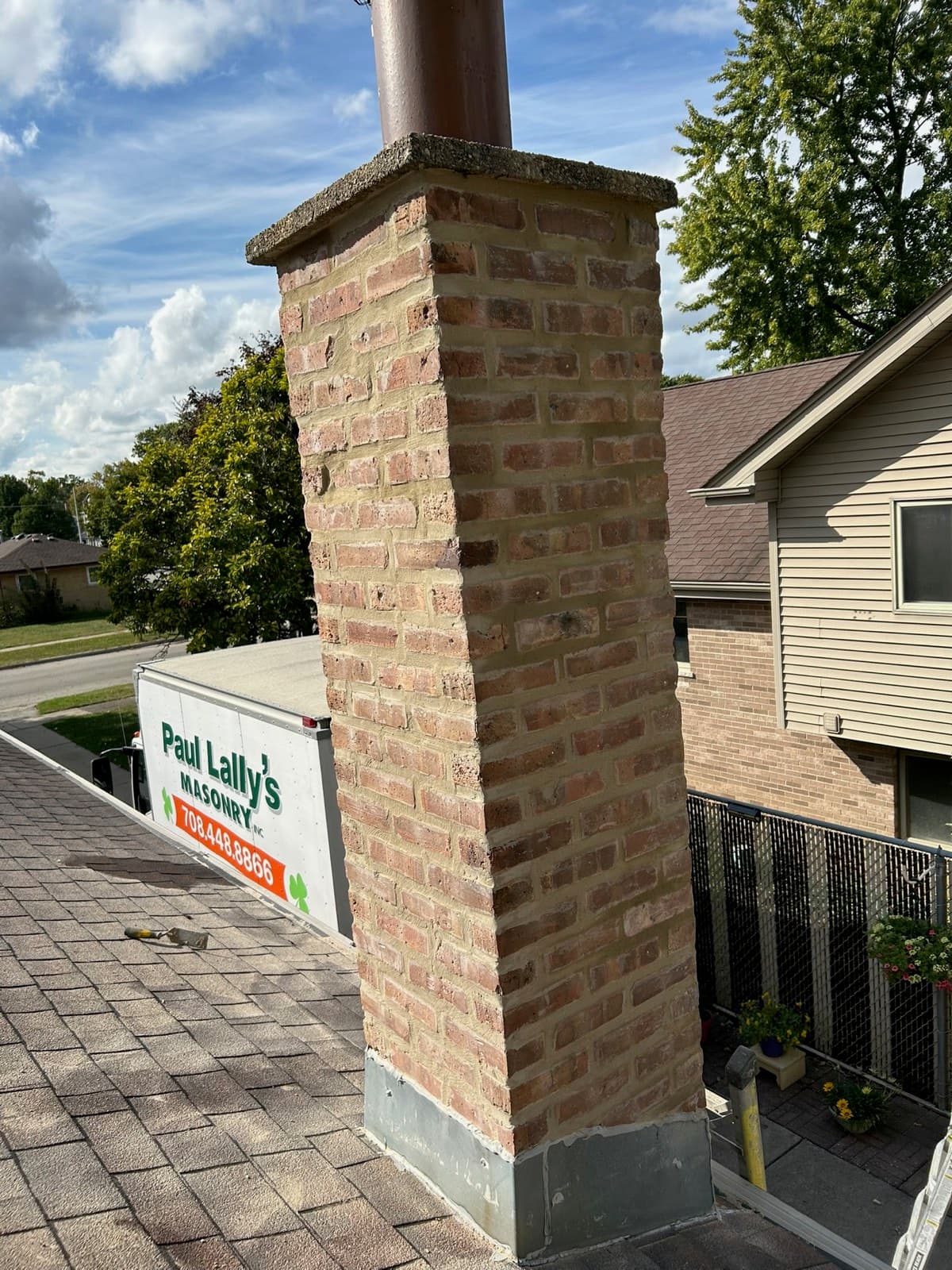
| Chimney crumbling, leaking, or missing a cap | Mason | Masonry, crown, flashing |
| Smoke backing up, draft problems, creosote | Chimney sweep | Flue and venting, not masonry |
| Wall bowing, leaning, or displaced | Structural engineer | Movement, not deterioration |
| Doors sticking + sloping floors + wall cracks | Structural engineer | Multiple movement signs |
| Water in the basement, walls sound | Waterproofing / drainage | Water management |
| Crumbling block at grade, wall plumb | Mason | Foundation masonry deterioration |
| Roof membrane leaking mid-field | Roofer | Roofing |
| Efflorescence on brick | Mason | Trace where water is moving through |
The five trades, and where each one actually stops
The mason
Ours: mortar joints, brick and block units, chimney masonry above the roofline, crowns and caps, parapets and coping, lintels, sills and stone, foundation masonry at grade, movement joints and sealant on masonry.
Where we stop: anything structural — a wall that's moving rather than wearing out. Anything inside a flue. Roofing membrane. Below-grade drainage systems. On a good day we tell you that before you've spent anything.
The chimney sweep
Theirs: what's happening inside the chimney. Cleaning, creosote removal, obstructions, liner condition, draft, and whether your appliances are venting safely.
Ours on the same chimney: the masonry itself — spalled brick, soft joints, a cracked crown, a missing cap, and the flashing where it meets the roof.
Practical version: if the problem is smoke, smell, draft, or safety, call a sweep. If it's crumbling, leaking, or leaning, call a mason. If you have an unused chimney after a furnace conversion, you probably want both opinions — see your furnace doesn't use the chimney anymore.
The structural engineer
Theirs: determining whether a building is performing safely, why movement is happening, and what the remedy should be. They produce a specification. They generally don't do the repair.
When to go here first: a wall that's bowing, bulging, or leaning; horizontal cracking; a crack where one side sits proud of the other; or exterior cracking paired with sticking doors, sloping floors, and fresh plaster cracks inside.
Why it matters: rebuilding a wall that's still moving produces a new wall that moves the same way. You've paid twice and still have the original problem. See mason or structural engineer.
The waterproofing / drainage contractor
Theirs: water management — grade, drainage, downspout discharge, below-grade systems, sump and interior drainage.
Where the confusion lives: on a brick building, water usually enters through failed mortar joints, a rusting lintel, a cracked chimney crown, or failed parapet coping — none of which a coating or a drain tile addresses. Sealing a wall with failing joints coats the leak path and slows the wall's ability to dry.
The honest sequence: repair the masonry water paths, fix the drainage, then consider sealing. See is masonry waterproofing worth it.
The roofer
Theirs: the roof covering — membrane, shingles, and the field of the roof.
Not theirs: the parapet wall standing above a flat roof. That's masonry. A roofer replaces what's on the deck; the wall above it isn't part of that job.
This causes more confusion than anything else on this page. If a top-floor ceiling stain survived a roof replacement, the roofer probably did their job correctly and the water is coming in above them. See parapet wall repair.
The overlaps, resolved
Chimney leak. Sweep checks the flue and venting; mason handles the crown, cap, brick, joints, and flashing. A leak is nearly always masonry.
Wet basement. If the walls are plumb and the masonry is crumbling — mason. If the masonry is sound and water is coming through the slab joint or under the footing — drainage. Frequently both, in that order.
Cracked brick. Deterioration and dormant settlement — mason. Active movement — engineer first, mason after.
Flat roof leak. Membrane field — roofer. Parapet, coping, or the flashing junction — mason. When it's the junction, the two trades should be talking.
Newly exposed party wall after a demolition next door — mason, and fairly promptly. See shared walls and party walls.
The handyman question
Worth addressing directly, because it comes up on every small job.
Masonry is unusually easy to do badly and have it look correct. A skimmed joint and a properly cut one are visually near-identical on the day the work finishes. The difference appears two or three winters later.
The two decisions that determine whether masonry lasts:
- Cutting joints to proper depth — roughly two to two and a half times the joint width, back to sound mortar. Skip it and the new mortar has nothing to bond to.
- Matching mortar hardness to the brick — mortar must be softer than the masonry beside it. On soft, century-old Chicago common brick, a hard modern bagged mix makes the brick face spall along every joint line. That damage is permanent.
Neither is visible once the work is cleaned down. See why masonry repairs fail and professional mason vs. handyman.
Reading a home inspection report
A general inspector's job is to document observable conditions and recommend specialist evaluation. So you get: "stepped cracking observed at the northwest elevation; recommend evaluation by a qualified masonry contractor."
That's appropriate and it's also not a diagnosis. It can't tell you whether the crack is dormant settlement from 1970 or a lintel actively pushing the wall apart — and those are wildly different jobs.
A specialist visit converts a condition into a cause, a scope, and a number. Sometimes that number is much smaller than the report implied. See what actually happens during a free masonry estimate.
Chicagoland specifics
A few local wrinkles that shift who you should call:
Two-flats, three-flats, and storefronts. Flat roofs, so parapets — and parapet leaks are the single most misattributed problem in the city, routinely blamed on roofers. See the two-flat owner's guide.
Greystones. Indiana limestone facades. Stone restoration is a specialised corner of masonry — consolidation, Dutchman repairs, matched lime mortar — and aggressive cleaning by a general contractor permanently destroys it.
Post-war suburbs. Brick veneer with a drainage cavity and weep holes. Leaks here are frequently flashing, blocked weeps, or corroded ties rather than the brick face — and a painter or caulker sealing the weep holes is a genuine, common cause of damage. See weep holes explained.
Century-old soft brick everywhere. Which is why "who does the work" matters more here than in a market of hard modern brick — the wrong trade with the wrong mortar does damage that can't be undone.
The question that sorts most of it
If you're unsure, ask whoever you call one thing:
"What do you think is causing this, and what part of it isn't your scope?"
A contractor who answers the second half specifically is one worth listening to on the first half. Anyone whose scope happens to cover exactly the whole problem, whatever the problem turns out to be, is describing a sales boundary rather than a trade.
Related services
Masonry scope covers tuckpointing and repointing, brick repair, brick replacement, chimney repair and rebuilds, lintel repair and replacement, parapet wall repair, limestone and sill repair, foundation masonry repair, caulking and joint sealant, masonry waterproofing, and residential, commercial, and historic masonry restoration.
The bottom line
Mason for mortar, brick, chimneys, lintels, parapets, and stone. Engineer for anything moving. Sweep for what's inside the flue. Roofer for the membrane, but not the wall above it. Drainage for water that isn't coming through the masonry.
And the single most useful correction on this page: if your ceiling stain outlived a new roof, that's a masonry call, and the roofer was probably right.
Paul Lally's Masonry Inc. is a family-owned, insured masonry contractor serving Chicago and the Chicagoland suburbs since 1988 — tuckpointing, brick repair and replacement, chimney repair and rebuilds, lintel replacement, masonry restoration, and waterproofing for residential and commercial properties. Built on Craftsmanship. Backed by Experience.
Tell us the symptom and we'll tell you whether it's ours — including when it isn't. Our family name is on every job.
Free on-site estimates — call (708) 448-8866 or request an estimate online.
Frequently Asked Questions
My ceiling is staining and I just replaced the roof. Who do I call?
A mason, and specifically one who will get on the roof. On a flat-roofed building the parapet wall standing above the roof deck is masonry, not roofing, so a new membrane doesn't touch it — and open coping joints up there are the most common source of ceiling stains that survive a roof replacement.
Do I need a chimney sweep or a mason?
A sweep for what's happening inside the flue — cleaning, creosote, obstructions, and whether appliances are venting safely. A mason for the masonry itself: the crown, the cap, spalled brick, soft joints, and the flashing where it meets the roof. Leaks and crumbling brick are masonry; draft and venting safety are the sweep's.
Is a bowing brick wall a job for a mason?
Not first. A wall that's bowing, leaning, or displaced across a crack is moving, and that needs a licensed structural engineer to determine the cause and specify the remedy before any masonry goes back. A mason who offers to rebuild a moving wall without that is selling you a repair that will reopen.
What's the difference between a waterproofing company and a mason?
Waterproofing contractors generally address water management — drainage, below-grade systems, coatings. Masons repair the masonry the water is getting through. On a brick wall, the water usually enters via failed mortar joints, a lintel, a chimney, or a parapet, so sealing without repairing those just coats the leak path.
Should I let a handyman do small masonry repairs?
It's risky in ways that aren't obvious until later. The two decisions that determine whether masonry work lasts — cutting joints to proper depth and matching mortar hardness to the brick — are the two most commonly gotten wrong, and on soft century-old Chicago brick a hard mix causes permanent damage.
My home inspector said 'recommend evaluation by a qualified masonry contractor.' What does that mean?
It means they documented a condition without diagnosing its cause, which is the appropriate limit of a general inspection. A mason's visit converts that into a cause, a scope, and a number — and occasionally into 'that's dormant, it needs repointing' rather than anything alarming.
Who handles the foundation — a mason or a foundation company?
It depends on whether the wall is deteriorating or moving. Crumbling mortar, spalling block, and failed parging on a wall that's still plumb is masonry work. Settlement, bowing, or a wall that needs underpinning or piering is structural, and that starts with an engineer.
Do I need a permit, and who sorts that out?
It depends on the municipality and the scope, and it's worth asking your contractor early. We'll tell you what we understand to apply to the work we're quoting, but permit requirements vary by village and by job, so confirm with your local building department rather than assume.
Can one contractor handle everything?
Rarely, and be cautious of anyone who claims to. Masonry, roofing, structural engineering, chimney sweeping, and waterproofing are genuinely different trades with different training — the useful thing is a contractor who tells you plainly where their scope ends rather than stretching to cover it.
Who does masonry work in the Chicago area?
Paul Lally's Masonry Inc. is a family-owned, insured masonry contractor serving Chicago and the Chicagoland suburbs since 1988 — tuckpointing, brick repair and replacement, chimney repair and rebuilds, lintel replacement, parapet wall repair, restoration, and waterproofing. Free on-site estimates at (708) 448-8866.