
Brick Replacement · Evergreen Park, IL
Brick Replacement in Evergreen Park, IL — Swapping Out Failed Brick So the Wall Reads as Original
Tuckpointing fixes the mortar. It does nothing for a brick whose face has already popped off. Paul Lally's Masonry cuts out failed brick in Evergreen Park and replaces it with units matched to the wall — since 1988.
Quick Answer
Brick replacement in Evergreen Park, IL is the removal of individual failed brick units — spalled, cracked, crumbling, or displaced — and the installation of matched replacement brick bedded in color-matched mortar. It is the repair tuckpointing cannot do, because tuckpointing only renews joints. Paul Lally's Masonry has replaced Chicagoland brick since 1988. Free on-site estimates: (708) 448-8866.
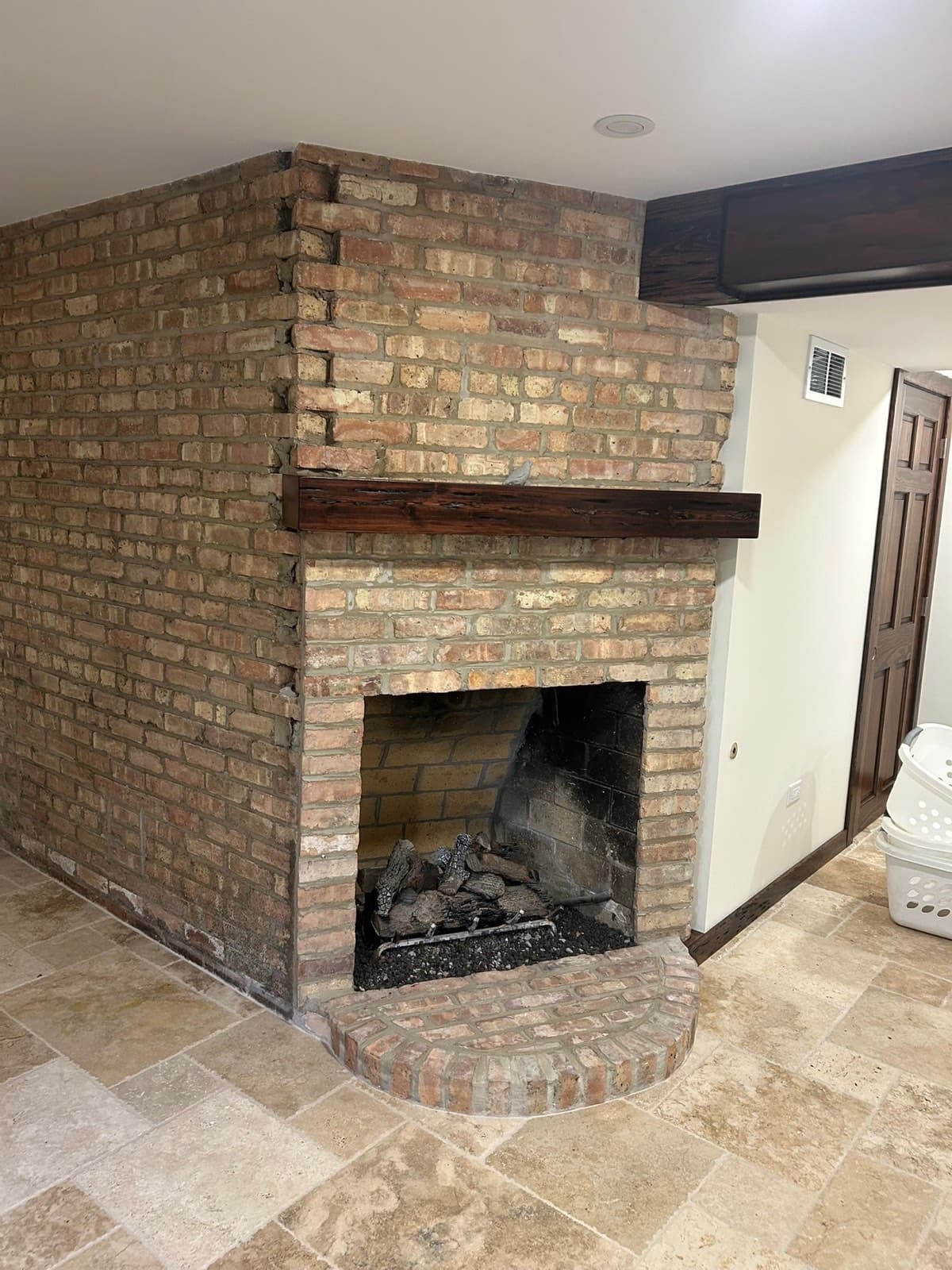
There's a patch on the south wall where the brick faces have simply come off — flat, shale-like flakes on the ground below, and the exposed brick behind them looks raw and porous, like the inside of a cracker. No amount of tuckpointing will fix that. Brick replacement in Evergreen Park, IL is the repair for brick units that have failed as units — cut out, replaced with matched brick, and pointed back into the wall. Paul Lally's Masonry has been doing this work in Evergreen Park and along the 87th Street corridor since 1988.
Brick replacement vs. tuckpointing — the distinction that decides your whole job
Almost everyone who calls about failing brick has already been told they need tuckpointing. Sometimes that's right. Often it's only half the job.
| | Tuckpointing / repointing | Brick replacement | |---|---|---| | What fails | The mortar joints between brick | The brick units themselves | | What you see | Receding, powdery, gapped, or missing mortar | Faces popped off, brick cracked through, crumbling, soft, displaced | | What the fix is | Grind out the joint, repack with matched mortar, tool the profile | Cut the unit out, set a matched brick, point around it | | What it does NOT fix | A brick whose face is already gone | Failing mortar in the surrounding wall |
The two repairs live side by side on most real jobs. A wall with twenty spalled brick and forty feet of failed joint needs both — the units swapped and the surrounding joints repointed — and the sequence matters, because you never point into a wall you're about to open up.
The rule of thumb: if the damage is in the gray, it's mortar. If the damage is in the red, it's brick.
What failed brick actually looks like in Evergreen Park
Evergreen Park is a solidly built village, and its brick reflects that — but everything on these blocks is now between sixty and a hundred years old, and that's the age at which brick starts telling you about the water it's been holding.
- Spalling brick — the hard, fired outer face of the brick has flaked, sheeted, or popped away, leaving a soft, sandy-looking interior exposed. The single most common failure we replace here.
- Cracked brick — a clean vertical or diagonal split through the unit, usually part of a larger pattern (a step crack, or a straight run of cracks above a window where a lintel is rusting).
- Crumbling / soft brick — a screwdriver corner digs in and powders it. The unit has lost its structural integrity and is now a sponge holding water against its neighbors.
- Displaced or loose brick — a unit sitting proud of the wall plane, or one you can rock by hand. Often the visible edge of a movement problem behind it.
- Efflorescence-heavy brick — chalky white salts bleeding through the face means water is moving through that unit continuously. Not itself a reason to replace, but it tells us where to look.
Why brick fails here: freeze-thaw plus a water source
The mechanism is the same on every one of these houses. Brick is porous by design. It absorbs some water and releases it. Trouble starts when it absorbs more than it can release — because a joint has opened, a gutter is dumping on the wall, a sill has lost its slope, or caulking at a window has gapped.
Then a Chicago winter arrives. Water inside the brick freezes, expands roughly nine percent, and pushes outward. The weakest point is the boundary between the brick's dense fired face and its softer core. After enough cycles, that face lets go. That's spalling, and it's why the damage is almost never random — it clusters below gutters, at grade level where snow piles against the wall, on the north and west elevations, and around every opening in the wall.
This is the part competitors' brick pages leave out, and it's the part that determines whether your repair lasts: replacing brick without correcting the water source means you'll be replacing brick again. On every Evergreen Park estimate we trace the water first — joints, sills, flashing, caulking, gutters, grade — and tell you what has to change alongside the masonry.
Matching brick in a village of Chicago common and mid-century face brick
Matching is where brick replacement is won or lost, and "we color match" isn't an answer. Here's how it actually works on Evergreen Park housing stock:
Chicago common brick (the softer, buff-to-salmon, irregular brick used on side and rear elevations, and throughout the older north end of the village near the Beverly and Morgan Park borders) is not in production in its original form. The honest match is reclaimed brick of the same era — salvaged from demolition, sorted for size and color range. It is softer than modern brick and must be bedded in a compatible, softer mortar. Putting hard modern mortar around soft common brick will destroy the brick around it inside a decade.
Mid-century face brick (the harder, uniform brick on the front elevations of Evergreen Park's ranches, Georgians, and Cape Cods) matches more easily. Current production offers close analogs; the variables are unit size, texture, and color range rather than availability.
On-house salvage is the highest-fidelity option and the one most contractors don't offer. Brick pulled from a hidden elevation — behind a garage, under a porch, from a closet chase — is a perfect match by definition, because it is your brick. We backfill the donor area with the closest commercial match where it won't be seen. On a prominent front elevation, this is often the right call.
Mortar matches on four variables, not one: hardness (must be softer than the brick), sand (color and grain size — this is where most of the visible color comes from), pigment, and joint profile (concave, weathered, raked — tooled to match what's already there).
How we replace brick
- Diagnose and mark. Every unit that needs to come out gets marked, and we confirm the count with you before anything is cut. No expanding scope mid-job.
- Source the match. Reclaimed, current-production, or on-house salvage — decided at the estimate, not on the fly.
- Cut the units out. The surrounding joints are cut and the failed brick removed without disturbing the sound brick around it. This is slow, careful work; it is the reason brick replacement costs what it costs.
- Clean the pocket. Old mortar cleaned back to a sound bed so the new unit sits at the correct depth and plane.
- Set the new brick. Bedded in matched mortar, aligned to the existing coursing, set flush to the wall plane.
- Point and tool. Joints packed and tooled to the same profile as the surrounding wall.
- Address the water. Repoint the surrounding failed joint, correct the sill, caulk the opening, flag the gutter — whatever put water in that wall.
- Clean down. The wall is cleaned so the repair reads as part of the building, not as a patch.
What drives the cost of brick replacement
No two walls price the same. The honest variables:
- Unit count — and, more importantly, whether they're scattered or concentrated.
- Height and access — ground-floor work versus staging a second-story elevation. Setup is real work.
- Match difficulty — an easily matched face brick versus sourcing and sorting reclaimed common brick.
- Extent of surrounding mortar failure — most brick replacement jobs carry repointing with them.
- Whether the wall has moved — a bowed or separated section is a rebuild, not a swap.
- Water-source corrections — sills, flashing, caulking, drainage.
We don't publish numbers, because a number without your wall in front of it is a guess. Paul Lally's Masonry gives you a free on-site estimate in writing, with the unit count and scope spelled out.
Timing and season
Mortar needs workable temperatures to cure properly. In Chicagoland that makes spring through fall the productive window for brick replacement, with late fall work scheduled around the forecast. If brick is actively dropping off a wall in December, that's a safety issue and gets handled — but planned replacement work is best scheduled in season, and the calendar fills from spring on.
Most scattered-unit jobs on a single elevation are measured in days, not weeks. Larger elevations, staging, and matched-brick sourcing extend that, and we'll tell you the realistic window before you sign anything.
Evergreen Park specifics
Evergreen Park is dense, well-kept, and almost entirely masonry — brick ranches and Georgians from the post-war boom, Cape Cods, brick two-flats and courtyard buildings toward the Chicago line, plus the commercial masonry along 95th Street and around the Little Company of Mary campus. Lots are tight, which means access and staging get planned rather than assumed. Village streets are heavily salted in winter, and de-icing salt at grade level is a genuine driver of low-course brick failure here — one of the reasons the bottom three or four courses so often go first.
We work the whole southwest corridor from here — Oak Lawn, Chicago Ridge, Hometown, Burbank, Worth, and Chicago's Beverly and Mount Greenwood neighborhoods just over the line. If your brick problem is bigger than a handful of units, our masonry restoration and brick wall rebuilding work is the same crew. If the mortar around the units is also failing, that's tuckpointing. If the brick above a window is cracking in a straight line, that's usually a lintel, not the brick. And once the wall is sound, masonry waterproofing keeps water out of it.
Nearby, we've done the same work in Oak Lawn and Worth.
Why Evergreen Park calls Paul Lally's
Paul Lally's Masonry Inc. is a family-owned, insured masonry contractor serving Chicago and the Chicagoland suburbs since 1988 — tuckpointing, brick repair and replacement, chimney repair and rebuilds, lintel replacement, masonry restoration, and waterproofing for residential and commercial properties. Built on Craftsmanship. Backed by Experience. Free on-site estimates — call (708) 448-8866.
Our name is on every job. That's not a marketing line — it's why we'll tell you when a wall needs twelve brick instead of forty, and why we'd rather explain the water source than sell you a second round of the same repair three years from now.
Get a free on-site estimate for brick replacement in Evergreen Park, IL. Call (708) 448-8866 or request an estimate.
Brick Replacement in Evergreen Park, IL — Frequently Asked Questions
What is brick replacement, and how is it different from tuckpointing?
Tuckpointing renews the mortar joints between brick; brick replacement removes and replaces the brick units themselves. If your mortar is crumbling but the brick is sound, you need tuckpointing. If the brick faces are popping off, cracked through, or crumbling, mortar work alone won't help — those units have to come out.
How do I know if my brick needs to be replaced instead of repointed?
Press a screwdriver against the brick face. Sound brick rings hard; failed brick crumbles, flakes, or leaves powder. Spalled brick with the hard outer face already gone, brick cracked cleanly through, brick that has shifted out of plane, and brick that is soft to the touch are all replacement candidates — not repointing candidates.
Can you match the brick on my Evergreen Park house?
Usually, yes. Evergreen Park's housing stock is largely mid-century face brick and Chicago common brick, and for both there is a real matching path — reclaimed brick of the same era, a current-production brick selected by size, texture, and color range, or salvage taken from a hidden elevation on your own house. We'll tell you honestly at the estimate how close a match is realistically achievable.
How much does brick replacement cost in Evergreen Park, IL?
It comes down to how many units are failing, whether they are scattered or concentrated, the height and access to the work, how hard the brick is to match, and whether the surrounding mortar also needs repointing. Twenty scattered face-brick swaps on a ground-floor elevation is a different job than a failing section above a second-story window. Paul Lally's Masonry provides a free on-site estimate in writing.
At what point does brick replacement become a wall rebuild?
When the failed units are concentrated rather than scattered. Individual replacements work when the surrounding wall is holding the new units in place. Once a large contiguous area has failed — or the wall has lost its plane, bowed, or separated — cutting out one brick at a time no longer works, and that section gets taken down and relaid. We'll show you which situation you have.
Why is my brick spalling in the first place?
Water got into the brick and froze. Chicago-area brick absorbs moisture through failed joints, bad caulking, missing flashing, or a leaking gutter, and when that water freezes it expands and pushes the hard outer face off the brick. Spalling is almost always a water-management symptom, which is why replacing brick without fixing the water source just resets the clock.
Do you have to replace the whole wall if a few bricks failed?
No — scattered failures are cut out and replaced individually, and done properly the repair should be hard to find. Whole-wall work is only warranted when the failure is widespread or the wall itself has moved. We don't sell a rebuild where a replacement will hold.
Will the new brick look different from the rest of my house?
New brick is dimensionally consistent and unweathered, so on a wall that has been exposed for sixty-plus years there is often a slight tonal difference at first that closes as the replacement weathers. Matching size and texture matters more than matching color exactly — a size mismatch never blends, while a modest color difference usually does.
Brick Replacement in Nearby Areas
Other Masonry Services in Evergreen Park, IL
Learn more about our brick replacement services across Chicagoland, or view all service areas.
Free on-site estimates across Chicagoland.