
Brick Replacement · Hinsdale, IL
Brick Replacement in Hinsdale, IL — Matching a Hundred Years of Weather
Anyone can take a bad brick out. The craft is putting one back that nobody notices — on a wall that has been weathering since before the First World War.
Quick Answer
Brick replacement in Hinsdale, IL is the cutting out and replacing of spalled, cracked or loose brick units with matched brick, toothed into the surrounding wall and repointed with matched mortar. Paul Lally's Masonry has matched and replaced Chicagoland brick since 1988 — family-owned, insured, free on-site estimates, (708) 448-8866.
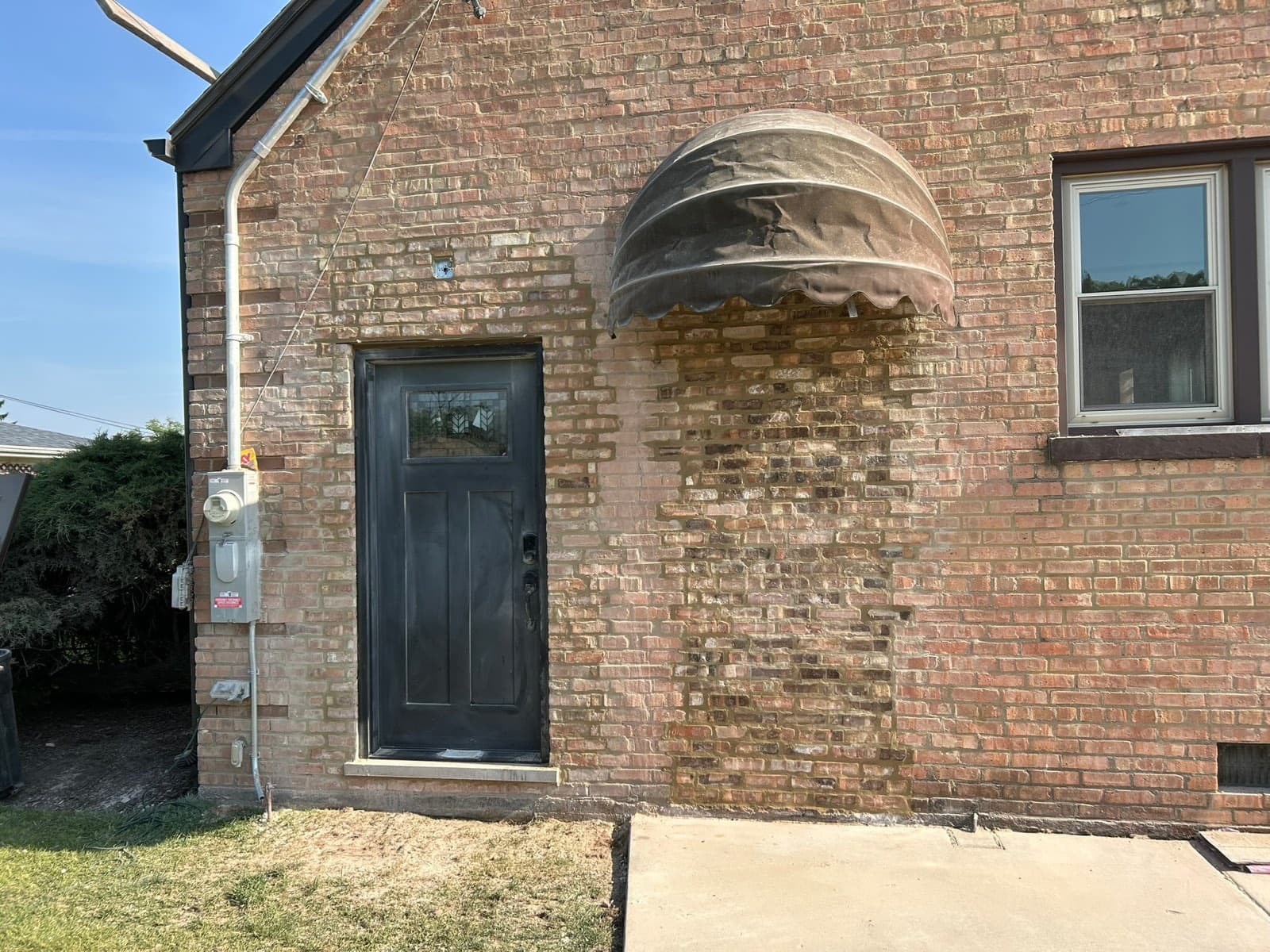
Taking a bad brick out of a wall is not difficult.
Putting one back that nobody notices — in a wall that has been weathering since before the First World War, in a mortar that was mixed by hand on site, in a colour that has been altered by a century of Chicagoland winters — is the entire craft.
Brick replacement in Hinsdale, IL is a matching problem before it is a masonry problem.
Paul Lally's Masonry Inc. is a family-owned, insured masonry contractor serving Chicago and the Chicagoland suburbs since 1988 — tuckpointing, brick repair and replacement, chimney repair and rebuilds, lintel replacement, masonry restoration, and waterproofing for residential and commercial properties. Built on Craftsmanship. Backed by Experience. Free on-site estimates — call (708) 448-8866.
When a brick has to come out
Not every damaged brick needs replacing. These do.
Spalled through the face. The hard outer skin has popped off and the soft interior is exposed and absorbing water. Once that skin is gone it does not come back, and the unit deteriorates quickly from there.
Cracked through the unit. A crack running the depth of the brick, particularly where it lines up with neighbours — that pattern usually points to movement or to a lintel below.
Loose or displaced. The bond has failed. On an upper elevation over a walkway, this is not a maintenance item.
Severely eroded or sugared from long weathering or, frequently, from having been sandblasted at some point in its life.
Burned or fire-damaged units after a chimney or structure fire.
Our guide to brick repair versus replacement covers where the line falls.
The matching problem, honestly
This is where expectations should be set before work starts rather than after.
Size first. Brick dimensions changed over the decades — a standard modern unit is not the same as Chicago common brick from the 1910s or the oversize units used in mid-century construction. A unit that is a shade off in colour but correct in size disappears. One that is perfect in colour but wrong in size never will, because the coursing gives it away.
Then texture. Wire-cut, sand-struck, tumbled, pressed — the surface catches light differently, and that reads from across the street.
Then colour. And colour is the one that cannot be fully solved, because what you are matching is not a brick — it is a brick plus a hundred years of weather, soot and freeze-thaw. A new unit will read newer for some time. It weathers in.
Three sourcing routes:
| Source | Best for | |---|---| | Salvaged brick from reclaimers | Older and historic walls; closest colour and size match | | Current production matched by size and texture | Newer veneer and mid-century stock | | Harvested from your own house | The strongest match — take units from a hidden elevation and put new brick there |
That third one is frequently the right answer on a prominent Hinsdale elevation, and it is the option most contractors never raise. Our post on why repairs look different goes further.
Hinsdale, specifically
Hinsdale has one of the more demanding building stocks in DuPage for this work, because it spans so much.
The historic district and the older streets around Robbins Park and the downtown. Late-nineteenth and early-twentieth-century homes with soft, hand-made brick in lime-rich mortar, and architecture where the wall itself is the finish. Matching here is exacting, historic review may apply, and the mortar rule is absolute: softer than the brick around it, because mortar harder than the unit drives stress into the unit and spalls its face.
The mid-century stock through the neighbourhoods east and south, where the brick is harder and more uniform and the matching problem is mostly about size and texture.
Teardown replacement construction, where brick and stone veneer over frame is the assembly and a "brick problem" is often really a flashing, weep hole or shelf angle problem behind the veneer.
Wooded lots and mature canopy across much of the village mean shaded north and east elevations that dry slowly — which is why those walls almost always show more spalling than the sunny side of the same house.
Fix the water first, or do it twice
Brick spalls because water got into it and froze. So replacing a spalled unit without finding the water source is a repair on a timer.
The usual sources, in order:
- Open or eroded mortar joints letting water into the wall
- A failed sill above the damage that has stopped shedding water
- A corroding lintel driving cracks that admit water
- Coping or a chimney crown feeding the top of the wall
- Gutter and downspout discharge hitting the same corner every storm
- Grade and splash at the bottom courses, with road salt in winter
We look at all six before quoting units. Our post on what causes brick to spall walks the mechanism.
How the work is done
- Assess the elevation, not just the visible damage — and identify the water source.
- Cut out the failed units carefully, without chipping the neighbours. This is slow work and it is where damage gets done by people in a hurry.
- Tooth the opening so the new brick interlocks with existing coursing instead of sitting in a straight-edged patch.
- Set the matched units in mortar matched in type, colour, sand and joint profile.
- Point and tool to the existing profile.
- Address the water source — sill, lintel, joints, coping, drainage.
- Clean down gently. No sandblasting, no high-pressure washing; both strip the fired skin from brick and cause the next generation of spalling. See power washing and sandblasting brick.
What drives the cost
Number of units and how scattered they are across the wall — twenty units in one area is a different job from twenty spread across three elevations. Height and access. Whether matching brick can be sourced, salvaged or harvested. How much repointing goes with it. Whether a sill, lintel or coping has to be addressed as part of the same repair. Whether historic requirements apply. Weather windows, since mortar needs workable temperatures to cure.
Free on-site estimate, in writing — call (708) 448-8866.
Serving Hinsdale and the surrounding DuPage suburbs
We work throughout Hinsdale and the communities around it — Clarendon Hills, Western Springs, Burr Ridge, Willowbrook, Downers Grove and La Grange. Related services: brick replacement, brick repair, tuckpointing and repointing, limestone and sill repair, and masonry restoration.
Get the match right the first time
Family-owned since 1988, insured, and our name is on every job.
Get a free on-site estimate — or call (708) 448-8866. Built on Craftsmanship. Backed by Experience.
Brick Replacement in Hinsdale, IL — Frequently Asked Questions
How much does brick replacement cost in Hinsdale, IL?
It depends on the number of units, how scattered they are across the elevation, height and access, whether matching brick can be sourced or salvaged, and how much repointing goes with it. Paul Lally's Masonry provides a free on-site estimate in writing.
Can you match brick on a hundred-year-old house?
Closely, in most cases, but never perfectly on day one. A century of Chicagoland weather, coal smoke and freeze-thaw changes a wall in ways no new unit reproduces, so a good match is judged at normal viewing distance rather than at arm's length.
Where does matching brick come from?
Three sources: salvaged brick from reclaimers, current production that is close in size, colour and texture, and — often the best option — brick harvested from a less visible elevation of your own house, with the new units placed where they will not be seen.
Do you have to replace a whole section or just the bad bricks?
Individual units can be cut out and replaced where the surrounding wall is sound. Where units are loose over a large area, the bond has failed, or the wall has moved, rebuilding a section is the sounder repair and usually the cheaper one over time.
Why is my brick spalling in the first place?
Water in the brick freezing. Water gets in through open joints, a failed sill or coping, or a saturated wall, then expands as it freezes and pushes the face off. Replacing the brick without fixing the water source means doing it again.
Should the wall be repointed at the same time?
Usually, at least locally. New units set into old joints look like an island unless the surrounding mortar is addressed, and if the joints are failing anyway the access is already there — doing both at once costs less than doing them separately.
What is toothing?
Cutting the replacement area so the new brick interlocks with the existing coursing rather than sitting in a straight-edged patch. It is what makes a repair read as part of the wall and what keeps the new work structurally tied into the old.
Do historic district rules apply in Hinsdale?
They can, depending on the property and its location. Historic review commonly covers brick and mortar matching, joint profile and cleaning method — all things a proper repair would do anyway. We confirm requirements before work begins rather than after.
Brick Replacement in Nearby Areas
Other Masonry Services in Hinsdale, IL
Learn more about our brick replacement services across Chicagoland, or view all service areas.
Free on-site estimates across Chicagoland.