
Brick Replacement · Downers Grove, IL
Brick Replacement in Downers Grove, IL — When a Brick Can't Be Saved
Spalled brick cannot be repaired — the hard fired face is gone and it does not grow back. What decides whether a replacement job looks right ten years later isn't finding a perfect brick. It's how many come out, where the new ones go, and what the mortar around them is doing.
Quick Answer
Paul Lally's Masonry Inc. provides brick replacement in Downers Grove, IL — cutting out spalled, cracked and debonded brick, matching replacement units for size, colour and texture, and blending them through the surrounding wall so the repair reads as masonry rather than a patch. Family-owned since 1988, insured. Free estimates — call (708) 448-8866.
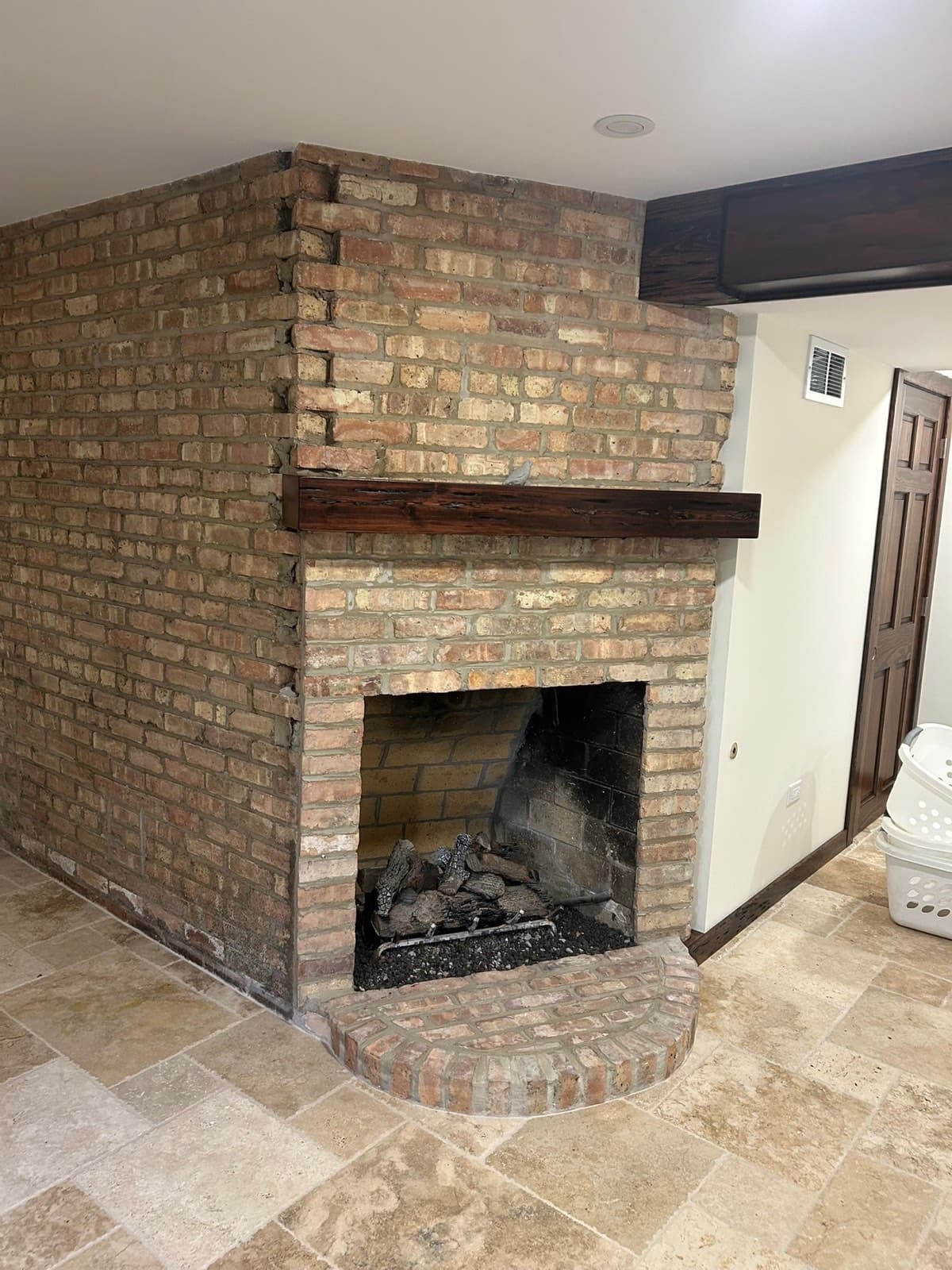
Brick Replacement in Downers Grove, IL
Brick replacement in Downers Grove, IL becomes the answer at one specific moment: when the fired face is gone. Paul Lally's Masonry Inc. cuts out and replaces failed brick on homes and commercial buildings throughout DuPage County. Family-owned since 1988, insured, free on-site estimates. Call (708) 448-8866.
Up to that moment, most brick problems are repairable. After it, they are not — and understanding where that line sits saves homeowners a great deal of money in both directions.
The Line Between Repair and Replace
A brick is not uniform material. It has a hard, dense, fired outer face — the skin that formed in the kiln — and a softer, more absorptive core behind it. That face is what makes brick weather-resistant.
When brick spalls, that face flakes, sheets or crumbles away and the soft core is exposed. It cannot be patched back on. Face a spalled brick with mortar or a repair compound and you have covered a sponge with something harder than itself, which traps water behind the patch and takes more brick off next winter.
Spalled brick gets replaced. That is the whole rule.
Alongside spalling, these also get replaced rather than repaired:
- Units cracked all the way through
- Units that have lost bond — they move, or sound hollow when tapped
- Units displaced out of plane from movement or rust jacking
- Badly impact-damaged brick at corners, stoops and drive edges
And these do not need replacement — they need tuckpointing:
- Eroded, receding or missing mortar joints with sound brick faces
- Hairline surface crazing with no material loss
- Staining, efflorescence or discolouration on otherwise intact brick
Why Downers Grove Makes Matching Interesting
Downers Grove has an unusually wide span of building eras for one village, and brick matching is entirely an era problem.
The older core near the downtown and the historic districts runs back into the nineteenth century — soft, hand-made and early machine-made brick, irregular in size and colour, laid in lime-rich mortar. Here the goal is almost always salvage: reclaimed period brick from the same era matches in a way modern production cannot, and taking sound units from a hidden elevation to patch a visible one is often the best available answer.
The post-war stock — ranches, split-levels, Georgians and Cape Cods through the 1950s and 60s — used denser machine-made brick in identifiable colour ranges. Close matches usually exist.
The modern veneer on later subdivision and infill construction was specified in named colour blends, many now discontinued. Matching means finding the nearest current run and blending carefully.
In every case, matching is less about the brick than about the placement.
The Thing That Actually Makes a Repair Invisible
Homeowners assume a good repair means finding a perfect brick. It rarely does, and that is not what the eye reads anyway.
What the eye reads is:
- Blending. Replacements scattered through the surrounding field rather than concentrated in one rectangle. A solid block of slightly-off brick shouts; the same brick dispersed disappears.
- Mortar colour, matched against cured mortar rather than the wet mix, because it lightens considerably as it dries.
- Joint profile. Concave, weathered, flush, raked — matched to the surrounding wall. Profile is most of what makes new work read as original.
- Coursing and bond, held exactly, so nothing shifts a fraction of an inch out of line.
Get those four right with an imperfect brick and it reads as wall. Get them wrong with a perfect brick and it reads as a patch forever.
Signs You Need Brick Replacement
- Faces flaking, sheeting or crumbling — spalling, most often near grade
- A band of damage at the splash line, where roof runoff bounces off drives and walks
- Cracked-through units, or bricks you can move by hand
- Brick that sounds hollow when tapped
- Units pushed out of plane, or a wall that bulges when you sight along it
- A horizontal crack line with rust staining above a window or garage door — corroding lintel steel
- Stepped diagonal cracking, which means movement rather than weather
- Deteriorated brick around a chimney or chase
Risks of Waiting
A spalled brick is an open door. Having lost its hardest layer, it absorbs water faster than the sound brick around it, and each Chicagoland freeze-thaw cycle takes a little more — first from that unit, then from its neighbours. Damage spreads outward, which is why a handful of failed brick becomes a section.
Water passing through open faces also reaches the steel and the framing behind the wall. And the cost curve is steep in a particular way: unit replacement is straightforward, but once a section has lost bond it becomes a rebuild, and a rebuild on an upper elevation brings staging that dwarfs the masonry itself.
Our Process
- Diagnose the cause — weather and salt, impact, corroding steel, or structural movement. Four different jobs.
- Sound the surrounding wall by tapping to find every unit that has actually failed, not just the visible ones.
- Source the match — size, colour range, texture and face treatment, checked against the wall in daylight.
- Cut out the failed units by removing surrounding mortar and drawing the brick out without disturbing the courses above.
- Correct what caused it — replace corroding steel, clear blocked weep holes, fix a downspout, address grade.
- Set the replacements in matched mortar, keyed to existing coursing and bond.
- Blend, don't block — scatter new units through the field wherever the damage pattern allows.
- Repoint the transition so old and new joints tool and cure alike.
- Clean down and walk the finished wall with you.
Materials
Type N covers most Downers Grove veneer and post-war brick. Softer, lime-rich mixes belong on the older stock near the village core, where a hard Portland mortar would push stress into century-old brick faces and spall them. The mortar always has to be softer than the brick it sits against — mortar is the sacrificial part.
Salvaged and reclaimed brick is used wherever it serves the match better than new material, particularly on pre-1930 work.
Related services: brick repair, tuckpointing and repointing, lintel replacement, limestone and sill repair, and residential masonry restoration.
What Drives the Cost
- How many units come out once the wall is properly sounded
- Match difficulty, and whether salvaged material has to be sourced
- Height and access — a stoop is not a third-floor gable
- Whether the underlying cause has to be corrected as part of the work
- Section rebuilding versus scattered replacement
- Site conditions — landscaping, tight side yards, neighbour protection
We do not quote brick work over the phone. The look is free and the estimate is written.
Serving Downers Grove and DuPage County
Paul Lally's Masonry Inc. is a family-owned, insured masonry contractor serving Chicago and the Chicagoland suburbs since 1988 — tuckpointing, brick repair and replacement, chimney repair and rebuilds, lintel replacement, masonry restoration, and waterproofing for residential and commercial properties. Built on Craftsmanship. Backed by Experience. Free on-site estimates — call (708) 448-8866.
We work throughout Downers Grove and neighbouring Westmont, Lisle, Darien and Clarendon Hills.
Get a Free Downers Grove Brick Replacement Estimate
If brick faces are flaking off your walls, have them looked at before the damage takes the units around them. Call (708) 448-8866 or request a free estimate.
Brick Replacement in Downers Grove, IL — Frequently Asked Questions
How much does brick replacement cost in Downers Grove, IL?
It comes down to how many units actually have to come out once the wall is sounded, how difficult the brick is to match, how high the work is, and whether the cause — corroding steel, drainage, movement — has to be corrected as part of the job. Paul Lally's Masonry Inc. gives free on-site estimates in Downers Grove — call (708) 448-8866.
When does brick need replacing instead of repairing?
When the fired face is gone. A spalled or flaked brick has lost the hard outer skin that made it weather-resistant, and nothing puts that back — the softer core behind it will just absorb more water. Cracked-through units and bricks that have lost their bond also get replaced rather than patched.
Can you match the brick on my Downers Grove house?
Usually very closely. Downers Grove spans everything from nineteenth-century homes near the village core to post-war ranches and modern veneer, so the answer depends on the era — but between current production, salvaged stock and careful blending, we can generally get a repair that reads as wall rather than patch.
Will the new brick look different from the old?
Somewhat, at first, and any mason who promises otherwise is overselling. New brick has not weathered for fifty years. What makes a repair disappear is blending replacements through the surrounding field instead of setting them in one block, plus matching the mortar colour and the tooled joint profile exactly. It evens out over time.
How many bricks will actually need to come out?
Usually more than what looks damaged from the ground. We sound the surrounding area by tapping, which finds units that have lost bond or gone hollow behind a face that still looks acceptable. Those come out too, and an estimate that skips this step will grow once work starts.
My brick is cracked in a line above the garage door. Is that a replacement job?
Partly, but the crack is a symptom. A horizontal crack line above an opening, especially with rust staining, means the steel lintel behind the wall is corroding and expanding. The steel has to be dealt with or the new brick will crack in the same line.
Do you work throughout Downers Grove and DuPage County?
Yes. Paul Lally's Masonry Inc. serves Downers Grove and the surrounding DuPage and Cook County suburbs, residential and commercial, and has since 1988. Free on-site estimates — call (708) 448-8866.
Brick Replacement in Nearby Areas
Other Masonry Services in Downers Grove, IL
Learn more about our brick replacement services across Chicagoland, or view all service areas.
Free on-site estimates across Chicagoland.