
Limestone / Sill Repair · Tinley Park, IL
Limestone & Sill Repair in Tinley Park, IL — The Stone That Decides What Happens Below It
A window sill is the one piece of masonry on your house whose entire job is to get wet and throw the water clear. When it stops doing that, the brick underneath starts paying for it.
Quick Answer
Paul Lally's Masonry Inc. provides limestone and sill repair in Tinley Park, IL — restoring cracked, spalled and eroded stone sills, bands, lintels and trim so they shed water again, using Dutchman repairs, matched stone and soft compatible mortar. Family-owned since 1988, insured. Free on-site estimates — call (708) 448-8866.
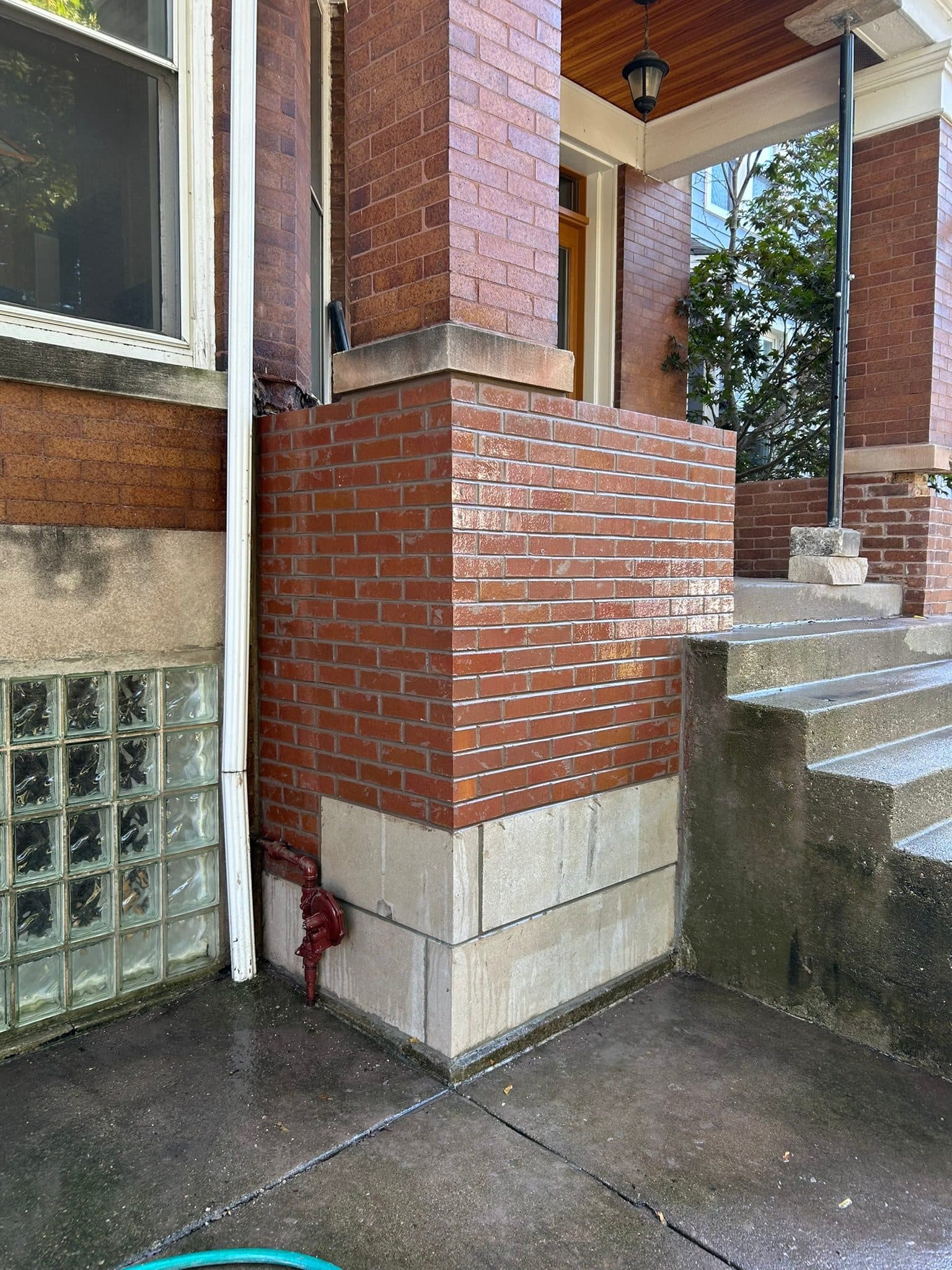
Limestone and sill repair in Tinley Park, IL
There is one piece of masonry on your house whose entire job is to get wet. A window sill is supposed to take the water running down the glass, carry it out past the face of the wall, and drop it clear of the brick beneath. Paul Lally's Masonry Inc. provides limestone and sill repair in Tinley Park, IL — restoring cracked, spalled, and eroded stone sills, bands, lintels, and trim so they shed water again. Family-owned, serving Chicagoland since 1988, insured. Free on-site estimate: (708) 448-8866.
When a sill stops doing that job, the water does not disappear. It runs back underneath the stone and down the wall — which is why the brick under your windows is so often the worst brick on the elevation while the sill above still looks passable.
The two details that make a sill work
The wash. The top surface is sloped outward so water runs off rather than sitting. Decades of weathering flattens that slope, and a flat sill ponds water. Standing water on limestone in a freeze-thaw climate is how stone comes apart.
The drip edge. On the underside of the sill's projecting nose there is a small groove. Water running along the bottom of the stone reaches that groove and drops off. Without it, surface tension pulls the water back along the underside, into the joint, and down the wall face.
Lose either one and the sill has stopped being a sill. It is a decorative stone with a water problem behind it.
What goes wrong with limestone
The stone loses its skin
Limestone weathers to a hardened outer surface that protects the softer body beneath. Strip that skin and the stone absorbs water at a much higher rate from then on. Sandblasting and high-pressure washing strip it permanently — the most damaging thing routinely done to Chicagoland stone, usually with good intentions.
Sugaring and delamination
Once water is working into the body of the stone, the surface breaks down into a loose, sandy texture, or begins separating in sheets along its bedding planes. Both mean the stone is losing material, and both accelerate.
Cracking through
Stone cracks from settlement, from rust jacking where embedded or adjacent steel is corroding, from impact, and from freeze-thaw in a saturated stone. A crack through the sill lets water into the middle of the stone and into the wall.
Hard mortar and caulk
Repointing stone joints with hard modern mortar forces movement into the stone rather than the joint. Slathering caulk over a cracked sill seals water inside it. Both are common, both make it worse.
Salt
De-icing salt reaches sills at porches, stoops, and low openings. Salts crystallize inside the pores and push the stone apart from within.
How we repair stone sills
- Assess every stone on the elevation — sills, bands, lintels, and caps usually fail together because they weather together.
- Find out why. A sill that failed under a leaking gutter or beside a rusting lintel will fail again unless that is corrected.
- Choose the right repair for each stone — repair in place (reform the wash, re-cut the drip edge, repoint in soft mortar), a Dutchman patch let into a sound stone with localized damage, or replacement where the stone is cracked through or has lost bearing.
- Match the stone — colour, grain, and finish, sourced to match the existing.
- Point in soft, compatible mortar — never a mix harder than the stone.
- Restore the water path — correct slope on the wash, a real drip edge underneath, joints that shed rather than hold.
- Repair the brick below where the failed sill has already taken it.
- Clean gently, seal breathable — the mildest effective cleaning, and a penetrating repellent only after repairs have cured.
Why Tinley Park has so much of this work
Tinley Park spans an unusually wide build range for one village. The historic downtown around Oak Park Avenue and the Metra stations carries late-1800s and early-1900s brick commercial buildings and older homes with real dressed stone — sills, watertable courses, lintels, and entry surrounds. The postwar and 1960s–80s residential neighbourhoods brought brick ranches, split-levels and Georgians with limestone sills and banding as standard trim. And the newer subdivisions toward 80th Avenue and the I-80 corridor use cast stone and stone veneer detailing.
All three have stone doing the same job, and all three sit in Cook County's freeze-thaw cycling — dozens of freeze and thaw events every winter, working hardest on the wettest, most exposed stone on the building.
Add old gutters overflowing onto the same sill for decades, salt at the porches, and a few well-meant pressure washings, and you get the village's characteristic pattern: sound-looking brick walls with quietly failing stone details, and damaged brick directly beneath them.
What drives the cost of limestone and sill repair
How many stones are affected across the house · repair method per stone — in-place repair, Dutchman, or full replacement · match difficulty for colour, grain, and profile · height and access, from a first-floor sill to an upper story needing staging · brick damage below that must be repaired at the same time · underlying causes such as gutters, lintels, or flashing needing correction · how gentle the cleaning has to be · season and curing conditions. We look at every stone before pricing it, and the estimate is free.
Paul Lally's Masonry Inc. is a family-owned, insured masonry contractor serving Chicago and the Chicagoland suburbs since 1988 — tuckpointing, brick repair and replacement, chimney repair and rebuilds, lintel replacement, masonry restoration, and waterproofing for residential and commercial properties. Built on Craftsmanship. Backed by Experience. Free on-site estimates — call (708) 448-8866.
Serving Tinley Park and the surrounding suburbs
We restore stone throughout Tinley Park's 60477 and 60487 — the historic downtown blocks near Oak Park Avenue, the postwar residential streets, and the newer neighbourhoods toward 80th Avenue — and across the neighbouring Cook and Will County suburbs. Stone repair here usually runs alongside tuckpointing in Tinley Park, brick repair in Tinley Park, lintel replacement in Tinley Park, and masonry restoration in Tinley Park. We do the same work in Orland Park, Oak Forest, Mokena, and Frankfort.
Why Tinley Park homeowners call Paul Lally's Masonry Inc.
We repair stone rather than replacing it whenever the stone will take a repair, we restore the wash and the drip edge so the sill works again, and we point in mortar the stone can live with. We never blast, never bury a cracked sill in caulk, and never seal a wall we have not repaired. Family-owned since 1988, insured, and the family name is on every job. Built on Craftsmanship. Backed by Experience.
Sills cracking, sugaring, or dropping water onto the brick below? Request a free on-site estimate or call (708) 448-8866.
Limestone / Sill Repair in Tinley Park, IL — Frequently Asked Questions
How much does limestone sill repair cost in Tinley Park, IL?
It depends how many sills are affected, whether each can be repaired in place or needs a Dutchman patch or full replacement, how hard the stone is to match, the height and access, and whether the brick beneath has already been damaged. Paul Lally's Masonry Inc. gives free on-site estimates — call (708) 448-8866.
Why does the brick right under my window look damaged?
Almost always because the sill above stopped throwing water clear. When a sill loses its slope or its drip edge wears away, water runs back underneath the stone and down the wall, and the brick directly below takes the freeze-thaw damage.
Can a cracked limestone sill be repaired, or does it need replacing?
Many can be repaired. A sound stone with localized failure takes a Dutchman — a cut piece of matching stone let into the damaged area with tight joints. A sill cracked through, badly delaminating, or that has lost its bearing usually needs replacing.
What is sugaring on limestone?
It is the surface breaking down into a loose, granular texture that rubs off like sand. It means the stone's weathered outer skin is gone and water is now working directly into the body of the stone, which accelerates from there.
Should I seal my limestone sills?
Only with a breathable penetrating repellent, and only after repairs. A film-forming or glossy sealer traps moisture inside the stone, and trapped moisture is exactly what spalls and delaminates limestone in a freeze-thaw climate.
Can I just caulk the crack in my sill?
Caulk over a cracked sill is one of the most common bad repairs we find. It hides the problem, holds water in the stone, and often makes the deterioration worse — a cracked sill needs the stone repaired, not the crack covered.
Does power washing damage limestone?
Yes, and it cannot be undone. High-pressure washing and sandblasting strip the weathered outer skin off limestone, opening the surface so it absorbs far more water than before. Stone should be cleaned with the gentlest effective method.
Do you repair stone bands and porch caps too?
Yes — sills, watertable and belt courses, stone lintels, porch caps, steps, and cast stone trim. On many Tinley Park homes these are the same stone failing for the same reason, so they are usually assessed together.
Limestone / Sill Repair in Nearby Areas
Other Masonry Services in Tinley Park, IL
Learn more about our limestone / sill repair services across Chicagoland, or view all service areas.
Free on-site estimates across Chicagoland.