
Limestone / Sill Repair · Chicago, IL
Limestone & Sill Repair in Chicago, IL — Greystone Stone, Saved Not Replaced
A greystone facade is Indiana limestone that's been on the building for a century. Once a piece is gone it can only be approximated — which is why the whole craft is saving what's there.
Quick Answer
Limestone and sill repair in Chicago, IL is the restoration of Indiana limestone sills, lintels, water tables, steps, and carved trim on greystones and older masonry — using patching, Dutchman repairs, and matched replacement stone set in soft lime-based mortar. Paul Lally's Masonry has restored Chicago stone since 1988. Free estimates: (708) 448-8866.
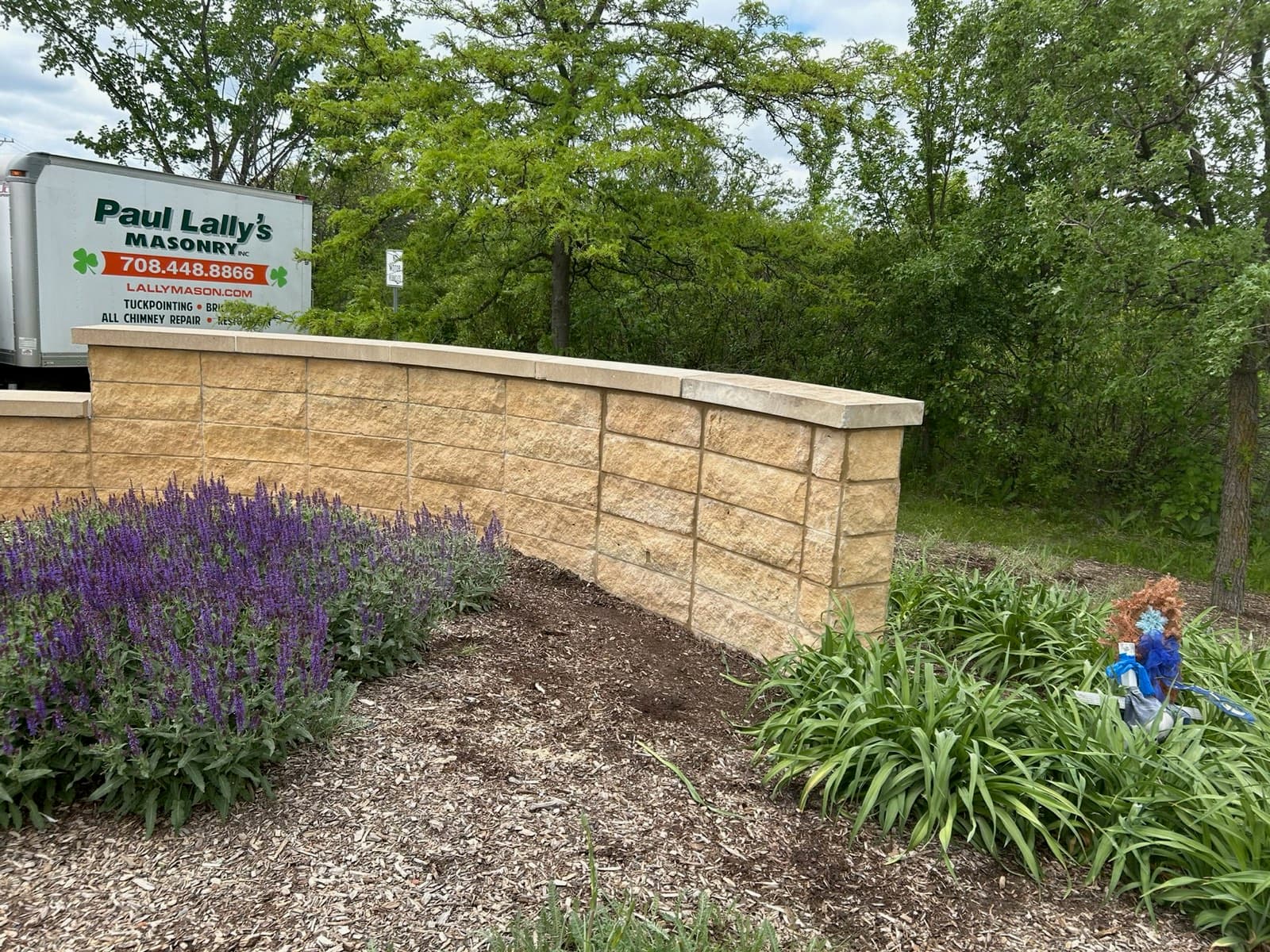
There are roughly thirty thousand greystones still standing in Chicago, and the thing that makes them greystones is a facade of Indiana limestone — Salem limestone, quarried around Bedford, whose grey-buff color gave the building type its name. Most went up between about 1890 and 1915.
That stone has been on the building for a century or more. Limestone and sill repair in Chicago, IL is almost entirely about saving it, because once a piece is genuinely gone, everything after is an approximation. Paul Lally's Masonry has been repairing Chicago limestone since 1988.
Limestone is not brick, and the repair isn't either
This matters more than most homeowners expect. Different material, different failure modes, different mortar, different vocabulary.
It's porous. Limestone absorbs water far more readily than fired brick.
It's bedded. The stone formed in layers, and those bedding planes are lines of weakness. So when absorbed water freezes and expands — or when de-icing salt crystallizes inside the pores as it dries — the stone splits along those layers. That's why failing limestone comes away in flat sheets and plates rather than crumbling evenly. The word for it is delamination, and it's the signature limestone failure in this climate.
It's soft. Softer than most brick, and dramatically softer than modern mortar. Which sets up the single most damaging thing done to Chicago stone.
The mistake that has cost this city the most stone
Mortar must always be softer, and more vapor-permeable, than the stone it sits against.
Mortar is the sacrificial element. It should yield first, absorbing thermal movement and moisture cycling, because a joint is straightforward to replace. That's the design.
Pack a modern, Portland-rich mortar against soft limestone and the physics invert. The joint is now harder than the stone, so the stone becomes what gets sacrificed — spalling and crumbling at the joint edges, a little more with every freeze.
That isn't a maintenance issue you can undo. It's permanent loss of original material, and on a greystone it's loss of carved detail that no one is going to re-carve. We see it constantly on buildings that were "restored" a decade or two ago by someone who reached for the strongest bag on the shelf.
The second mistake: cleaning it wrong
Nearly as costly, and far more common than it should be.
Limestone has a weathered outer skin — a naturally hardened surface layer that has been protecting the softer stone beneath it for a hundred years.
- Sandblasting removes it, along with tooling marks and carved detail. Permanently.
- High-pressure washing at settings people use on concrete does a milder version of the same thing.
What's left is raw, porous, absorbent stone that takes on water far faster than it did before — so it delaminates and spalls on a much shorter clock. A greystone facade that was blasted clean in the 1990s is very often the one needing the most stone work today.
The rule: gentlest effective method, always. Soft washing, appropriate cleaners matched to the stone, dwell time and rinsing rather than force.
Where Chicago limestone appears
On a greystone and on much of the city's older masonry, the stone is doing visible work everywhere:
- Window sills and lintels at every opening
- The water table course near grade
- Steps, stoops, and porch piers
- Quoins at the corners
- Carved trim, banding, cornices, and keystones
- Full facade panels on greystone fronts
Signs your stone needs attention
- Flaking or delaminating stone — flat sheets lifting off the face
- Cracks through a sill, frequently centered under the window
- Sugary, eroded surfaces where crisp tooling used to be
- A lost drip edge — the groove underneath has worn away
- Sills pitched flat or backward instead of sloping away
- Open, missing, or hard-patched mortar joints around the stone
- Rust staining on stone beneath a corroding steel lintel or embedded anchor
- Dark saturation lines that never dry, or white efflorescence
- Stone debris on the sidewalk after a hard freeze
- Deteriorated steps and water table at grade — the salt signature
- Water inside, on plaster beneath a window
What waiting costs — and the ladder it climbs
Stone deterioration has a specific progression, and where you catch it determines what the repair even is:
| Stage | Condition | Repair available | |---|---|---| | Early | Surface scaling, minor erosion, sound stone beneath | Consolidate and patch | | Middle | Localized deep damage, one area failed | Dutchman repair | | Late | Piece cracked through, major material lost | Full replacement | | Too late | Carved detail eroded away | Approximation only |
Every stage you fall down that ladder costs more and preserves less. A sill that could have been consolidated and patched two years ago may only take a Dutchman today, and a full replacement next season.
Meanwhile the failing sill is directing water into the wall below — soaking brick, feeding mortar failure, reaching any steel it can find, and staining interior finishes.
How Paul Lally's Masonry repairs Chicago limestone
- Assess every piece individually. Stone is never a uniform scope. On one elevation you may have a sill needing nothing, one needing a patch, one needing a Dutchman, and one genuinely past saving.
- Find the water source above. A badly failing sill is usually being fed by something — a failed joint, gapped sealant at the window, a gutter overshooting, a rusting lintel. Fix the source or the repair fails again.
- Clean gently. Soft-wash methods appropriate to historic stone. Never sandblasting, never aggressive pressure.
- Consolidate and patch where the stone is sound. Failed material cut back to solid stone and rebuilt with matched lime-based stone repair mortar, tinted and textured to blend.
- Dutchman repairs on partial failures — damaged portion cut out squarely, a matching piece of new limestone cut, fitted, and set, preserving the original piece and its profile.
- Full replacement only where necessary, matched for color, grain, finish, thickness, slope, and drip edge.
- Repoint with the correct mortar — soft, lime-based, vapor-permeable, matched in color, sand, and joint profile.
- Reinstate the details that make stone work — proper slope away from the window and a functioning drip edge underneath. This is the prevention step most repairs skip.
- Seal only where appropriate, and only with a breathable penetrating product over sound joints.
Materials
Matched Indiana limestone — the same Salem stone the building was faced with, still quarried, which is why matching is usually achievable. Lime-based stone repair mortars, tinted and textured to the original. Soft, vapor-permeable lime mortars for repointing stone. Breathable penetrating sealers only, and only where warranted.
What we don't put on a greystone: hard Portland-rich mortar, sandblasting, high-pressure washing, film-forming sealers, or masonry paint.
What drives the cost
- How many pieces, and the split between patching, Dutchman, and replacement
- Stone matching — color, grain, finish, and tooling, plus sourcing and fabrication lead time
- Carved detail — profiled and ornamental stone takes far more time than a plain sill
- Height and access — upper-floor stone and staging on a narrow city lot with gangway-only access
- Repointing scope around the stone
- Fixing what's feeding it — joints, sealant at the head, gutters, a rusted lintel
- Cleaning requirements and how delicate the surface is
- Grade-level work — steps, stoops, and water table, where salt damage runs deeper than it looks
- How much previous bad work has to be undone — hard mortar or blast damage from a prior "restoration"
There's no square-foot rate for stone work that means anything, and you should be cautious of one. Paul Lally's Masonry gives a free on-site estimate in writing after inspecting each piece.
Local context: where Chicago's stone is, and what's eating it
Greystones cluster on the West and South Sides and through the older neighborhoods — Bronzeville, Logan Square, Humboldt Park, Garfield Park, Pilsen, Woodlawn, and beyond. Landmarks Illinois has run a dedicated Historic Chicago Greystone Initiative precisely because the building type is both abundant and vulnerable.
Bungalows carry limestone sills and trim on brick. Two-flats and three-flats carry it at openings and grade. Storefronts and institutional buildings carry it as banding, cornices, and full facade panels.
The failures concentrate predictably:
- At grade — de-icing salt on sidewalks and steps, plowed snowpack, and splashback attacking the water table, stoops, and steps hardest. Salt draws into porous stone and crystallizes as it dries, expanding much like ice. Chicago's salt load is the single most aggressive thing acting on its limestone.
- At the front edge of sills, where water sits longest and the drip edge wears away first
- On north and west elevations, taking wind-driven rain off the lake
- Anywhere a previous repointing job locked soft stone into hard modern mortar
- Anywhere a facade was blasted clean decades ago
Related masonry services in Chicago
Stone work travels with tuckpointing and repointing, brick repair and brick replacement in the surrounding wall, lintel repair and replacement where steel above an opening has rusted into the stone, caulking and joint sealant at window heads, foundation masonry repair at grade, and masonry waterproofing once everything is sound. For full-facade work, historic masonry restoration and residential masonry restoration.
Worth reading: our limestone sill repair guide, historic masonry restoration and lime mortar, the Chicago bungalow and greystone masonry guide, and masonry steps, stoops, and porches.
Nearby: masonry restoration in Chicago, brick repair in Chicago, tuckpointing in Chicago, limestone and sill repair in Hinsdale, and limestone and sill repair in La Grange.
Save the stone while it can still be saved
Paul Lally's Masonry Inc. is a family-owned, insured masonry contractor serving Chicago and the Chicagoland suburbs since 1988 — tuckpointing, brick repair and replacement, chimney repair and rebuilds, lintel replacement, limestone and sill repair, masonry restoration, and waterproofing for residential and commercial properties. Built on Craftsmanship. Backed by Experience.
We'll walk your stone piece by piece and tell you honestly what can be consolidated, what needs a Dutchman, and what's genuinely beyond saving — and we won't put hard mortar or a pressure washer anywhere near it. Our family name is on every job.
Free on-site estimates — call (708) 448-8866 or request an estimate online.
Limestone / Sill Repair in Chicago, IL — Frequently Asked Questions
What stone is a Chicago greystone actually made of?
Indiana limestone — Salem limestone quarried around Bedford in south-central Indiana, which is where the grey-buff color and the building type's name come from. It was used across Chicago on greystones built roughly between 1890 and 1915, and it's still quarried, which is why matching replacement stone is usually achievable.
Can a delaminating limestone sill be saved?
Often, yes, and saving it is always the goal. Stone that's sound underneath localized damage can be cut back and patched with a matched lime-based stone repair mortar, and partial failures take a Dutchman repair — cutting out only the failed portion and fitting in a matching piece. Full replacement is the last resort.
What is a Dutchman repair?
A Dutchman is a stone repair where only the damaged portion of a piece is cut away squarely and a matching piece of new limestone is precisely fitted into the void. It preserves the surrounding original stone and its carved profile, and on a greystone it's the difference between restoring a facade and replacing it.
How much does limestone sill repair cost in Chicago, IL?
It depends on how many pieces are involved and how they divide between patching, Dutchman repairs, and full replacement, plus matching difficulty, height and access on a city lot, and the repointing scope around the stone. Sourcing and fabricating matching stone adds lead time. Paul Lally's Masonry provides a free on-site estimate in writing.
Why does my limestone come away in flat sheets?
Because limestone is bedded — it formed in natural layers, and those bedding planes are lines of weakness. When absorbed water freezes and expands, or when de-icing salt crystallizes inside the pores, the stone splits along those layers rather than crumbling evenly. That's delamination, and it's the signature limestone failure in this climate.
Can Chicago greystone limestone be cleaned?
Gently, and with real care. Sandblasting and high-pressure washing strip the durable weathered skin off limestone and erase carved detail permanently, leaving porous stone that deteriorates far faster afterward. Soft-wash methods and cleaners appropriate to the stone are the only approach we'll use on a historic facade.
Why does the mortar around my stone matter so much?
Because mortar must always be softer and more vapor-permeable than the stone it sits against. When hard Portland-rich mortar is packed against soft limestone, the joint stops absorbing movement and the stone sacrifices its own face instead. A great deal of the eroded Chicago limestone we're asked to fix was damaged by a well-intentioned repointing job.
What is a drip edge and why does losing it matter?
A drip edge is the groove cut into the underside of a sill that makes water fall clear of the wall instead of running back against the masonry below. Once it erodes away, every rainfall pulls water onto the brick beneath the window — so one worn sill quietly becomes a problem for the whole wall under it.
Limestone / Sill Repair in Nearby Areas
Other Masonry Services in Chicago, IL
Learn more about our limestone / sill repair services across Chicagoland, or view all service areas.
Free on-site estimates across Chicagoland.