
Lintel Repair & Replacement · Tinley Park, IL
Lintel Replacement in Tinley Park, IL — Rusted Steel Over Garage Doors, Picture Windows, and Veneer Openings
In Tinley Park the first lintel to go is almost always the one over the garage door — the widest opening on the house, carrying the most brick, with the least flashing above it. Paul Lally's Masonry has been replacing them since 1988.
Quick Answer
Lintel replacement in Tinley Park, IL removes the corroded steel carrying brick over a window, door, or garage opening and installs a new protected lintel with the masonry above rebuilt. Rusting steel swells and cracks the wall it supports — the widest openings fail first. Paul Lally's Masonry has replaced Chicagoland lintels since 1988. Estimates: (708) 448-8866.
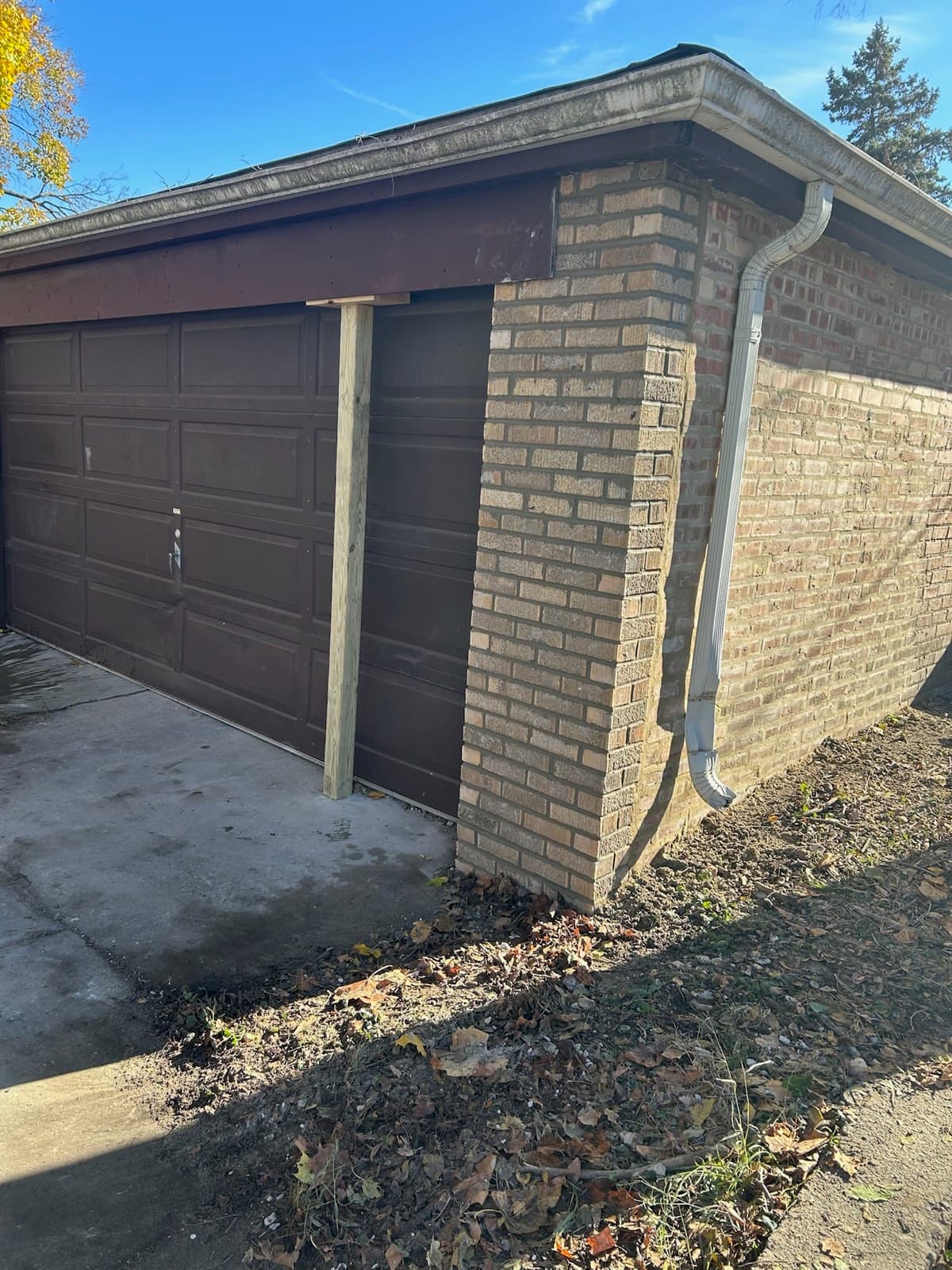
Stand at the end of your driveway and look at the brick directly above the garage door. If there's a long horizontal crack running most of the width of the opening — and the course of brick just above the door looks like it's been nudged upward — you're looking at a lintel that's rusting. Lintel replacement in Tinley Park, IL is the repair for that condition: the corroded steel comes out, a new protected lintel goes in, and the brick above is rebuilt. Paul Lally's Masonry has been doing this across Tinley Park since 1988.
The garage header goes first, and there's a reason
We get called to more garage-opening lintels in Tinley Park than any other single repair on this list, and it isn't a coincidence.
The garage door is the widest span on the house. A bedroom window lintel might carry four feet of brick; a two-car garage header carries sixteen or eighteen. More span means more load, more deflection, and more brick above the steel holding water. It also sits low, where snow gets plowed and drifted against the wall, and it's usually the opening with the least generous flashing detail above it.
So the garage header takes the most water and the most load, and it fails first. The picture window in the front room is usually second.
What a lintel is and how it fails
Brick can't span an opening on its own. Every window, door, and garage opening in a masonry or brick-veneer wall needs a lintel — on virtually every Tinley Park home, a length of structural steel angle iron tucked into the wall so only a thin dark edge shows above the frame.
Steel is excellent at that job. It has exactly one enemy: water.
- Water reaches the steel — through open mortar joints above the opening, gapped caulking at the window or door head, a leaking gutter dumping on the wall, or flashing that was never installed or has failed.
- The steel corrodes.
- Rust occupies several times the volume of the metal it replaced.
- The brick above has nowhere to go, so the wall lifts and cracks.
- The crack lets in more water, which reaches more steel. The cycle accelerates.
That's rust jacking, and once you know the mechanism, the straight horizontal crack above an opening stops being mysterious.
Brick veneer changes the picture — and most of Tinley Park is veneer
This is where Tinley Park differs from the century-old solid-masonry stock closer to the city, and it changes both the diagnosis and the repair.
Much of the village — the subdivisions that filled in from the 1970s through the 2000s, from Bremen Township out to the Brookside Glen and Timbers Edge side in Will County — is brick veneer: a single wythe of brick hung on a wood-framed wall with an air cavity behind it. That cavity is supposed to drain. Water that gets through the brick is meant to run down the back face, hit flashing above the lintel, and exit through weep holes in the joint above the steel.
| | Solid masonry (older stock) | Brick veneer (most Tinley Park homes) | |---|---|---| | Brick thickness | Multiple wythes, structural | Single wythe, non-structural skin | | How water is managed | Mass — the wall absorbs and dries | Cavity, flashing, and weep holes must drain it | | How lintel failure shows | Lifting and cracking; slow | Cracking plus outward displacement; faster | | Common root cause | Failed joints and gutters | Missing, damaged, or blocked flashing and weeps |
Here's the practical consequence: on a veneer wall, replacing the steel without correcting the flashing and weep holes is a half repair. The new lintel will sit in the same wet pocket the old one died in. Whenever we have a veneer opening open, we look at whether flashing exists, whether it's lapped correctly, and whether the weep holes above the lintel are present and clear. Weeps get mortared shut, painted over, caulked closed, or packed with debris more often than anyone expects.
Look along the joint just above your garage lintel. You should see small open gaps at regular intervals. If you see continuous unbroken mortar, that cavity has nowhere to drain.
Lintels fail in batches — inspect every opening
Every lintel on your elevation was installed the same week, from the same steel, with the same coating (or lack of it), and has weathered the same thirty or forty winters. When one has jacked, the others are on the same clock.
That's why our estimate covers every opening on the house — front, sides, rear, garage, service door, basement windows if they're headed in steel. It costs you nothing to know, and it usually changes the plan: staging set once for four openings is a very different job from setting up four separate times over four years.
Signs to look for
- A straight horizontal crack in the brick above a window, door, or garage opening — the signature.
- The brick course above an opening sitting higher or proud of the courses beside it.
- Rust staining bleeding down the brick or the window head.
- A visible rust line, flaking, or delamination on the exposed steel edge above the frame.
- Mortar joints above the opening opening up or dropping out.
- The window or garage frame no longer square, or a garage door binding in its track.
- No visible weep holes in the joint above the lintel on a veneer wall.
Repair or replace?
Not every lintel comes out. The honest framework:
Treat and protect when the steel has only surface corrosion, retains its full section thickness, and hasn't yet moved the brick. The steel is cleaned back, treated, and protected, the masonry above is repointed, and the water source is corrected.
Replace when the steel has lost real section, is delaminating in layers, has visibly deflected, or has already lifted the course above it. At that point treating it only postpones the same job — and the same staging cost — a few years.
We'll show you which one you have and why. We don't sell replacements where treatment holds.
How we replace a lintel
- Inspect every opening and agree the scope in writing before anything is touched.
- Shore the masonry above the opening so the wall is supported while the steel is out.
- Remove the brick bearing on the lintel, carefully, setting sound units aside for reuse.
- Cut out the old steel.
- Set the new lintel — properly sized for the span, with adequate bearing at each end, and protected against corrosion.
- Install or correct flashing over the lintel where the wall is veneer, and lap it properly.
- Relay the brick on the new steel, matched to the coursing, with weep holes formed in the joint above the lintel.
- Point and tool to match the surrounding joint profile, then clean the wall down.
What drives the cost
- Span width — a two-car garage header versus a bedroom window.
- Number of failing lintels — and whether one staging setup covers them.
- Height and access — second-story openings need staging; ground floor often doesn't.
- How much brick has to come down and go back — this is often the largest share of the labor.
- Brick and mortar matching difficulty.
- Flashing and weep-hole work while the wall is open.
- Condition of the surrounding masonry — most lintel jobs carry some repointing with them.
We never publish prices, because a number quoted without your wall in front of us isn't worth anything. Paul Lally's Masonry gives you a free on-site estimate in writing with the openings, the scope, and the sequence spelled out.
Timing
Mortar needs workable temperatures to cure, so planned lintel work runs best spring through fall in Chicagoland, with late-season jobs scheduled around the forecast. A lintel that has dropped brick or left an opening unsupported is a different conversation — that gets stabilized when it's found.
Tinley Park specifics
Tinley Park spans two counties and two eras of building, and both show up in this work. The older core around Oak Park Avenue and the Metra station carries genuine turn-of-the-century solid masonry — storefronts and homes where lintels may be steel or cut stone, and where soft historic brick demands a compatible, softer mortar. The subdivisions from the 1970s onward are brick veneer over frame, where flashing and weep-hole detail decide how long the steel lasts. The village's wide-lot layouts mean access is usually straightforward, which keeps staging simple on most jobs.
We run this work throughout the southwest suburbs — Orland Park, Mokena, Frankfort, New Lenox, Oak Forest, and Homer Glen — from the same crew. If the cracked brick above your opening has already spalled or split, that's brick replacement. If the joints across the elevation are receding, that's tuckpointing. If a chimney is involved, see chimney repair. Once the wall is sound and drained, masonry waterproofing helps keep it that way.
Nearby: our lintel replacement work in Orland Park and New Lenox.
Why Tinley Park calls Paul Lally's
Paul Lally's Masonry Inc. is a family-owned, insured masonry contractor serving Chicago and the Chicagoland suburbs since 1988 — tuckpointing, brick repair and replacement, chimney repair and rebuilds, lintel replacement, masonry restoration, and waterproofing for residential and commercial properties. Built on Craftsmanship. Backed by Experience. Free on-site estimates — call (708) 448-8866.
The Lally name is on the truck and on the work. We'd rather explain why your weep holes matter than come back in four years to redo a lintel we already replaced once.
Get a free on-site estimate for lintel replacement in Tinley Park, IL. Call (708) 448-8866 or request an estimate.
Lintel Repair & Replacement in Tinley Park, IL — Frequently Asked Questions
Why is the brick above my garage door cracking in Tinley Park?
Because the steel lintel spanning that opening is rusting. The garage door is the widest opening on most Tinley Park homes, so its lintel carries the most brick and sits under the most wall area collecting water. As the steel corrodes it expands and lifts the courses above it, producing the long horizontal crack you're seeing.
What is rust jacking?
Rust jacking is what happens when corroding steel expands inside a masonry wall. Rusted steel occupies several times the volume of the original metal, and because the brick above it can't move out of the way, the wall cracks, the joints open, and the brick course lifts. It's the mechanism behind nearly every lintel failure.
How do lintels fail differently in a brick-veneer house?
In brick veneer the brick is a single wythe hung on a frame wall, so a lintel failure has less mass restraining it — cracks open faster and the brick can displace outward rather than just lift. Veneer also depends on flashing and weep holes above the lintel to drain the cavity, and when those are missing or blocked, water sits directly on the steel.
How much does lintel replacement cost in Tinley Park, IL?
It depends on the width of the opening, how many lintels are failing across the house, working height and access, how much brick has to be shored and relaid, and whether flashing and weep holes need to be installed while the wall is open. A garage header is a bigger span than a bedroom window and prices accordingly. Paul Lally's Masonry provides a free on-site estimate in writing.
Do lintels fail one at a time or all at once?
In batches. Every lintel on the same elevation was installed the same year, from the same steel, with the same protection, under the same weather exposure — so when one has failed, its neighbors are usually well along. That's why we inspect every opening on the house, not just the one that's cracking.
Can you replace a lintel without taking brick out?
No. The courses of brick bearing on the lintel have to be supported and removed so the old steel can come out and the new lintel can go in, then relaid on top of it. That's why brick matching and mortar matching matter as much on a lintel job as the steel does — done right, the repair shouldn't be findable.
How long does a lintel replacement take?
A single ground-floor opening is generally a one-day job once staging is set — shore the brick, remove the steel, set the new lintel, relay and point the masonry. A wide garage header, multiple openings, or second-story work with staging runs longer. Mortar also needs workable temperatures to cure, which affects when we can schedule it.
What happens if I leave a rusted lintel alone?
It keeps swelling. The crack widens, the joints above the opening open up, more water reaches the steel, and the corrosion accelerates. Eventually brick loosens or drops, the opening can be pushed out of square, and a one-lintel job turns into rebuilding the whole section of wall above it.
Lintel Repair & Replacement in Nearby Areas
Other Masonry Services in Tinley Park, IL
Learn more about our lintel repair & replacement services across Chicagoland, or view all service areas.
Free on-site estimates across Chicagoland.