
Limestone / Sill Repair · Oak Lawn, IL
Limestone & Sill Repair in Oak Lawn, IL — Cracked Window Sills, Cast Stone, and the Wash That Stopped Working
A window sill is a tiny piece of stone doing an outsized job: throwing water off the wall. When the slope flattens or the sill cracks, everything below it starts failing too.
Quick Answer
Limestone and sill repair in Oak Lawn, IL covers cracked, spalling, or delaminating stone and cast-stone window sills, lintels, and trim — repaired by Dutchman patch or replaced outright, with the sill's slope and drip edge corrected. A failed sill drives water into the brick below it. Paul Lally's Masonry has repaired Chicagoland stone since 1988. Free on-site estimates: (708) 448-8866.
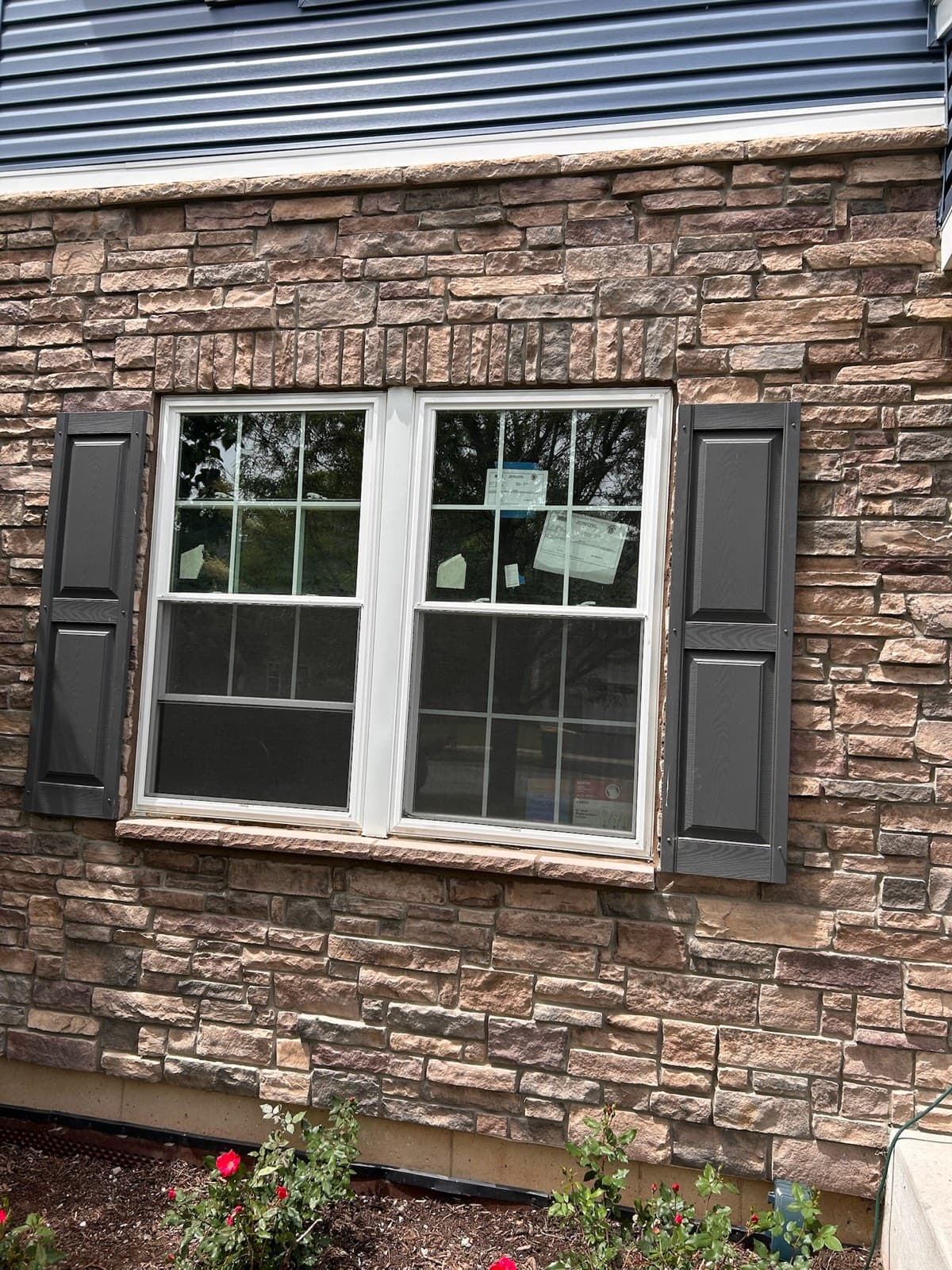
Look at the window sills on the front of your house. On a lot of Oak Lawn homes you'll find at least one with a crack running through it, a corner missing, a chalky flaking surface, or a dark plume of staining on the brick directly beneath it. Limestone and sill repair in Oak Lawn, IL is the fix for exactly that — the stone repaired or replaced, and, just as importantly, the drainage detail that failed put back to work. Paul Lally's Masonry has been repairing Chicagoland stone since 1988.
A sill is a drainage device, not decoration
It's easy to read a window sill as trim. It isn't. It's the single most important water-management detail on the face of your house, and it does its job through two features most people have never noticed:
The wash. The sill is set with a deliberate slope away from the window so runoff from the glass and frame is carried out past the face of the brick rather than dumped onto it.
The drip edge. A groove cut into the underside of the sill, near the outer edge. Water clinging to the underside hits that groove, loses surface tension, and falls clear. Without it, water tracks backward along the underside and runs down the brick — which is exactly the streaking you see under sills that have lost their drip.
Both are small. Both are the reason the brick beneath a working sill stays dry and the brick beneath a failed sill doesn't.
Limestone or cast stone? It changes the repair
Oak Lawn's housing stock is heavily post-war, and that matters here.
| | Indiana limestone | Cast stone / concrete | |---|---|---| | What it is | Natural quarried stone | Manufactured units, cement and aggregate | | How to spot it | Fine natural bedding lines, soft gray patina, subtle variation | Uniform color, exposed aggregate as it weathers, occasional form lines | | Typical failure | Delamination along bedding planes, spalling at edges, salt damage, surface sugaring | Surface scaling, aggregate exposure, cracking, rebar or wire corrosion inside | | Repair options | Dutchman patch, consolidation, replacement | Patch with matched cementitious repair mortar, or replacement | | Where you find it here | Older village-center homes, trim and belt courses, some front elevations | Most 1950s–1970s ranches, Georgians, and split-levels |
We identify which you have before writing a scope, because the wrong repair material on either one fails fast. A hard cement patch on soft limestone spalls the stone around it. A limestone-appropriate approach on a cast unit with corroding internal wire doesn't address the actual cause.
How sills fail in Oak Lawn
- Cracked through — a clean break, often near the middle of the span or at a corner.
- Spalling and scaling — the surface flaking or sheeting off, exposing aggregate or a sugary interior.
- Delaminating — limestone letting go in layers along its natural bedding planes.
- Lost wash — the slope flattened by wear, or the sill re-bedded flat during a past repair. Water now stands on it.
- Failed drip edge — filled with paint, caulk, or mortar, or worn away. Water tracks back onto the brick.
- Open joints — the joint between the sill and the brick beside or beneath it has opened, letting water into the wall behind.
- Rust staining — steel below or inside the sill assembly is corroding and expanding.
- Salt damage — chalky, sugary, crumbling stone, concentrated at grade level and around the stoop.
That last one deserves emphasis in Oak Lawn. Village streets, drives, and walks get heavily salted, and de-icing salt is genuinely destructive to both limestone and cast stone. Salt-laden water wicks into the stone, crystallizes as it dries, and expands inside the pore structure — mechanically breaking the stone apart from within. It's why the sills and stone at your front steps and lowest windows are almost always in the worst shape on the house.
The chain reaction below a failed sill
Here's the pattern we see on Oak Lawn houses over and over, and why we push people not to wait:
- The sill cracks or loses its wash.
- Runoff now lands on the brick immediately below the window instead of clearing it.
- That band of brick stays wet far longer than the rest of the wall.
- Mortar joints in that band wash out and recede.
- Water enters the wall through the open joints.
- Freeze-thaw cycling spalls the brick faces in a neat rectangle under the window.
- If there's steel in the assembly, it corrodes and starts jacking.
By the time someone calls about "brick damage under the window," the sill has usually been failing for years. Repairing the brick without repairing the sill guarantees a repeat. We won't quote it that way.
Repair or replace?
Repair in place when the stone is fundamentally sound, the crack is tight and stable, the wash still works, and the failure is localized. Includes crack repair, a Dutchman patch, and joint work.
Dutchman when a sound unit has failed in one area — a broken corner, a spalled section. The damaged area is cut to a clean geometric pocket and a matched piece of stone is fitted in. Done well, it's nearly invisible and it preserves the original unit.
Replace when the sill is cracked through in multiple places, delaminating in sheets, sugaring across its face, or has lost its slope. No patch restores drainage to a sill that no longer sheds water — and drainage is the entire point.
We give you the honest read. A sound sill with one bad corner should not be replaced, and a sill with no wash left should not be patched.
How we do the work
- Identify the material and diagnose the actual cause — water path, steel, salt, or age.
- Check the wash and drip on every sill, not only the visibly damaged ones.
- Repair, Dutchman, or replace — sourcing and cutting matched stone where replacement is needed.
- Reset with correct slope, and form or restore the drip edge on the underside.
- Point the perimeter joints where the sill meets brick, with mortar compatible with both.
- Repair the brick below where the failed sill has already done damage — repointing and unit replacement as needed.
- Caulk the window-to-sill junction correctly, with backer rod where the joint depth calls for it.
- Consider a breathable sealer — last, and only where appropriate.
What drives the cost
- Number of sills affected, and how many elevations they're on
- Patch vs. Dutchman vs. full replacement per unit
- Material and match difficulty — sourcing and cutting stone to size takes time
- Height and access — a second-story sill needs staging
- Condition of the brick beneath — most sill jobs carry some brick and joint repair
- Whether steel is involved in the assembly
We publish no prices, because stone work varies enormously unit to unit. Paul Lally's Masonry provides a free on-site estimate in writing, sill by sill.
Oak Lawn specifics
Oak Lawn is a brick village. The bulk of its housing stock went up in the post-war boom — brick ranches, Georgians, Cape Cods, and split-levels from the 1950s and 60s, with cast stone sills, headers, and trim as the standard detail of that era. Those units are now sixty to seventy years old, which is right where cast stone starts scaling and exposing aggregate. Closer to the village center and the Metra line there's older stock with genuine limestone trim, and around the 95th Street corridor and the Advocate Christ campus there's commercial masonry with limestone banding and coping that fails the same way at a larger scale.
Two local factors drive the work here: heavy winter salting on tightly spaced lots, and the flat, dense grading that keeps snow piled against foundations and lower walls well into spring.
We cover the surrounding southwest suburbs from the same shop — Evergreen Park, Chicago Ridge, Burbank, Hometown, Worth, Palos Heights, and Chicago's Beverly and Mount Greenwood neighborhoods. Related work: brick repair and brick replacement for the masonry below a failed sill, tuckpointing for the joints, lintel replacement when steel above the opening is involved, caulking and joint sealant at the window perimeter, and masonry waterproofing once the details are right.
Nearby: limestone and sill repair in Chicago and our brick repair work in Oak Lawn.
Why Oak Lawn calls Paul Lally's
Paul Lally's Masonry Inc. is a family-owned, insured masonry contractor serving Chicago and the Chicagoland suburbs since 1988 — tuckpointing, brick repair and replacement, chimney repair and rebuilds, lintel replacement, masonry restoration, and waterproofing for residential and commercial properties. Built on Craftsmanship. Backed by Experience. Free on-site estimates — call (708) 448-8866.
Stone work is where shortcuts show. A mortar smear across a cracked sill looks fine for one season and terrible for the next twenty. We'd rather cut the Dutchman.
Get a free on-site estimate for limestone and sill repair in Oak Lawn, IL. Call (708) 448-8866 or request an estimate.
Limestone / Sill Repair in Oak Lawn, IL — Frequently Asked Questions
What does a window sill actually do?
It throws water away from the wall. A sill is set with a slope — the wash — so rain running down the glass and frame is carried past the face of the brick instead of onto it, and a groove on its underside called a drip edge breaks the water's path so it falls clear. When the wash flattens or the drip fails, that water goes straight into the masonry below.
Is my sill limestone or cast stone?
On Oak Lawn's post-war brick homes, most sills are cast stone or concrete — manufactured units, uniform in color, that often reveal aggregate as they weather. True Indiana limestone shows fine natural bedding lines and weathers to a soft gray patina. They fail differently and get repaired differently, so it's the first thing we identify at the estimate.
How much does limestone sill repair cost in Oak Lawn, IL?
It depends on how many sills are affected, whether each one is a patch or a full replacement, the height and access, whether the sill has to be sourced and cut to match, and whether the brick beneath it also needs repair. One cracked ground-floor sill is a small job; eight sills across two elevations is a project. Paul Lally's Masonry provides a free on-site estimate in writing.
Can a cracked stone sill be repaired, or does it have to be replaced?
Both are legitimate depending on the stone. A tight crack in otherwise sound stone can be repaired in place. Localized spalling can take a Dutchman — a matched piece of stone cut in to replace only the failed area. A sill that is cracked through in multiple places, delaminating in sheets, or has lost its slope gets replaced, because patching won't restore the drainage.
What is a Dutchman repair?
A Dutchman is a stone patch: the damaged area is cut out to a clean geometric pocket and a matched piece of new stone is fitted and set into it. It's the traditional way to save a sound stone unit that has failed in one spot, and on visible stone it looks far better than a mortar patch, which never matches for long and weathers at a different rate.
Why did my sill crack in the first place?
Usually water plus freeze-thaw, sometimes steel. Water sits on a flattened wash or wicks into the stone through open joints, freezes, and splits it. On some homes there is steel under or within the sill assembly, and rusting steel expands and cracks the stone from the inside. De-icing salt at grade level accelerates all of it.
Why is the brick under my window stained and deteriorating?
Because the sill above it stopped shedding water. A failed sill dumps runoff directly onto the brick below, and that concentrated wetting produces the classic pattern: staining, efflorescence, spalled brick, and washed-out mortar in a band directly under the window. Fixing the brick without fixing the sill just restarts the clock.
Do you seal stone sills after repair?
Sometimes, and only after the drainage is right. A breathable sealer can help a porous sill shed water, but sealing a sill that has no slope or a cracked joint traps moisture inside the stone and makes things worse. Slope, drip edge, and sound joints first — sealer, if it's appropriate, last.
Limestone / Sill Repair in Nearby Areas
Other Masonry Services in Oak Lawn, IL
Learn more about our limestone / sill repair services across Chicagoland, or view all service areas.
Free on-site estimates across Chicagoland.