
Commercial Masonry Restoration · Oak Lawn, IL
Commercial Masonry Restoration in Oak Lawn, IL — Storefronts, Strips, and Multi-Tenant Buildings
A commercial building has tenants, customers, and a parking lot full of cars. Restoring its masonry is as much about sequencing and access as it is about mortar. Paul Lally's Masonry has done both since 1988.
Quick Answer
Commercial masonry restoration in Oak Lawn, IL covers storefronts, strip centers, and multi-tenant buildings — parapets and coping, lintels over wide openings, block and brick walls, and tuckpointing, scheduled around business hours. Paul Lally's Masonry has restored Chicagoland commercial masonry since 1988. Free on-site estimates: (708) 448-8866.
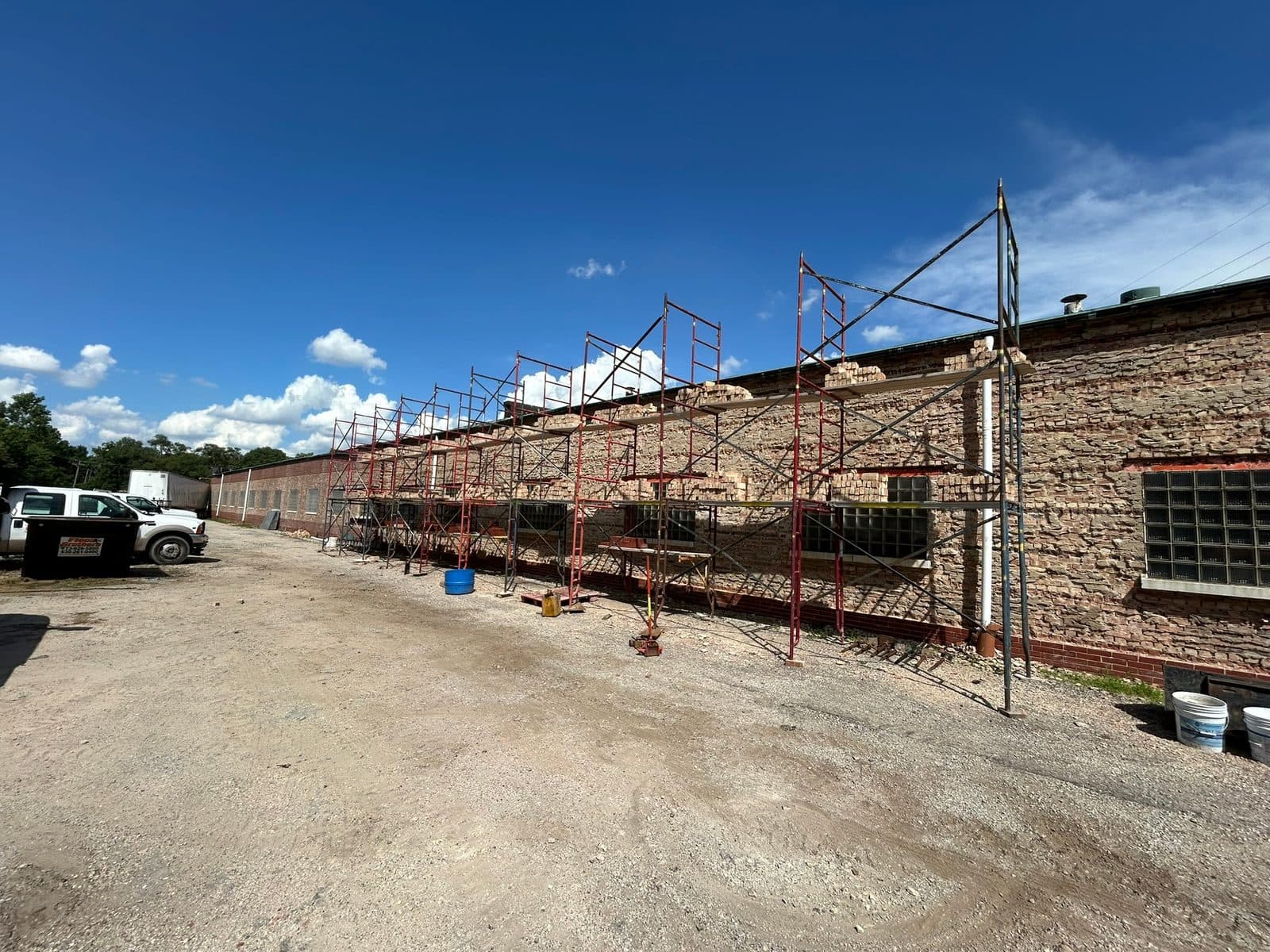
A commercial building doesn't get to shut down for its masonry. There are tenants inside, customers coming through the door, delivery trucks at the back, and a parking lot that has to keep working. Commercial masonry restoration in Oak Lawn, IL is as much about sequencing, access, and keeping a building open as it is about mortar and brick. Paul Lally's Masonry has been doing commercial work across Chicagoland since 1988, and the buildings along Oak Lawn's commercial corridors are exactly the kind we know.
What commercial masonry restoration covers
On an Oak Lawn storefront, strip center, office, or multi-tenant building, restoration typically involves some combination of:
- Parapet wall repair and rebuilds — the wall above the flat roofline
- Coping replacement and resetting — the cap that sheds water off the top of that wall
- Tuckpointing and repointing — failed mortar joints across the facade and side elevations
- Lintel repair and replacement — the steel carrying brick above wide storefront, service, and overhead-door openings
- Brick and block replacement — spalled, cracked, or displaced units
- Foundation and base-course masonry — where salt, snowpack, and splashback attack at grade
- Caulking and joint sealant — expansion and control joints, window and door perimeters
- Waterproofing — breathable sealers, last, once the wall is sound
The failure order on an Oak Lawn commercial building
After decades on these buildings, the pattern is consistent.
First, the parapet and coping. On a flat-roofed commercial building the exterior wall continues above the roof deck, exposed to weather on both faces plus the top. Every other wall is protected on one side by the building's interior. The parapet isn't — so it takes freeze-thaw from all directions and stays wet longer. When the coping joints open, water stops running off the top of the wall and starts running down inside it.
That's why so many "the roof is leaking" calls turn out to have nothing to do with the roof membrane. A new roof doesn't touch the parapet. If a tenant's ceiling stain survived a roof replacement, the wall above the roof is where to look.
Second, the lintels. Commercial buildings have the widest openings anywhere — storefront glass, overhead doors, service entries, loading openings. That means the longest spans of steel under the most load. As that steel corrodes it expands to several times its original thickness, and with nowhere to go it lifts the masonry above it. The signature is a horizontal crack running along the joint just above an opening, often with rust staining bleeding down the brick.
Third, the base course and grade-level masonry. De-icing salt, plowed snowpack piled against the wall, splashback off pavement, and vehicle contact at docks and drive lanes. This is the masonry your customers stand closest to.
Fourth, the general wall field — and side and rear elevations, which are usually exposed block and usually the last thing anyone budgets for, deteriorate faster than the finished street elevation.
Signs your building needs attention
- Tenant complaints of ceiling stains, damp walls, or musty smells on the top floor
- Loose or cracked coping, or pieces missing entirely
- Mortar sand, brick chips, or coping fragments collecting on the roof
- A horizontal crack above a storefront or overhead door, with or without rust staining
- Spalling brick or block — faces flaking, powdering, or popped
- Step cracks running diagonally through the joints
- Any wall out of plumb, bowing, or bulging
- Efflorescence — white chalky deposits signalling water moving through the wall
- Loose brick above an entrance, sidewalk, or parking area — a safety item, not a maintenance item
- Deteriorated masonry at grade where salt and snow sit
How we prioritize when the budget is finite
Most commercial owners and managers are working inside a budget year. We sequence by risk, not by what's most visible from the street:
| Priority | What | Why | |---|---|---| | 1 — Immediate | Anything that could fall near an entrance, walkway, or parking area; any bowing or leaning wall | Public safety and liability, full stop | | 2 — This season | Active water entry into tenant space; failed parapet coping | Interior damage and tenant relations compound fast | | 3 — This season if possible | Rust-jacked lintels over wide openings | Actively destroying the masonry above and losing capacity | | 4 — Next phase | Repointing weather elevations; brick and block replacement | Real deterioration, not yet emergency | | 5 — Preventive | Remaining elevations, caulking, sealing | Protects everything already done |
The sequencing mistake we see most often is spending category-5 money — sealing and cosmetic work on the street elevation — while a category-2 parapet keeps pouring water down inside the wall.
Our process on a commercial building
- Inspect the whole envelope, including the roof. Nobody can scope a parapet from the parking lot, and the parapet is usually the problem.
- Document the condition in writing, in a form you can use for budgeting, ownership discussions, or a lease conversation.
- Separate safety, structural, water-entry, and cosmetic items so priorities are obvious.
- Plan access and staging around your operations — entrances, drive lanes, dock access, parking, and tenant hours.
- Protect the site — roof membrane, glass, storefront finishes, walkways, landscaping.
- Do the work in order: cause before symptom, top of the building before the bottom, structure before surface.
- Match materials — mortar type, color, sand, and joint profile; brick and block matched for size, color, and texture; salvaged units where matching matters.
- Clean up daily. A commercial site has customers walking it every morning.
- Walk the finished work and hand over what to watch and when.
Materials
Mortar matched for type, color, sand, and joint profile — standard Type N for much of the work, Type S where structure and exposure genuinely call for it, and softer mixes on older, softer masonry. Coping in clay tile, limestone, precast concrete, or metal to suit the building. New lintels sized for the span and protected against corrosion. Brick and block matched to the existing, with salvaged units where a modern unit would read wrong. Sealants specified per joint condition, with backer rod set to control bead depth. Breathable penetrating sealers only — never a film-forming coating that traps moisture in the wall.
What drives the cost
- Building height and access — staging, lifts, and how material reaches the work
- Linear footage of parapet and coping, and how many sides are involved
- Repair versus rebuild ratio on the parapet
- Number of failing lintels and the width of the openings they carry
- Extent of brick and block replacement, and matching difficulty
- Grade-level and dock masonry condition
- Operational constraints — restricted work hours, phased access, keeping entrances open
- What's found once the top courses come off — the honest variable on any parapet
Paul Lally's Masonry gives a free on-site estimate in writing, and a real commercial estimate includes getting on the roof.
Local context: Oak Lawn's commercial masonry
Oak Lawn's commercial building stock is largely post-war and reflects how the village grew — the retail corridors along 95th Street, the businesses near the Metra station and the village center, medical and office buildings around the hospital campus, and the strip centers and service buildings that came with the subdivisions from the 1950s through the 1970s and beyond.
Structurally that means a lot of concrete block with brick or stone veneer on the street elevation and exposed block on the sides and rear, flat roofs with parapets nearly everywhere, wide storefront openings on steel lintels, and masonry at grade taking the full brunt of Cook County winters and de-icing salt.
Those buildings are now fifty to seventy years old. Original mortar is at the end of its service life, original lintels — mostly never galvanized — are corroding on schedule, and coping that hasn't been reset in decades is letting water into the top of the wall. Chicagoland freeze-thaw does the rest: water absorbs, freezes, expands about nine percent, and works the masonry apart from the inside, cycle after cycle.
It's a predictable maintenance profile, and it responds well to a sequenced plan.
Related masonry services in Oak Lawn
Commercial scopes draw on commercial masonry restoration, parapet wall repair, tuckpointing and repointing, lintel repair and replacement, brick repair and brick replacement, foundation masonry repair, limestone and sill repair, caulking and joint sealant, and masonry waterproofing.
Worth reading: our commercial masonry restoration guide for Chicagoland and the owner's guide to two-flats and small apartment buildings. Nearby work: tuckpointing in Oak Lawn, brick replacement in Oak Lawn, and commercial masonry restoration in Downers Grove.
Get a scope you can budget against
Paul Lally's Masonry Inc. is a family-owned, insured masonry contractor serving Chicago and the Chicagoland suburbs since 1988 — tuckpointing, brick repair and replacement, chimney repair and rebuilds, lintel replacement, parapet wall repair, masonry restoration, and waterproofing for residential and commercial properties. Built on Craftsmanship. Backed by Experience.
We'll walk the building including the roof, tell you what's a safety item and what can be phased, and put a scope in writing you can take to ownership. Our family name is on every job.
Free on-site estimates — call (708) 448-8866 or request an estimate online.
Commercial Masonry Restoration in Oak Lawn, IL — Frequently Asked Questions
Can masonry work be done without closing my Oak Lawn business?
Almost always, yes. Commercial masonry is exterior work, and we sequence it so entrances stay usable and the work zone moves around the building rather than blocking it all at once. Staging areas, material drops, and the loudest phases get scheduled around your hours where the building allows it.
What fails first on a commercial building in Oak Lawn?
The parapet and its coping, almost every time. On a flat-roofed storefront or strip center that wall stands above the roof exposed on both faces, so it deteriorates decades before the rest of the building — and when the coping joints open, water runs down inside the wall and shows up as ceiling stains in a tenant space. Lintels over wide storefront and loading openings are next.
How much does commercial masonry restoration cost in Oak Lawn, IL?
There's no per-square-foot rate that means anything on commercial work. Cost is driven by building height and how the crew reaches the work, linear footage of parapet and coping, the number of failing lintels, the extent of brick or block replacement, staging and access requirements, and whether work must happen outside business hours. Paul Lally's Masonry provides a free on-site estimate in writing after inspecting the building including the roof.
Do you work on block walls as well as brick?
Yes. A lot of Oak Lawn commercial construction is concrete block — often with a brick or stone veneer on the street elevation and exposed block on the sides and rear. Block has its own failure patterns, particularly at control joints, at grade, and where water has been getting into the cores, and it's repaired and repointed differently than brick.
Can the work be phased across budget years?
Yes, and on commercial property it usually should be. We sequence by risk: anything that could fall near an entrance, sidewalk, or parking area goes first, then active water entry into tenant spaces, then the roofline, then the weather elevations, then preventive work. We'll give you a phased scope you can budget against.
Who is responsible for masonry repairs, the landlord or the tenant?
That depends entirely on your lease — exterior structure and roof are commonly landlord obligations, but triple-net and modified leases vary widely and we can't interpret your agreement. What we can do is provide a clear written scope and documentation of the condition, which is usually what both parties need to sort it out.
How much disruption should tenants expect?
Grinder noise during work hours is the main one, along with staging along the building, dust control measures, and restricted access directly below the work area. We'd rather you give tenants notice ahead of time than have them surprised, so we'll confirm the schedule with you before mobilizing.
Do you handle loading docks, retaining walls, and site masonry?
We handle the masonry elements of commercial property — walls, facades, parapets, lintels, foundations, and the masonry around docks and openings. During the estimate we'll be straight with you about anything outside masonry scope, like structural steel design or paving, rather than taking on work that needs a different trade.
Commercial Masonry Restoration in Nearby Areas
Other Masonry Services in Oak Lawn, IL
Learn more about our commercial masonry restoration services across Chicagoland, or view all service areas.
Free on-site estimates across Chicagoland.