
Parapet Wall Repair · Orland Park, IL
Parapet Wall Repair in Orland Park, IL — The Wall Above the Roofline Nobody Inspects
On a one-story Orland Park retail building, the parapet is the tallest, wettest and least-looked-at masonry on the property — and when it leaks, the bill almost always goes to a roofer first. That is why the same tenant space gets re-roofed twice before anyone fixes the actual problem.
Quick Answer
Paul Lally's Masonry Inc. provides parapet wall repair in Orland Park, IL — resetting and replacing coping, installing through-wall flashing, repointing and rebuilding deteriorated roof-edge masonry on retail centers, commercial buildings and multi-tenant properties. Family-owned since 1988, insured. Free on-site assessments — call (708) 448-8866.
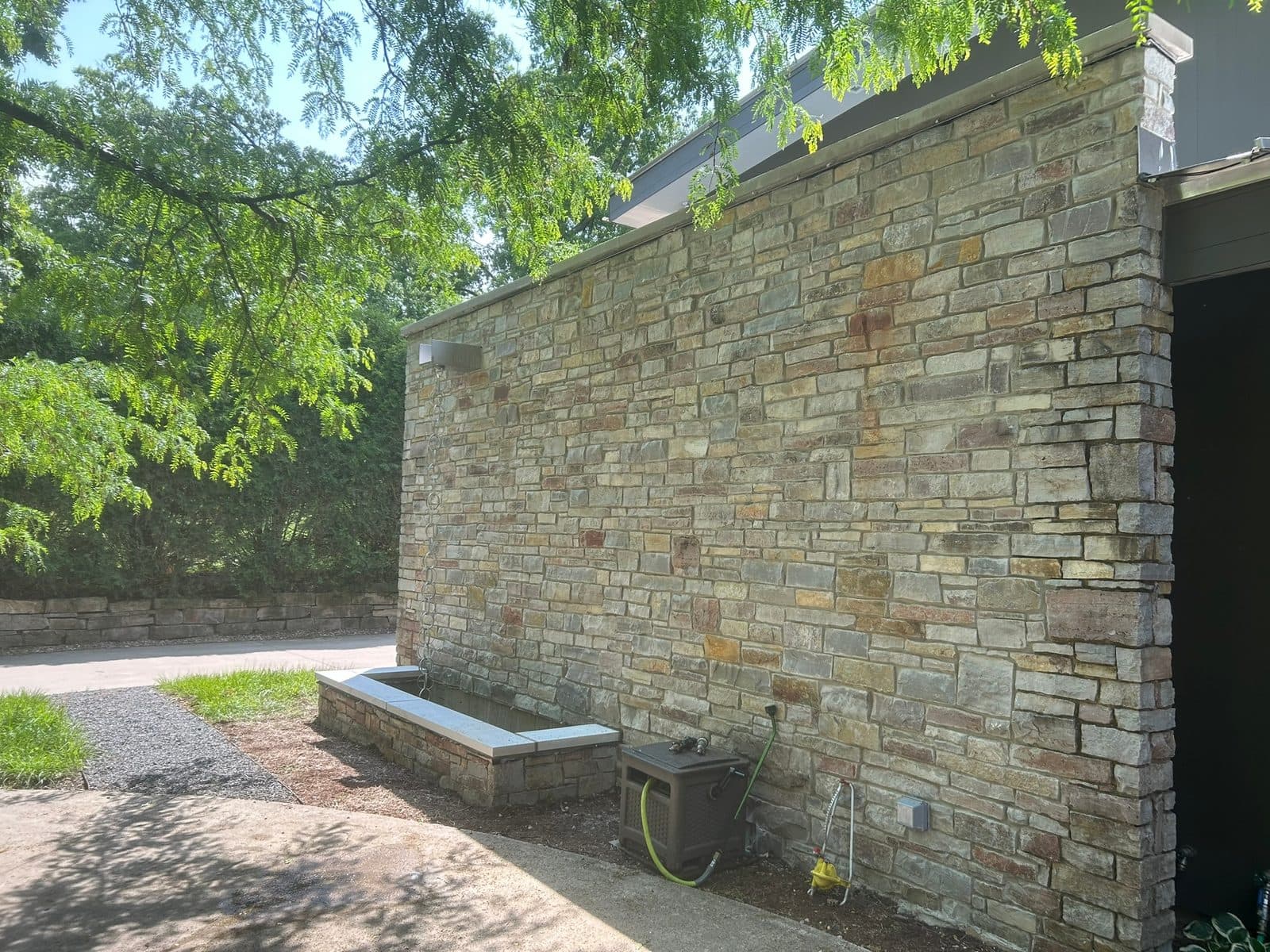
Parapet Wall Repair in Orland Park, IL
Parapet wall repair in Orland Park, IL is the most commonly misdiagnosed masonry problem in commercial property management. Paul Lally's Masonry Inc. repoints, resets and rebuilds parapet walls, coping and roof-edge masonry on retail, commercial and multi-tenant buildings throughout the southwest suburbs. Family-owned since 1988, insured, free on-site assessments. Call (708) 448-8866.
Misdiagnosed because of one simple fact: water that gets in at the top of a wall does not come out at the top of a wall. It runs down inside the masonry and appears on a ceiling twenty feet away — which looks exactly like a roof leak, and gets billed as one.
Why the Parapet Is Different From Every Other Wall
Every other wall on a building has advantages the parapet does not.
A normal wall has a roof over it, a heated interior behind it, and one face exposed. It sheds water downward and dries out from the back.
A parapet has nothing over it, nothing behind it, and weather on every surface. It gets wet on the outside face, wet on the roof-side face, and soaked across the top. There is no warm building driving moisture out of it. It stands above the roofline in full wind exposure, so it takes more driven rain, freezes harder and thaws slower than anything below it — through dozens of freeze-thaw cycles in a Chicagoland winter.
Then the thing that makes it worse: nobody looks at it. A parapet is invisible from the parking lot and out of mind from inside a tenant space. On a building that has changed owners or managers a few times, the parapet is frequently the oldest untouched masonry on the property.
Check the roof-side face. It is almost always worse than the street face, and almost nobody has ever seen it.
The Orland Park Version of This Problem
Orland Park's commercial fabric is not century-old downtown storefronts. It is suburban retail and commercial built largely from the 1970s onward — strip centers and multi-tenant retail along the LaGrange Road and 159th Street corridors, freestanding restaurant and service buildings, professional and medical offices, and industrial and flex space.
That produces a specific parapet condition, and it differs from the older-city version in ways that matter:
- Low-slope roofs with parapets on all sides, so the roof-edge masonry runs the entire perimeter rather than just a street elevation.
- Long, uninterrupted runs of parapet on strip retail, often shared across multiple tenant spaces under one roof.
- Coping in precast concrete or metal, with sealed joints that are a maintenance item and are frequently well past their life.
- Roof drains, scuppers and overflow outlets cut through the parapet — every one of those is a penetration.
- Rooftop equipment and its curbs, adding traffic and more penetrations near the wall.
- Signage and light fixtures anchored into the parapet, which is steel embedded in the wettest masonry on the building.
On a multi-tenant building, one failing parapet section leaks into somebody's leased space — and that makes it a lease problem, not just a maintenance problem.
Signs Your Parapet Needs Work
- Coping joints open, cracked, or with sealant that has hardened and pulled loose
- Coping units loose, rocking, or shifted out of line
- The wall visibly leaning, toward the parking lot or toward the roof
- A horizontal crack near the roof line running the length of the wall
- Displaced or missing brick in the top courses
- Spalling and washed-out mortar on the roof-side face — check this one specifically
- Rust staining or bulging where a sign bracket, ladder anchor or steel angle is corroding
- White efflorescence streaking the interior wall below the roof line
- Interior ceiling staining near the perimeter that returns after a new roof
Risks of Waiting
A parapet is masonry standing free, above head height, with nothing bracing its top — and on a retail building there are customers, entrances and parked cars beneath it. That makes it a safety matter before it is a maintenance matter.
Short of that, the cost curve is steep. An open coping joint lets water into the core of the wall. That water freezes and opens the joint further, saturates the brick, and reaches any embedded steel. Corroding steel expands and pushes the wall out of plumb — and a leaning parapet cannot be repointed back into position. What began as resetting coping and repointing becomes a rebuild with full staging.
And throughout all of it, water is running down inside the wall into a tenant space, while the owner pays for roofing that does not fix it.
Our Parapet Repair Process
- Inspect both faces and the top, from the roof and from staging, plus the affected interior below.
- Check plumb and document lean, displacement and cracking along the full run.
- Trace the water path — coping joints, masonry, flashing, scuppers, drains, penetrations — before scoping anything.
- Determine repair versus rebuild section by section, and say plainly which is which.
- Set up access and protection — lift or staging, overhead protection at entrances, pedestrian and parking routing.
- Remove and salvage coping, cataloguing units worth resetting.
- Take down deteriorated courses to sound masonry, salvaging usable brick.
- Install through-wall flashing at the parapet base with end dams where the rebuild depth allows.
- Rebuild in matched brick and compatible mortar, holding original coursing and bond.
- Reset or replace coping on a full bed, with correct pitch and joints detailed to shed water rather than hold it.
- Repoint remaining sound masonry and rebuild the coping joint sealant.
- Tie into the roof membrane and counterflashing, coordinating with the roofer so the two systems actually meet.
- Walk the finished work with the owner or manager and document it.
Materials
Mortar matched for hardness, colour and texture, and always softer than the brick it sits against. Coping in precast, stone or metal depending on the building — salvaged original units are often better than substitutes, and any replacement needs an overhang and drip edge rather than sitting flush. Flashing in durable membrane or metal with end dams. Sealant selected for the joint's movement capability and both substrates, installed over proper backer rod — coping joints move, and a bead with no backer rod tears.
Related work commonly runs alongside: commercial masonry restoration, tuckpointing, brick repair, lintel replacement at storefront openings, and caulking and joint sealant.
What Drives the Cost
- Access — usually the single largest line, and the reason phasing by elevation saves money
- Linear footage and height of parapet
- Repair versus rebuild, and how many courses come down
- Coping — reset and reseal, or replace
- Flashing installation, which means opening the wall
- Penetrations at scuppers, drains, signage and equipment
- Overhead protection and pedestrian control at a customer-facing building
- Off-hours scheduling where tenants require it
- Roofing coordination
We do not price parapet work from a photo. The assessment is free, and the written scope can be phased across budget years.
Serving Orland Park and the Southwest Suburbs
Paul Lally's Masonry Inc. is a family-owned, insured masonry contractor serving Chicago and the Chicagoland suburbs since 1988 — tuckpointing, brick repair and replacement, chimney repair and rebuilds, lintel replacement, masonry restoration, and waterproofing for residential and commercial properties. Built on Craftsmanship. Backed by Experience. Free on-site estimates — call (708) 448-8866.
We work throughout Orland Park and neighbouring Tinley Park, Palos Park, Homer Glen and Oak Forest.
Get a Free Orland Park Parapet Assessment
If a tenant space keeps staining after a new roof, or your coping is loose, look at the wall above the roofline before buying more roofing. Call (708) 448-8866 or request a free assessment.
Parapet Wall Repair in Orland Park, IL — Frequently Asked Questions
How much does parapet wall repair cost in Orland Park, IL?
Access is usually the largest driver before any masonry is touched — lift or staging, protection over entrances and walkways, and whether work has to happen outside business hours. Beyond that it is linear footage, coping condition, and whether the wall is repointed or rebuilt. Paul Lally's Masonry Inc. gives free on-site assessments — call (708) 448-8866.
My roof was replaced and it still leaks. Could it be the parapet?
Very often, yes. Water entering through open coping joints or failed parapet masonry runs down inside the wall and shows up at the ceiling well away from where it got in, which is why parapet leaks get repeatedly billed as roofing problems. A new membrane does not address masonry above it.
How do I know if my parapet needs repointing or a full rebuild?
Repointing works while the wall is still plumb, the brick is largely sound, and the coping is intact. Once the wall leans, the top courses have lost bond, or brick has spalled through, rebuilding that section is both safer and more economical than repointing it twice.
What is through-wall flashing and does my building have it?
It is a continuous waterproof membrane built into the masonry near the parapet base, catching water travelling down inside the wall and directing it back out. Many older buildings were built without it, and rebuilding a parapet without installing it leaves the same water path open.
Why does the parapet fail before the rest of the building?
Because it is the only masonry on the building with weather on both faces and the top, no heated interior behind it to dry it out, and nothing overhead to shed water. It also sits in full wind exposure, so it freezes harder and stays wet longer than any wall below it.
Can you work while our tenants stay open?
In almost every case. Parapet work is staged along the roof edge, entrances get overhead protection, and we keep walkways and parking access clear. Where the loudest work would affect a tenant's business hours, we schedule around it wherever the sequence allows.
Do you handle parapets on Orland Park retail and commercial buildings?
Yes — retail centers, multi-tenant buildings, offices and industrial properties throughout Orland Park and the surrounding suburbs. Paul Lally's Masonry Inc. has been doing this work since 1988. Free on-site assessments — call (708) 448-8866.
Parapet Wall Repair in Nearby Areas
Other Masonry Services in Orland Park, IL
Learn more about our parapet wall repair services across Chicagoland, or view all service areas.
Free on-site estimates across Chicagoland.