
Tuckpointing & Repointing · Lemont, IL
Tuckpointing in Lemont, IL — Soft Mortar for a Historic Limestone Town
Lemont is a limestone town, and its old masonry needs soft, lime-based mortar — not hard modern cement. Paul Lally's Masonry Inc. tuckpoints Lemont brick and stone with mortar matched to what the wall was actually built with.
Quick Answer
Paul Lally's Masonry Inc. provides tuckpointing in Lemont, IL — grinding out failed joints and repointing with mortar matched in strength, color, and profile to Lemont's historic limestone and soft brick as well as its newer bluff-top and subdivision homes. Family-owned, serving Chicagoland since 1988, insured. Free on-site estimates — call (708) 448-8866.
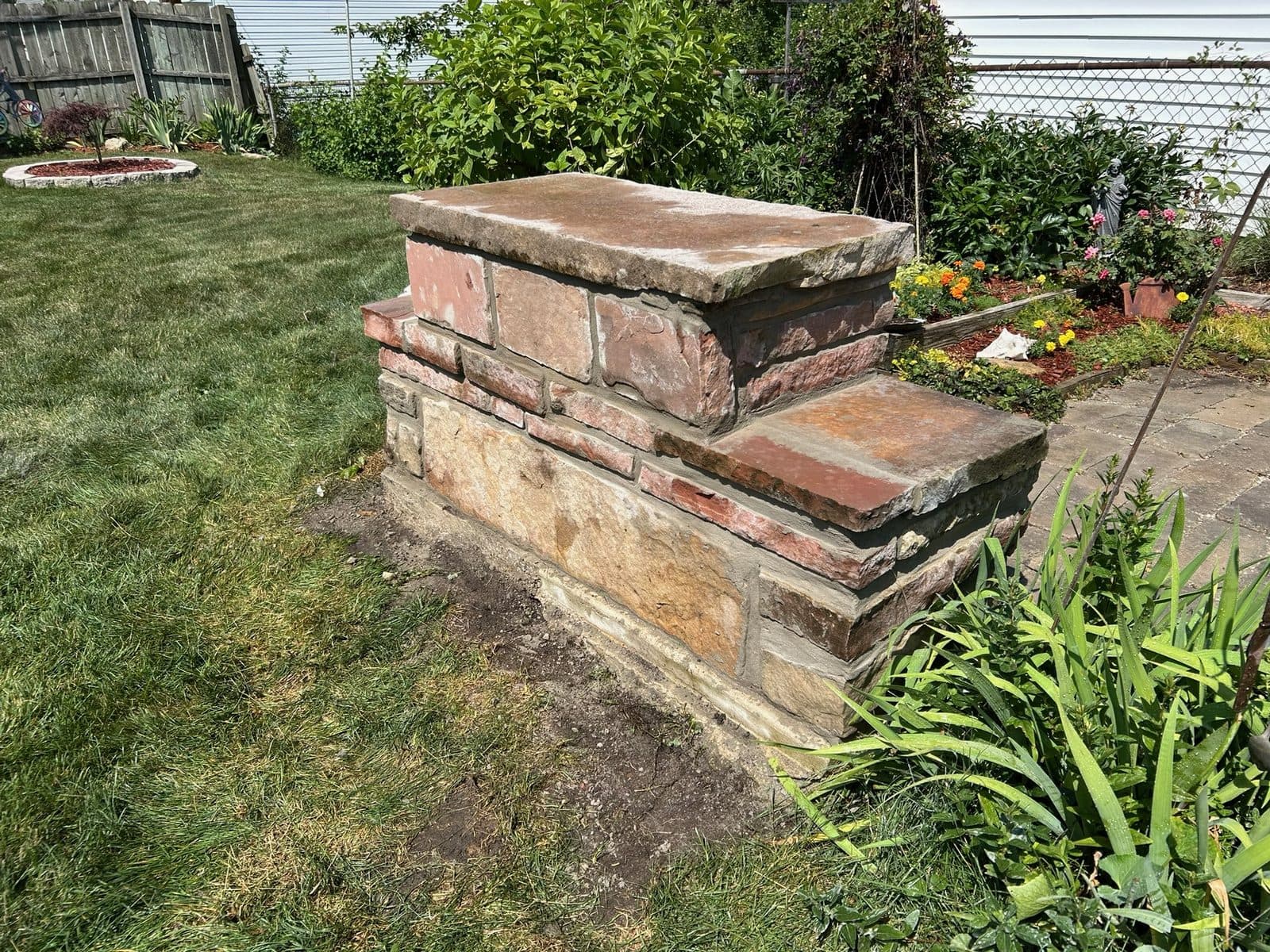
Lemont was built out of the ground it sits on. The stone quarried from the Des Plaines River valley — Lemont limestone, sold in its day as "Athens marble" — went into the churches, the downtown storefronts, and the houses that still line the bluff above the I&M Canal. That heritage is exactly why masonry work here goes wrong so often: tuckpointing in Lemont, IL is not the same job as tuckpointing a 1990s subdivision, and the wrong mortar on old stone and soft brick does more harm than no mortar at all.
Paul Lally's Masonry Inc. repoints Lemont brick and limestone with mortar matched to what the wall was actually built with — soft and lime-based where the masonry is soft, modern where it isn't. Family-owned, serving Chicagoland since 1988. Free on-site estimate: (708) 448-8866.
Why tuckpointing in Lemont IL is a mortar-hardness problem
Every brick or stone wall is a system: the units, and the mortar between them. Mortar is meant to be the sacrificial part — softer than the masonry, so it wears, cracks, and gives before the brick or stone does. Replace it and the wall is whole again.
That logic breaks the moment someone points a soft wall with hard mortar.
Nineteenth-century Lemont masonry — the limestone, the soft-fired common brick behind it — was laid up with lime-based mortar. It is porous, it flexes, and it lets moisture that gets into a wall evaporate back out through the joint. Modern Portland-heavy mortar does none of that. It is harder than the stone around it and it doesn't breathe. Water that gets in has to leave through the masonry instead, so it goes out through the face of the limestone and the brick:
- Limestone faces sugar, delaminate, and shed
- Soft brick spalls — the face flakes off, exposing the porous core
- Freeze-thaw cycles blow out the masonry rather than the joint
- The hard joint survives while the wall it was meant to protect crumbles around it
We see it constantly on buildings that were "repaired" a couple of decades ago by someone who only owned one bag of mortar. On soft historic masonry, hard mortar is the damage.
The newer side of town
Lemont isn't only its historic core. The bluff-top homes and the subdivisions that filled in from the 1980s onward are standard modern brick veneer, and they behave completely differently — a harder, standard-strength mortar is correct there, and using a soft lime mortar would be just as wrong in the other direction.
So the first thing we do on any Lemont wall is read it: what is the masonry, what was it originally pointed with, and what does it need now. That answer changes street by street here in a way it doesn't in most of the 60439.
Signs your Lemont masonry needs repointing
- Joints that have receded below the face of the brick or stone
- Mortar that crumbles to sand under a fingernail or a key
- Hairline separation where the mortar meets the masonry
- Sandy mortar dust collecting at the base of the wall
- White, chalky efflorescence, or damp patches showing on interior walls
- Limestone sills and lintels that are flaking, sugaring, or cracked
- Individual brick faces beginning to pop or flake
Those last two matter. Once stone is delaminating or brick is spalling, repointing alone won't restore it — the damaged units need limestone and sill repair or replacement as part of the work. The mortar is what lets the water in; the stone and brick are what the water destroys.
Water, the valley, and freeze-thaw
Lemont's terrain works against its masonry. Properties along the river valley and on the bluff take more wind-driven rain and hold more ambient moisture than a flat inland subdivision does, and moisture is the fuel for every masonry failure we repair. Water enters an open joint, freezes, expands, and pries the wall apart a fraction of a millimeter at a time. Do that for forty winters and you have a wall that no longer sheds water at all.
Sound joints are the wall's first and cheapest defense. Everything downstream — spalled brick, failed limestone, water in the basement, interior damage — starts with a joint that stopped doing its job.
How we tuckpoint in Lemont
- Read the wall. Identify the masonry and the original mortar before anything is ground out. On historic limestone and soft brick, that means a lime-based mix; on modern veneer, a standard Type N.
- Grind to depth. Each failed joint is cut to roughly twice its width so the new mortar has something to key into — not skimmed over the face of the old one.
- Match the mortar. Color, sand texture, joint profile, and — most importantly — strength. New work should disappear into the wall, not announce itself.
- Pack and tool. Mortar is packed in tight and tooled to the original profile, then cured properly.
- Clean down. The face is cleaned so the finished wall reads as original masonry.
On chimneys we handle the crown, cap, and flashing while we are already up there — they fail on the same schedule as the joints do, and they are the most exposed masonry on the house.
What drives the cost of tuckpointing in Lemont IL
We don't quote masonry over the phone, and you should be wary of anyone who does. What actually moves the number:
- How much of the wall is failing — spot repointing versus a full elevation
- Height and access — scaffolding on a two-and-a-half story bluff-side house is a different job than a one-story ranch
- Mortar matching — historic lime-based work takes more skill and care than modern veneer
- Condition of the masonry itself — spalled brick or delaminating limestone means replacement units, not just mortar
- Chimney work — crown, cap, and flashing bundled into the same visit
We look at the actual wall and give you a written estimate, free. That's the only honest way to price it.
Why Lemont homeowners call Paul Lally's Masonry Inc.
Paul Lally's Masonry Inc. is a family-owned, insured masonry contractor serving Lemont, Cook, DuPage, and Will County since 1988 — tuckpointing and repointing, brick repair and replacement, chimney repair and rebuilds, lintel replacement, limestone restoration, and waterproofing for residential and commercial properties. Built on Craftsmanship. Backed by Experience.
Thirty-plus years on Chicagoland masonry means we've seen what hard mortar does to soft stone, and we don't do it. We don't skim, we don't caulk over dead joints, and we don't invent a number sight-unseen. Our name is on every job.
See our full approach to tuckpointing and repointing and historic masonry restoration, our restoration work in Lemont, or our tuckpointing in neighboring Homer Glen.
Free on-site estimate in Lemont, IL — call (708) 448-8866 or request an estimate.
Tuckpointing & Repointing in Lemont, IL — Frequently Asked Questions
Why does tuckpointing in Lemont need different mortar than a newer suburb?
Much of Lemont's older masonry is soft — 19th-century limestone and soft-fired brick that were laid with lime-based mortar. That masonry needs a soft, lime-rich mortar that can flex and let moisture escape. Hard, Portland-heavy modern mortar is stronger than the stone and brick around it, so the wall fails through the masonry instead of the joint.
What is Lemont limestone, and does it need special care?
Lemont limestone — historically marketed as Athens marble — is the dolomitic stone quarried in the Des Plaines River valley and used across the region's 19th-century buildings. It is porous and relatively soft, so it must be repointed with compatible lime-based mortar and never sealed with a non-breathable coating that traps moisture inside the stone.
How do I know if my Lemont home needs tuckpointing?
Look for mortar joints that have receded below the face of the brick or stone, mortar that crumbles to sand under a fingernail, hairline gaps where mortar meets masonry, or white efflorescence and damp patches inside. On Lemont's bluff and river-valley exposures, the south and west walls and the chimney usually show it first.
Does the Des Plaines River valley make masonry damage worse in Lemont?
It contributes. Valley and bluff-side properties see more moisture and wind-driven rain, and that water is what freeze-thaw cycling needs to pry a wall apart. Open joints let it into the wall, so closing them with correctly matched mortar is the single most effective thing you can do.
Can newer Lemont subdivision homes need tuckpointing too?
Yes. Brick-front homes built from the 1980s onward still lose mortar to weather, and their chimneys are usually the first thing to go because they take the harshest exposure. Newer walls generally take a Type N mortar rather than the lime-based mortar an 1800s limestone wall needs — matching the wall is the whole point.
What is the difference between tuckpointing and repointing?
Repointing means grinding out failed mortar and packing fresh mortar into the joint. Tuckpointing traditionally adds a fine contrasting line for a crisp appearance. In Lemont and across Chicagoland the terms are used interchangeably for the same repair — renewing the mortar so the wall is weathertight again.
Do you offer free estimates for tuckpointing in Lemont, IL?
Yes. Paul Lally's Masonry Inc. gives free on-site estimates throughout Lemont and the surrounding southwest suburbs. We look at the actual wall, tell you what the original mortar was and what is failing, and put it in writing — call (708) 448-8866.
Tuckpointing & Repointing in Nearby Areas
Other Masonry Services in Lemont, IL
Learn more about our tuckpointing & repointing services across Chicagoland, or view all service areas.
Free on-site estimates across Chicagoland.