
Tuckpointing · Chicagoland, IL
How Long Does Tuckpointing Take? A Realistic Timeline for Chicagoland Homes
Everyone asks what tuckpointing costs. Almost nobody asks how long it takes — and then they're surprised when scaffolding goes up for a week. Here's an honest breakdown of tuckpointing timelines, what makes a job run long, and what actually happens each day.
2026-07-30
Quick Answer
Tuckpointing a single elevation on a typical Chicagoland home usually takes one to three days, a full house runs about three days to two weeks, and a large or multi-story building takes several weeks. Setup, weather, grinding, repointing, and mortar curing all drive the schedule. Paul Lally's Masonry has tuckpointed Chicagoland brick since 1988 — free on-site estimates at (708) 448-8866.
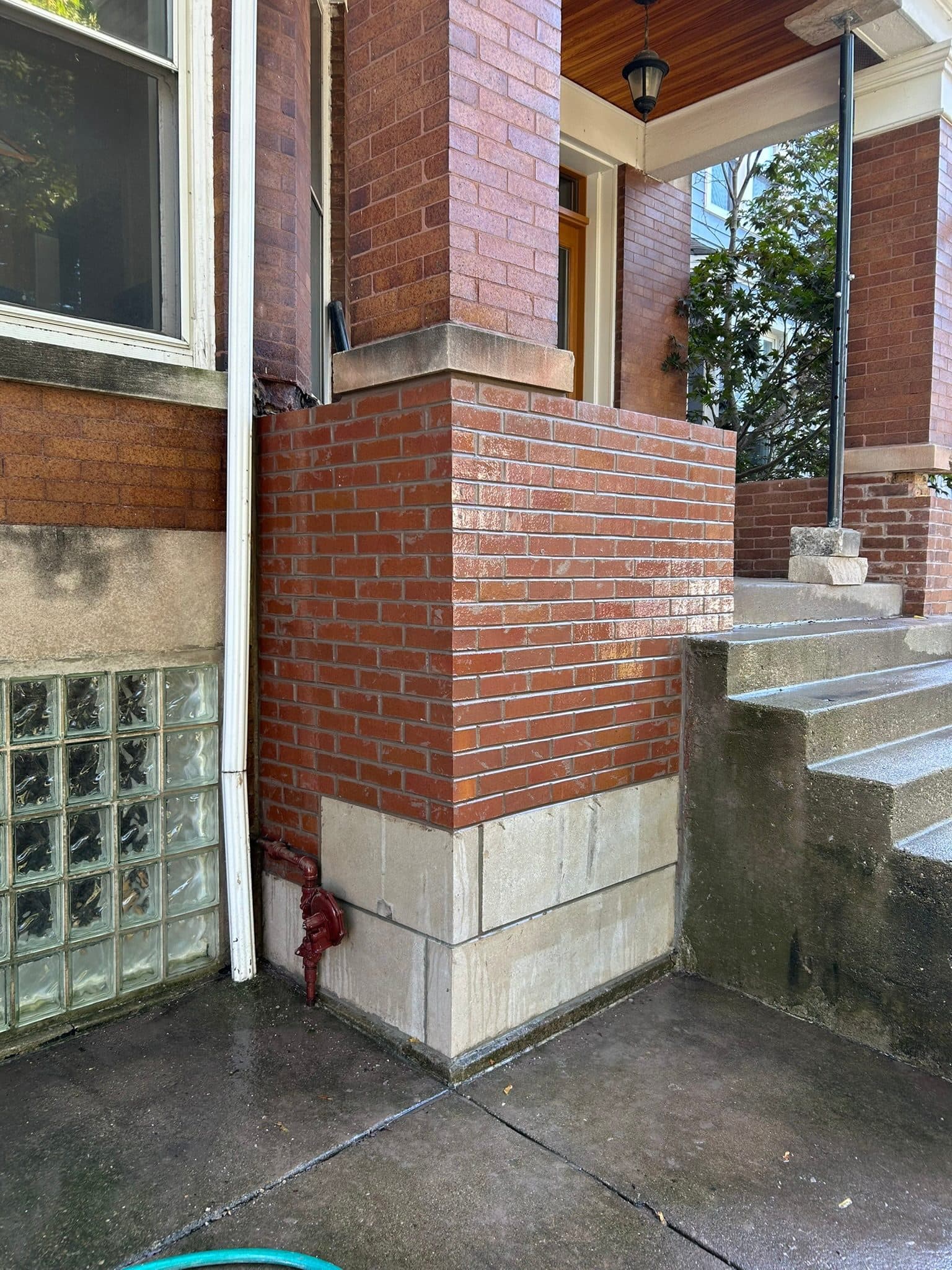
Homeowners ask us what tuckpointing costs constantly. They almost never ask how long it takes — right up until day four, when the scaffolding is still up and they're wondering whether something has gone wrong.
Usually nothing has gone wrong. Tuckpointing simply takes longer than most people picture, because the part they imagine — a mason smoothly packing fresh mortar into a joint — is the fastest step in the whole process. Everything before it is slower.
Here's the honest answer up front: a single elevation or a spot repair typically runs one to three days. A full exterior repoint on a typical Chicagoland home runs about three days to two weeks. A chimney is usually one to two days. A large or multi-story building runs several weeks. Paul Lally's Masonry has been giving Chicagoland homeowners those numbers since 1988, and below is exactly what drives them.
Quick reference: typical tuckpointing timelines
| Scope | Typical on-site time |
|---|---|
| Spot repointing — a small failed area | Under a day to 1 day |
| Chimney above the roofline | 1–2 days |
| One elevation of a single-family home | 1–3 days |
| Full exterior, single-story home | 3–5 days |
| Full exterior, two-story home | 5 days–2 weeks |
| Chicago two-flat or three-flat, full repoint | 1–3 weeks |
| Large multi-story or commercial building | Several weeks and up |
These are working-day ranges for the masonry itself, and they assume reasonable weather. Add time for staging setup on tall or awkward buildings, and add time whenever brick replacement, lintel work, or a chimney rebuild joins the scope — which happens often, because failing joints and failing brick keep each other company.
Why the grinding is the job
If you take one thing away, take this: cutting out the old mortar is the slow part, and it is not optional.
A proper repoint requires the failed joint to be cut back until you reach sound mortar — generally about two to two and a half times the width of the joint, which on a standard residential joint lands somewhere near three quarters of an inch. That depth exists for a mechanical reason. New mortar needs enough surface area inside the joint to key in and bond. Skim a quarter inch of fresh mortar over soft old mortar and you've made a cosmetic film that will crumble out within a few Chicago winters — and you'll have paid for the privilege of doing it again.
Getting that depth is painstaking. A mason works the grinder along a joint that's rarely perfectly straight, on brick that's often soft and old, trying to remove mortar without touching brick. Chip the brick edges and the damage is permanent — you can't put a brick arris back. On century-old Chicago common brick, that means slowing down further, and sometimes raking joints by hand rather than grinding at all.
So when you watch a crew and it looks like slow progress, that's what proper looks like. The fast alternative is the one that fails.
What actually happens, day by day
Day 1 — Setup, protection, and the start of grinding
Staging or ladders go up. Landscaping, walkways, windows, and AC units get covered. Dust control is set. Then grinding begins on the first section.
Setup is not filler time — on a two-story house, a chimney, or a building with a tight side yard, staging can consume a genuine half day or more before a single joint is touched.
Days 2 through most of the job — Grinding and joint prep
The bulk of the schedule. Joints cut to depth, section by section, then blown and brushed clean of dust so the new mortar bonds to masonry rather than to powder.
This is also when the job's real scope reveals itself. Open up the joints and you find out how much of the brick is genuinely spalled, whether a lintel is rust-jacking behind a crack, whether a section has lost bond. Discovering additional damage mid-job is the most common reason a timeline extends, and it's why a written estimate should describe how change in scope gets handled.
Middle to late — Repointing
The satisfying part, and the quick part. Mortar is mixed to the matched formula and packed into the joints in layers — not in one deep pass, because a single thick fill doesn't compact properly and shrinks as it cures. Each lift is allowed to firm up before the next.
Ongoing — Tooling the joints
As each section reaches the right stiffness ("thumbprint hard"), the joint gets tooled to match the existing profile — concave, weathered, raked, grapevine, struck, whatever the wall already has. Timing here is a craft judgment measured in minutes, not a step you can batch at the end of the week. Tool too early and you smear; too late and the joint won't compact or match.
Final — Cleaning and walkthrough
Brick cleaned down, mortar droppings removed, staging struck, site cleaned. Then we walk the work with you.
The ten things that actually change your timeline
- Height and access. A one-story ranch reached from ladders is a different animal than a three-story greystone requiring staging on all four sides. Setup and teardown scale with height.
- Total joint footage. A full four-sided repoint has several times the joint length of a single front elevation.
- How bad the joints are. Deeply eroded joints take more grinding passes and more mortar.
- Brick condition. If spalled brick has to come out and be replaced as you go, that's a second trade rhythm inside the same job. See tuckpointing vs. brick replacement.
- Brick softness and age. Soft, hand-molded pre-1930s Chicago brick demands slower, gentler joint removal — sometimes hand-raking. Historic work is deliberately slower. See our guide to historic masonry restoration and lime mortar.
- Mortar matching. Getting the color, sand, and texture right can require test batches that cure and are evaluated before the wall gets committed to. Worth every hour — see mortar matching for tuckpointing.
- Weather. The big one, covered below.
- What we find once joints are open. Rusted lintels, hidden spalling, a section that's lost bond.
- Related work in the same mobilization. Chimney, parapet, sills, caulking — bundling saves total time and cost, but extends the on-site window.
- Site conditions. Tight Chicago side yards, decks, mature landscaping, alley-only access, and parking restrictions all slow material handling.
Weather: the schedule variable nobody controls
Mortar is a chemical reaction, not a glue that dries. It needs moderate temperature and moisture to hydrate and gain strength, and it keeps gaining strength for weeks after it looks finished — the first few days being the most vulnerable.
That gives Chicagoland masonry a real season:
- Rain halts grinding and repointing, and fresh work needs protection while it sets. A wet spring stretch routinely adds days.
- Freezing temperatures are the hard limit. Water in curing mortar that freezes disrupts the cure permanently, producing weak, crumbly joints that fail early. Cold-weather work requires reliably above-freezing conditions, protection, and disciplined practice.
- Extreme heat and direct sun cause mortar to lose water too fast, which also weakens the cure. Hot summer work means shading and misting sections.
We will reschedule a job rather than install mortar we know won't cure. That occasionally frustrates a homeowner in November, and it's still the right call — a joint installed into a hard freeze is a joint you're paying for twice. Our post on the best time of year for masonry repair in Chicago walks through the seasonal picture.
What you should expect while the work is happening
- You stay in the house. Tuckpointing is exterior work.
- It's loud. Angle grinders on masonry, during working hours.
- There's dust. Controlled with wet methods, shrouds, and vacuums, but silica dust is real and managed as a safety matter — you'll see crews in respirators and eye protection for good reason.
- Windows closed on the elevation being worked.
- Vehicles moved clear of the work zone and the drop area below staging.
- Landscaping protected, and anything fragile moved back from the wall.
- Pets and kids kept clear of staging and the area below the work.
- Your driveway or parkway will host a mixing area and material.
How this maps to cost — and why neither is quoted by the day
Time and cost move together because labor dominates any masonry job. But nobody credible quotes tuckpointing by the day, and nobody credible quotes it over the phone.
The real cost drivers are the same ones driving the schedule: scope and joint footage, height and access, staging requirements, the extent of brick replacement, mortar matching difficulty, and what turns up once the wall is open. A fixed number requires seeing the wall. That's the point of a free on-site estimate, and it's also why our guide to what a masonry estimate should include exists.
Anyone who quotes a firm price and a firm finish date without looking at your masonry is guessing at both.
After the work: the timeline that continues
The crew leaving isn't the end of the schedule.
- First 24–72 hours: the most sensitive curing period. Fresh joints protected from freezing, driving rain, and baking sun.
- First few weeks: mortar continues gaining strength. Don't pressure wash. Don't seal yet.
- Before sealing: if you're waterproofing, the mortar needs to cure fully first — weeks, not days, and longer in cool weather. See do I need waterproofing after tuckpointing.
- First season: slight color shift as new mortar cures and weathers is normal. A properly matched joint blends in over the first year rather than on day one.
- Long term: a proper repoint on sound brick lasts a very long time. See how long tuckpointing lasts.
A word about jobs that finish suspiciously fast
If a crew tuckpoints an entire two-story house in a day and a half, something was skipped — and it was almost certainly the grinding depth. The most common shortcut in this trade is skim pointing: smearing a thin layer of fresh mortar over the face of old, failing joints. It looks terrific for a season or two. Then it sheets off, and underneath, the original failing joint has been quietly letting water in the whole time.
A fast finish is not a bargain. It's a deferred bill with interest, and the interest is paid in spalled brick. Our guide to hiring a masonry contractor in Chicago covers how to spot this before you sign.
Related services
Tuckpointing timelines commonly expand because these ride along: tuckpointing and repointing, brick repair, brick replacement, chimney repair and rebuilds, lintel repair and replacement, parapet wall repair, limestone and sill repair, caulking and joint sealant, and masonry waterproofing.
The bottom line
Plan on one to three days for a single elevation, three days to two weeks for a full house, one to two days for a chimney, and several weeks for a large building — with weather and hidden damage as the two variables nobody can promise away. The grinding is the job, the curing sets the pace, and a crew that finishes far faster than that has almost certainly cut the step that matters most.
Paul Lally's Masonry Inc. is a family-owned, insured masonry contractor serving Chicago and the Chicagoland suburbs since 1988 — tuckpointing, brick repair and replacement, chimney repair and rebuilds, lintel replacement, masonry restoration, and waterproofing for residential and commercial properties. Built on Craftsmanship. Backed by Experience.
We'll give you a realistic schedule and a written scope before we start, and we'll tell you if weather is going to move it. Our family name is on every job we do.
Free on-site estimates — call (708) 448-8866 or request an estimate online.
Frequently Asked Questions
How long does tuckpointing take on an average Chicago house?
For a typical single-family Chicagoland home needing a full exterior repoint, plan on roughly three days to two weeks of on-site work. A single elevation or a spot repair is often one to three days, and a large multi-story or commercial building can run several weeks. Height, access, and how much brick repair rides along with the joints are what move that range.
How long does it take to tuckpoint a chimney?
A chimney above the roofline is usually a one to two day job once the crew is set up, assuming the brick is sound and only the joints need repointing. If the crown is cracked, the cap is missing, or courses of brick have to be rebuilt, it becomes a two to four day job. Roof access and staging setup are often the longest single step.
Why does tuckpointing take longer than I expected?
Because the visible part — packing new mortar into joints — is the fastest step. Setup, protection, and especially grinding out the old joints to proper depth take the majority of the labor, and grinding is slow, careful work that can't be rushed without chipping the brick. Weather delays and discovering more damaged brick once the joints are open also extend jobs.
How deep do mortar joints have to be cut out?
Joints are generally cut back to roughly two to two and a half times the width of the joint, until solid mortar is reached — usually somewhere around three quarters of an inch on a standard joint. Anything shallower and the new mortar has nothing to grip, so it crumbles out within a few seasons. That depth requirement is exactly why grinding is the slowest part of the job.
How long does mortar take to cure after tuckpointing?
New mortar sets within hours but continues gaining strength for weeks, with the first few days being the most sensitive. It needs moderate temperatures and protection from freezing, direct baking sun, and heavy rain during that window. That's why reputable masons won't repoint in a hard freeze just to keep a schedule.
Can tuckpointing be done in winter in Chicago?
Only within limits. Mortar needs temperatures reliably above freezing to cure properly, so late-season work depends on the forecast and often requires protection and cold-weather practices. We'd rather reschedule a job than install mortar that will fail in its first winter — though genuinely urgent repairs can sometimes be stabilized in the off-season.
Will I have to move out during tuckpointing?
No. Tuckpointing is exterior work and homes stay fully occupied throughout. Expect noise from grinders during work hours, dust control measures, staging or ladders around the house, and a request to keep windows closed on the elevation being worked and to move vehicles clear of the work area.
Does rain stop tuckpointing work?
Yes, generally. Grinding and repointing both need dry conditions, and fresh mortar has to be protected from heavy rain while it sets. A rainy stretch in a Chicagoland spring can add days to a schedule, which is why we build weather contingency into the timeline we give you rather than quoting a best-case date.
How long before I can paint, seal, or wash the brick after tuckpointing?
Give the new mortar time to cure fully before applying any sealer — typically a matter of weeks, not days, and longer in cool weather. Sealing too early traps moisture in curing mortar and can affect both the cure and the sealer's performance. We'll give you a specific window based on the mortar used and the conditions.
How much does tuckpointing cost, and does a longer job cost more?
Time and cost track each other because labor is the bulk of any masonry job, but neither is quoted by the day. Scope, height and access, staging requirements, the amount of brick replacement involved, and mortar matching all drive the number. Paul Lally's Masonry gives free on-site estimates in writing after seeing the actual walls — call (708) 448-8866.