
Homeowner Education · Chicagoland, IL
Working the Gangway: Masonry Repair on Chicago's Narrow Lots
On a standard Chicago lot the side wall may sit four feet from the neighbour's. That single fact changes how the work is priced, scheduled, staged and sequenced — and it is why the side elevation is usually the worst wall on the building.
2026-09-23
Quick Answer
On Chicago's narrow lots the side elevation is typically the most deteriorated wall on the building and the hardest to reach — shaded and slow-drying, fed by downspout discharge, and accessible only through a gangway too tight for conventional staging. Access drives the cost and the sequence. Paul Lally's Masonry has worked Chicagoland gangways since 1988 — (708) 448-8866.
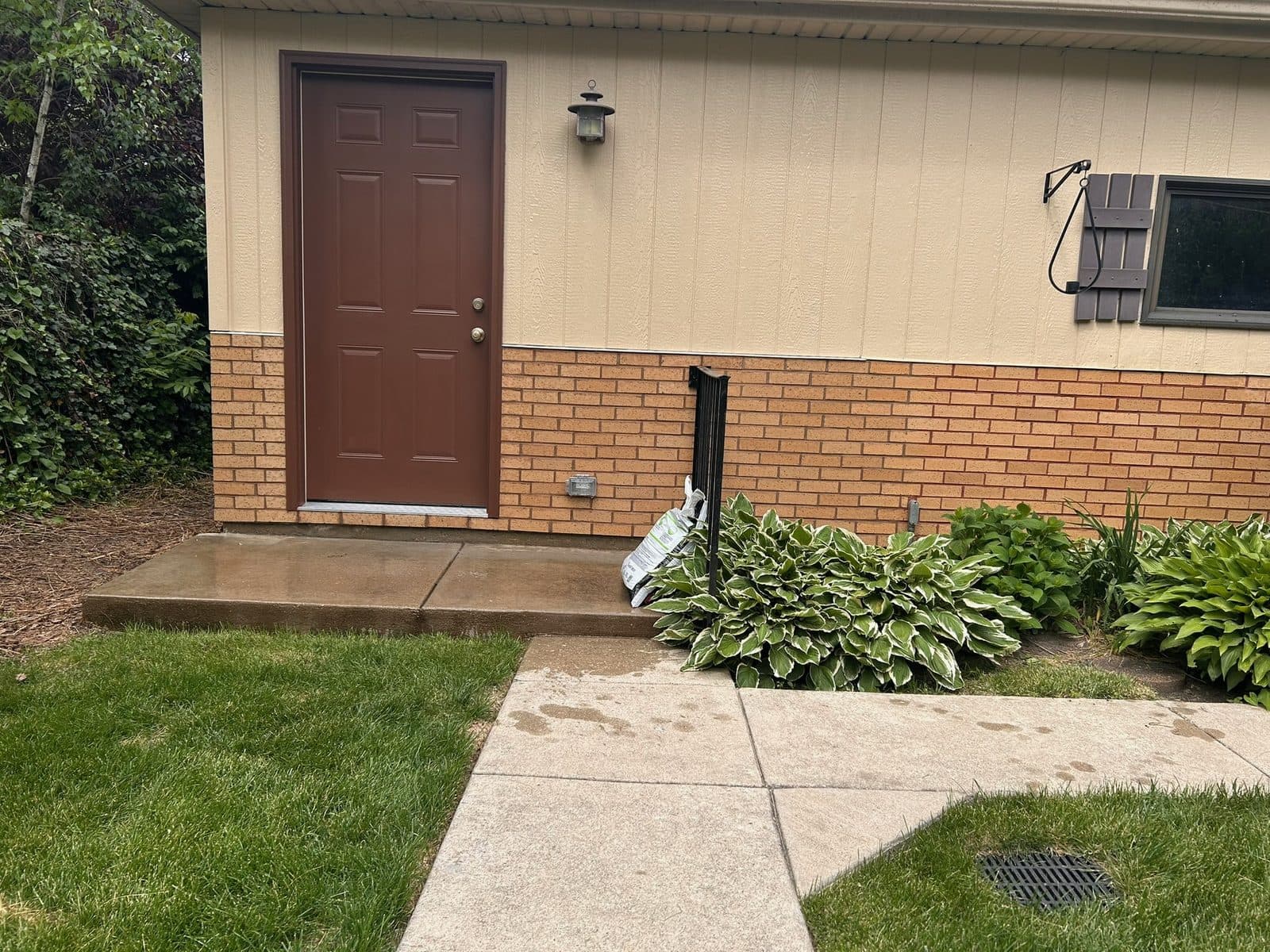
There is a wall on most Chicago buildings that nobody looks at, nobody photographs, and nobody budgets for — right up until it is the reason water is coming into a bedroom.
It is the side wall, four feet from the neighbour's, reachable only down a gangway you have to turn sideways to carry anything through. And on a very large share of the buildings in this city, it is the worst masonry on the property.
Paul Lally's Masonry Inc. is a family-owned, insured masonry contractor serving Chicago and the Chicagoland suburbs since 1988 — tuckpointing, brick repair and replacement, chimney repair and rebuilds, lintel replacement, masonry restoration, and waterproofing for residential and commercial properties. Built on Craftsmanship. Backed by Experience. Free on-site estimates — call (708) 448-8866.
Why the gangway wall goes first
Four things stack up against it, and they compound.
It never dries
A narrow passage between two buildings gets very little direct sun and almost no air movement. After every rain, the front and rear elevations dry within hours and the gangway wall stays damp for days.
That matters because masonry damage is a function of how long the material stays wet, not just how often it gets wet. A wall that is still saturated when the temperature drops overnight goes through the freeze-thaw cycle with water inside it. Repeat that dozens of times a season — which is exactly what a Chicago winter does — and the mortar erodes and the brick faces spall.
It is usually the cheaper brick
On older Chicago buildings, pressed face brick went on the street elevation and Chicago common brick went on the sides and rear. Common brick was made from local clay, fired unevenly, and is softer and considerably more absorbent than face brick.
So the wall that stays wettest is also the wall built from the material least able to handle being wet.
It collects the water
Downspouts discharge into gangways constantly, often onto a splash block that moved years ago, or straight onto grade against the foundation. Concentrated water at one point on a wall, every storm, for twenty years, will take out masonry that would otherwise have lasted another century. See downspouts, grading and drainage.
Gangways also tend to slope toward the building rather than away, hold snow long after it has melted elsewhere, and trap leaf litter that keeps the bottom courses damp year-round.
Nobody sees it
Which means deterioration that would have prompted a call three years earlier on a front elevation runs unnoticed until it reaches the inside.
The access problem, honestly
Here is the part that changes how the job is priced and scheduled.
Conventional staging often will not fit. A standard scaffold frame is wider than some gangways. Even where it fits, there may be no room to walk past it with a bucket.
Material has to be carried. On a front elevation, brick, mortar and tools stage beside the work. In a gangway they come down a passage, one load at a time, sometimes from the street.
There is nowhere to step back. A mason reads a wall by backing up and looking at it. In a four-foot gangway that is not possible, so the work is checked from the ends and from the neighbour's side where access allows.
Obstructions. Meters, service lines, AC condensers, fences, hose bibs, window wells and mature landscaping are all in the way, and some of them cannot be moved.
The neighbour's property. Any staging, material or worker footprint across the line needs permission.
None of this makes the work impossible. It makes it slower and more deliberate, and that is a real part of what access contributes to any masonry cost. Our guide to height, access and scaffolding covers the general principle; the gangway is its tightest case.
How access actually gets solved
- Narrow-frame scaffolding and sectional towers — purpose-built for tight passages, erected in sections and moved along the wall.
- Ladder-jack and pump-jack systems where the wall and working height allow.
- Roof-supported or suspended access for upper portions on taller buildings, where the roof structure and what is below permit it.
- Working from the neighbour's side with permission, which is frequently the most practical answer for the upper courses.
- Splitting the elevation — lower portion from the gangway, upper portion by another method.
Which one applies is a site decision, made at the assessment rather than discovered on the first morning.
Talking to the neighbour
This is the part homeowners dread and it is usually the easiest.
Ask early, ask in writing, and be specific: what the work is, which days, roughly how long, what will sit on their side and where, and that everything gets cleaned up and reinstated. Most neighbours agree without hesitation when they are asked three weeks out rather than at eight on a Monday morning.
Worth including:
- Dates and duration, honestly stated
- What footprint you need and for how long
- Protection for their plantings, fence, AC unit and windows
- A contact for anything that comes up
- Reinstatement — grade restored, plantings protected, gangway left clean
If the building genuinely shares a party wall rather than merely standing close, that is a different and more involved conversation about responsibility as well as access. See party walls and shared masonry.
What we find on gangway walls
A consistent list, in roughly the order it appears:
- Eroded and missing mortar joints, worst in the lower third and behind the downspout
- Spalling common brick, faces off, soft interiors exposed
- Efflorescence — white mineral bloom — proving water is moving through the wall
- Green and black biological growth on the permanently damp sections
- Bottom courses failing first, from splash, standing water and road salt tracked in
- Deterioration hidden behind the downspout that nobody could see until it came off
- Open joints at the window and door heads, where lintels are corroding out of sight
- Damp interior walls on that side of the building
- Foundation deterioration at grade, where the gangway slopes the wrong way
Our post on why one elevation is always worse explains the exposure pattern across a whole building.
Fix the water, not just the wall
Repointing a gangway wall without addressing why it stays wet is a repair with a short life. The order that works:
- Redirect the downspout discharge — extensions, or tie it into drainage that carries water away from the building.
- Correct the grade where the gangway pitches toward the wall.
- Clear the passage of leaf litter and debris that hold moisture at the base.
- Address the lintels, sills and any coping feeding water into the wall.
- Then repoint and replace units.
- Consider a breathable penetrating sealer on sound, repaired masonry — never a film-forming coating, which traps moisture in a wall that already struggles to dry. See is masonry waterproofing worth it.
That last point matters especially here. A gangway wall is the worst possible candidate for a coating that blocks vapour, because drying is precisely what it cannot do.
The chimney problem on a narrow lot
Worth separating out, because it is where access constraints bite hardest.
A great many Chicago buildings carry their chimney on or near the side wall, which means the stack sits directly above the gangway. Everything that makes the wall hard to reach makes the chimney harder — there is no room to set a ladder at a safe angle, nowhere to stage material, and a long carry to the roof.
It also means that anything that comes off the stack — a spalled brick, a piece of a failing crown — lands in a four-foot passage that somebody walks down to reach their back yard. That moves chimney work up the priority list on a narrow lot in a way it would not on a wide one.
The practical answer is usually roof-supported staging with proper roof protection, planned at the assessment. What it is not is somebody free-climbing off a ladder braced against a neighbour's fence. Our guides to signs your chimney needs repair and why the top of a chimney fails first cover what to look for from the ground.
Winter, and why gangway walls suffer most
Chicagoland's freeze-thaw cycle is the engine behind nearly all of this, and the gangway concentrates every part of it.
Snow pushed or shovelled into a narrow passage sits there long after the open yard has cleared, keeping the bottom courses saturated for weeks. De-icing salt tracked in from the walk collects at the base of the wall. Meltwater from the roof runs down a downspout into a passage that does not drain, refreezes overnight, and works its way into open joints.
Then the cycle repeats — thaw in the afternoon, refreeze after dark — dozens of times between December and March. Each cycle is an expansion event inside masonry that never got the chance to dry.
That is why the bottom three feet of a gangway wall is so often the worst masonry on an entire building, and why clearing the passage and getting the water out of it is genuinely half the repair. See winter masonry protection.
Materials and technique
Mortar matched in type, colour, sand and joint profile — and softer than the brick around it, which on soft Chicago common brick is not a preference but a requirement. Mortar harder than the unit drives stress into the unit and takes its face off. See type N versus type S mortar.
Replacement units matched on size first, texture second, colour third, toothed into the coursing rather than patched in as a rectangle. Gentle cleaning only — no sandblasting and no high-pressure washing, both of which strip the fired skin from brick and guarantee the next round of spalling.
Sequencing, and why it is worth doing at once
The expensive part of gangway work is getting set up in the gangway.
So if the side elevation needs repointing, and a lintel on that wall needs replacing, and the chimney on that side needs attention, doing all three in one mobilisation costs meaningfully less than doing them in three separate years. Group the work by access.
That is the single most useful budgeting principle on a narrow lot, and it is why an assessment should cover the whole elevation and everything on it rather than the one spot where water came through.
What drives the cost
Elevation area and height. The access method the site actually requires. How much of the work is repointing versus unit replacement or rebuilding. Whether matching brick can be sourced. Whether lintels, sills or a chimney are involved on the same elevation. Whether neighbour access is available. Weather windows, since mortar needs workable temperatures to cure.
We publish no figures, because a number that means anything requires walking the gangway. Free on-site estimate, in writing — call (708) 448-8866.
Go look at it this weekend
Take a flashlight down the gangway and look at the bottom three feet of wall, the area behind and below every downspout, and the joints around the windows. If the mortar rakes out with a key, if the brick faces are flaking, or if there is white bloom on the masonry, that wall is telling you something the front of your house is not.
Paul Lally's Masonry Inc. is family-owned, insured, and has been working Chicagoland's tight lots since 1988. Our name is on every job. Related services: tuckpointing and repointing, brick repair, brick replacement, lintel repair and replacement, and masonry sealing and waterproofing.
Built on Craftsmanship. Backed by Experience. Get a free on-site estimate or call (708) 448-8866.
Frequently Asked Questions
Why is my side wall in worse shape than the front?
Because it stays wet. A narrow gangway gets little sun and almost no air movement, so the wall dries slowly after every rain, and slow-drying masonry going through freeze-thaw deteriorates far faster. It is also usually common brick rather than face brick, which is softer and more absorbent.
Can a mason even work in a four-foot gangway?
Yes, with the right approach. Narrow-frame scaffolding, sectional towers and ladder-jack systems all work where conventional staging will not, and the plan is made before mobilisation rather than improvised on the day.
Do I need my neighbour's permission?
If any part of the work, the staging or the material handling sits on their property, yes — and it is worth asking in writing well in advance. Most neighbours agree readily when asked early and told how long it will take.
Does tight access cost more?
It affects the cost, because access is a real part of any masonry job. Narrow staging carries less material and takes longer to erect and move, and the work itself is slower when there is no room to step back. It is one of the factors we explain at the estimate.
Why does the same corner of my house keep failing?
Almost always a gutter or downspout discharging there. Concentrated water at one spot on a wall, every storm, for years, will destroy masonry no matter how sound it started. Fixing the discharge is part of fixing the wall.
Can you reach my side wall from the roof instead?
Sometimes, on the upper portion, using roof-supported staging or suspended access where the building and roof allow. It depends on the building height, the roof structure and what is below, and it is assessed on site rather than assumed.
What about the wall I share with the building next door?
A genuinely shared party wall is a different conversation, involving both owners and usually a written agreement about responsibility and access. Where buildings merely sit close without sharing a wall, each owner is responsible for their own masonry but still needs access across the line.
Do I need a permit to put scaffolding up?
Within your own property, generally not for the staging itself, though the underlying work may require a permit. Occupying a sidewalk, parkway or street with staging or a dumpster typically does require separate authorisation, and requirements are set by the municipality.
How long does gangway work take compared to a front elevation?
Longer, for the same square footage. Material has to be carried rather than staged beside the work, staging moves more often, and there is no room to step back and read the wall. We give a realistic window at the estimate rather than an optimistic one.
How much does masonry repair cost on a narrow lot?
It depends on the elevation area, the access method required, how much is repointing versus rebuilding, and whether units must be matched. Paul Lally's Masonry provides a free on-site estimate in writing.