
Residential Masonry Restoration · Orland Park, IL
Residential Masonry Restoration in Orland Park, IL — One Plan Instead of Five Repairs
If you've paid for three masonry repairs in five years and a new problem keeps turning up, you didn't need a fourth repair. Paul Lally's Masonry has restored Chicagoland brick homes since 1988.
Quick Answer
Residential masonry restoration in Orland Park, IL treats the whole exterior as one system — tuckpointing, brick replacement, lintels, sills, chimney, and waterproofing sequenced into a single plan rather than separate repairs. Paul Lally's Masonry has restored Chicagoland brick homes since 1988. Free on-site estimates: (708) 448-8866.
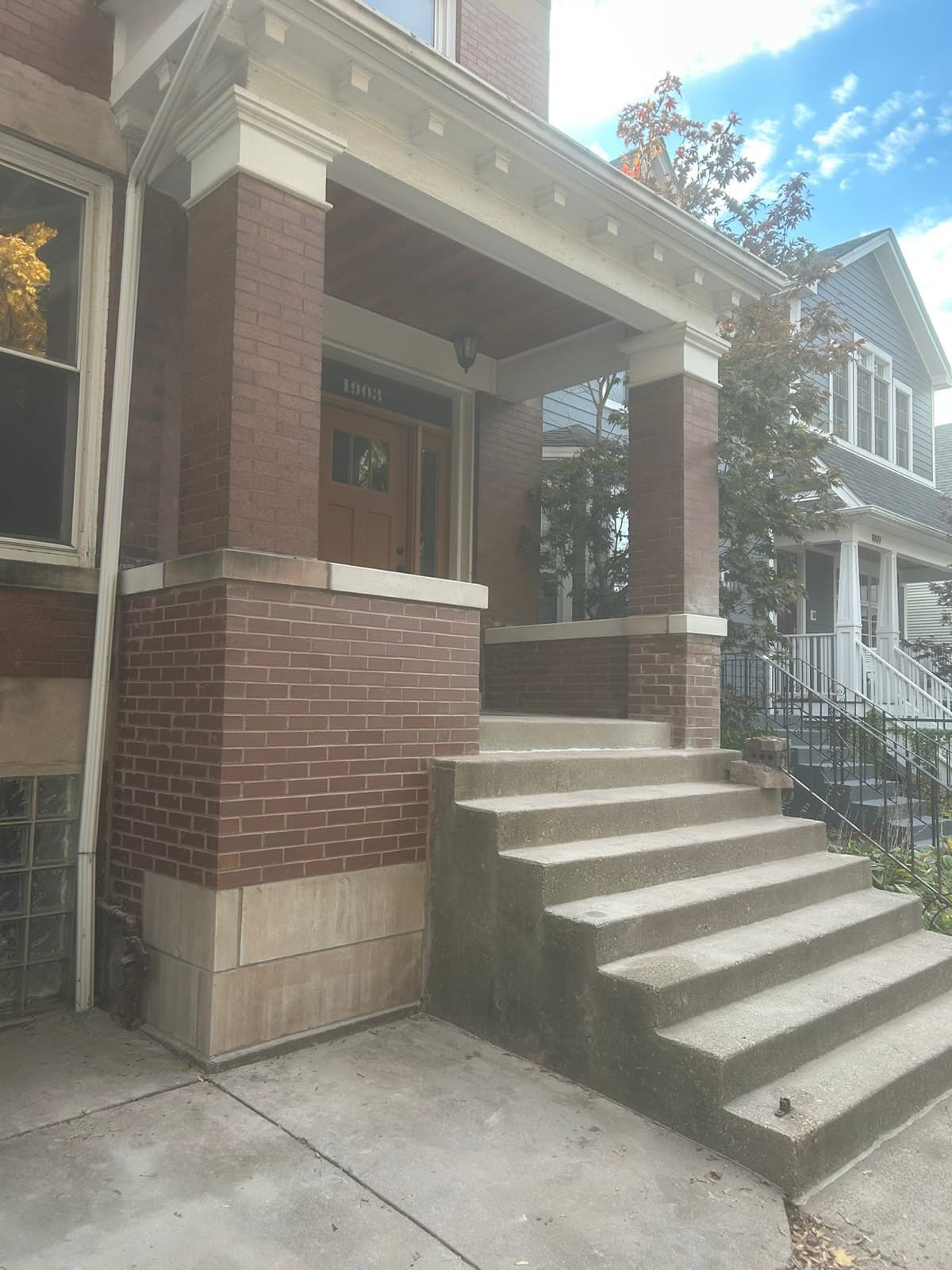
Here's a pattern we see constantly in Orland Park. A homeowner had the chimney repointed four years ago. Two years ago somebody replaced a few spalled bricks on the north wall. Last spring a different contractor caulked around the front windows. And now there's a fresh crack over the garage door and a damp patch on an upstairs wall.
Four separate invoices. Four separate contractors. Nobody ever looked at the house as one thing.
Residential masonry restoration in Orland Park, IL is the alternative — assessing the whole exterior as a single system, finding every place water is getting in, and sequencing the work so the repairs reinforce each other rather than working around each other. Paul Lally's Masonry has been doing it that way since 1988.
Repair or restoration? A test you can apply yourself
You need a repair when one specific thing failed, the surrounding masonry is sound, and fixing it solves the problem. That's most jobs, and we'll say so.
You need restoration if any of these are true:
- You've had two or three masonry repairs in recent years and something new keeps turning up.
- Water is getting in and nobody has been able to say definitively where.
- Mortar joints are soft across whole elevations, not just in patches.
- Several components are failing at once — joints, brick faces, a lintel, the chimney.
- The house is forty-plus years old and has never had significant masonry work.
- You plan to stay a long time and would rather have a plan than a series of surprises.
Why sequence is the whole point
The repairs interact, and doing them out of order wastes money:
- Repointing a wall while a rusted lintel keeps expanding — the new joints crack again as the steel keeps lifting the brick.
- Sealing brick that still has failing joints — you've coated the leak path and slowed the wall's ability to dry.
- Rebuilding a chimney while the flashing stays bad — the leak survives the rebuild.
- Fixing the wall before fixing the gutter that's been soaking it — same damage, new timeline.
The correct order is: cause before symptom. Top of the house before the bottom. (So finished work doesn't get rained on by unfinished work above it.) Structure before surface. Sealing dead last.
What a restoration scope covers
Depending on the house, some or all of:
- Tuckpointing and repointing — failed joints cut to depth and repacked with matched mortar
- Brick replacement — spalled, cracked, or crumbling units swapped for matched brick
- Lintel repair and replacement — the rusted steel above windows, doors, and garage openings
- Chimney repair or rebuild — above the roofline, plus crown, cap, and flashing coordination
- Limestone and sill repair — sills, trim, and stone at grade
- Caulking and joint sealant — window and door perimeters and movement joints
- Foundation masonry repair — the base course and grade-level masonry
- Waterproofing — a breathable penetrating sealer, last, only after everything above is sound
Signs your Orland Park home is ready
- Mortar you can dig out with a key across an entire elevation
- Spalling brick — faces flaking, powdering, or popped off
- A horizontal crack above a window or garage door, often with rust staining bleeding below it
- Step cracks climbing diagonally through the joints
- A chimney with soft joints, a cracked crown, or no cap
- Efflorescence — white chalky salt deposits on the brick
- Damp, musty, or stained interior walls on exterior-facing rooms
- Deteriorated sills or crumbling masonry at grade
- Brick or mortar debris on the ground after a hard freeze
- A previous repair that's already failing
How we plan and run a restoration
- Walk the entire exterior — all four elevations, the chimney, and the base course at grade. Not only the wall you called about.
- Diagnose the water. Nearly every masonry failure on a house traces back to water reaching somewhere it shouldn't: joints, lintels, chimney, coping, gutters, grade, splashback.
- Separate structural from cosmetic, plainly, so you know what's genuinely urgent and what's maintenance.
- Sequence the work using the order above.
- Put it in writing — phased if that suits your budget and timeline.
- Match the materials — mortar type, color, sand, and joint profile; brick size, color, and texture; salvaged units where matching matters.
- Do the work in order, cleaning up as we go.
- Walk the finished house with you and tell you what to watch and when to look again.
Materials, and the rule that governs the job
Mortar matched for type, color, sand, and joint profile — standard Type N for most residential work, softer mixes on older or softer brick, Type S only where structure and exposure genuinely call for it. Brick matched for size, color range, and texture, with salvaged units where a modern brick would read wrong. Sealers breathable and penetrating only, never a film-forming coating.
Underneath all of it: mortar should always be softer than the brick. The joint is meant to be the sacrificial element, absorbing thermal and moisture movement and straightforward to replace when it wears. Pack a modern high-strength mortar against softer brick and you invert that — the brick face becomes what gets sacrificed, spalling at the joint edges. A "stronger" repair that quietly destroys the wall is the most common bad masonry work we're called in to correct, and it isn't reversible.
What drives the cost
- Number of elevations in scope, and whether the work is phased
- Height and access — a ranch off ladders versus a two-story needing staging
- Ratio of repointing to brick replacement — replacing units is slower than repacking joints
- Chimney condition — repoint, crown work, or a full above-roofline rebuild
- Lintels — how many are failing and how much brick must be shored and relaid
- Brick and mortar matching difficulty, including sourcing lead time
- Site conditions — landscaping, decks, tight side yards, hardscape to protect
- What's found once joints are open — the honest variable on every restoration
No credible mason prices a restoration from the driveway. Paul Lally's Masonry gives a free on-site estimate in writing after walking the whole house.
Local context: Orland Park's brick, and what it's doing now
Orland Park's growth ran hard from the 1960s through the 1990s and kept going into the 2000s. That produced a distinctive masonry profile: brick ranches and split-levels in the older sections, then wide stretches of subdivision housing with brick-veneer fronts over frame, full masonry on some elevations, brick chimneys, stone accents, wide picture windows, and two- and three-car garage openings.
Those openings matter. Wide spans mean long steel lintels under real load, and most of that steel was never galvanized. Thirty to sixty years in, it's corroding on schedule — rust expands to several times the volume of the steel it came from, and with nowhere to go it lifts the brick above the opening. That's why the garage and the big front window are so often the first places an Orland Park homeowner notices a crack. See failing lintels and cracked brick above windows.
Being largely brick veneer also changes the diagnosis. A veneer wall is designed to let water in and drain it back out through a cavity and weep holes — so leaks there are frequently about blocked weeps, failed flashing, or corroded ties rather than the brick face. Our guide to brick veneer vs. solid masonry explains why that distinction changes every repair.
The failures cluster where you'd predict: north and west elevations taking the weather, the bottom courses where snowpack and splashback sit, around and under sills, at chimney shoulders, and directly above wide openings. Add Cook and Will County freeze-thaw cycling — absorbed water expanding roughly nine percent each time it freezes — and you have the standard Orland Park restoration profile.
That's a maintenance cycle arriving on schedule, not a defect in your house.
Related masonry services in Orland Park
A restoration draws on tuckpointing and repointing, brick repair, brick replacement, lintel repair and replacement, chimney repair and rebuilds, limestone and sill repair, foundation masonry repair, caulking and joint sealant, and masonry waterproofing. For period homes, see historic masonry restoration.
Nearby and related: tuckpointing in Orland Park, brick repair in Orland Park, masonry restoration in Orland Park, lintel replacement in Orland Park, and residential masonry restoration in Palos Heights.
One plan, in the right order
Paul Lally's Masonry Inc. is a family-owned, insured masonry contractor serving Chicago and the Chicagoland suburbs since 1988 — tuckpointing, brick repair and replacement, chimney repair and rebuilds, lintel replacement, masonry restoration, and waterproofing for residential and commercial properties. Built on Craftsmanship. Backed by Experience.
We'll walk your whole house, tell you what's urgent and what can wait a season, and give you a plan in writing — phased if that's what makes sense. Our family name is on every job.
Free on-site estimates — call (708) 448-8866 or request an estimate online.
Residential Masonry Restoration in Orland Park, IL — Frequently Asked Questions
How do I know if I need masonry restoration or just a repair?
A repair is right when one specific thing failed and the rest of the masonry is sound. Restoration is right when problems keep appearing somewhere new, mortar is soft across whole elevations, several components are failing at once, or the house is forty-plus years old and has never had significant masonry work. Three repairs in five years is the clearest signal.
How much does residential masonry restoration cost in Orland Park, IL?
There's no square-foot rate, because no two houses need the same scope. Cost is driven by how many elevations are involved, height and access, the ratio of repointing to brick replacement, whether the chimney and lintels are included, and how difficult the original brick and mortar are to match. Paul Lally's Masonry provides a free on-site estimate in writing.
Can the work be split across two seasons?
Yes, and on most homes it should be. We sequence by risk — anything structural or actively letting water in goes first, then the weather elevations, then preventive work like sealing. What matters is that the whole house gets assessed at once, even when the work happens over more than one season.
Why does the order of the repairs matter?
Because the repairs interact. Repointing a wall while a rusted lintel keeps pushing it apart is wasted money, sealing brick that still has failing joints traps water inside, and rebuilding a chimney while the flashing stays bad leaves the leak in place. Restoration is mostly about doing the right things in the right order.
Will the restored brick match the rest of my Orland Park home?
Matching is the core skill of the work. We match replacement brick for size, color range, and texture, and mortar for type, color, sand, and joint profile. New mortar reads slightly fresh for the first season and then blends as it weathers — repairs look like patches when the mortar color or joint profile is wrong, not because the material is new.
My house was built in the 1980s. Is it old enough to need this?
Quite possibly. Masonry from the 1970s and 1980s is now forty to fifty-plus years old, which is exactly where original mortar joints reach the end of their service life and original steel lintels over wide openings begin rusting. Age alone isn't the trigger, though — receding joints, spalling brick, and cracks above windows are.
How long does a residential masonry restoration take?
A single-elevation scope can take days, while a full exterior including chimney, lintels, and brick replacement on a two-story home commonly runs one to three weeks of on-site work. Weather moves schedules because mortar needs workable temperatures to cure. We give a realistic window at the estimate rather than a best case.
Is the chimney part of a restoration?
It should be. The chimney is the most exposed masonry on the house — weather on four sides above the roofline — so it's usually in worse shape than the walls and it's a frequent water entry point. Leaving it out is how homeowners end up with a beautifully repointed house that still leaks.
Residential Masonry Restoration in Nearby Areas
Other Masonry Services in Orland Park, IL
Learn more about our residential masonry restoration services across Chicagoland, or view all service areas.
Free on-site estimates across Chicagoland.