
Homeowner Education · Chicagoland, IL
Brick Sizes, Bonds and Coursing: Why the Replacement Brick Doesn't Sit Right
Homeowners judge a brick repair on colour. Masons judge it on size and coursing — because a unit that is a shade off disappears at twenty feet, and a unit that is the wrong height never will.
2026-09-23
Quick Answer
A replacement brick reads as a patch mainly because of size and coursing, not colour. Brick dimensions changed across eras — Chicago common, modular, oversize and utility units all course differently — so a unit of the wrong height throws off the joint lines permanently while a slightly off colour weathers in. Paul Lally's Masonry matches Chicagoland brick, since 1988 — (708) 448-8866.
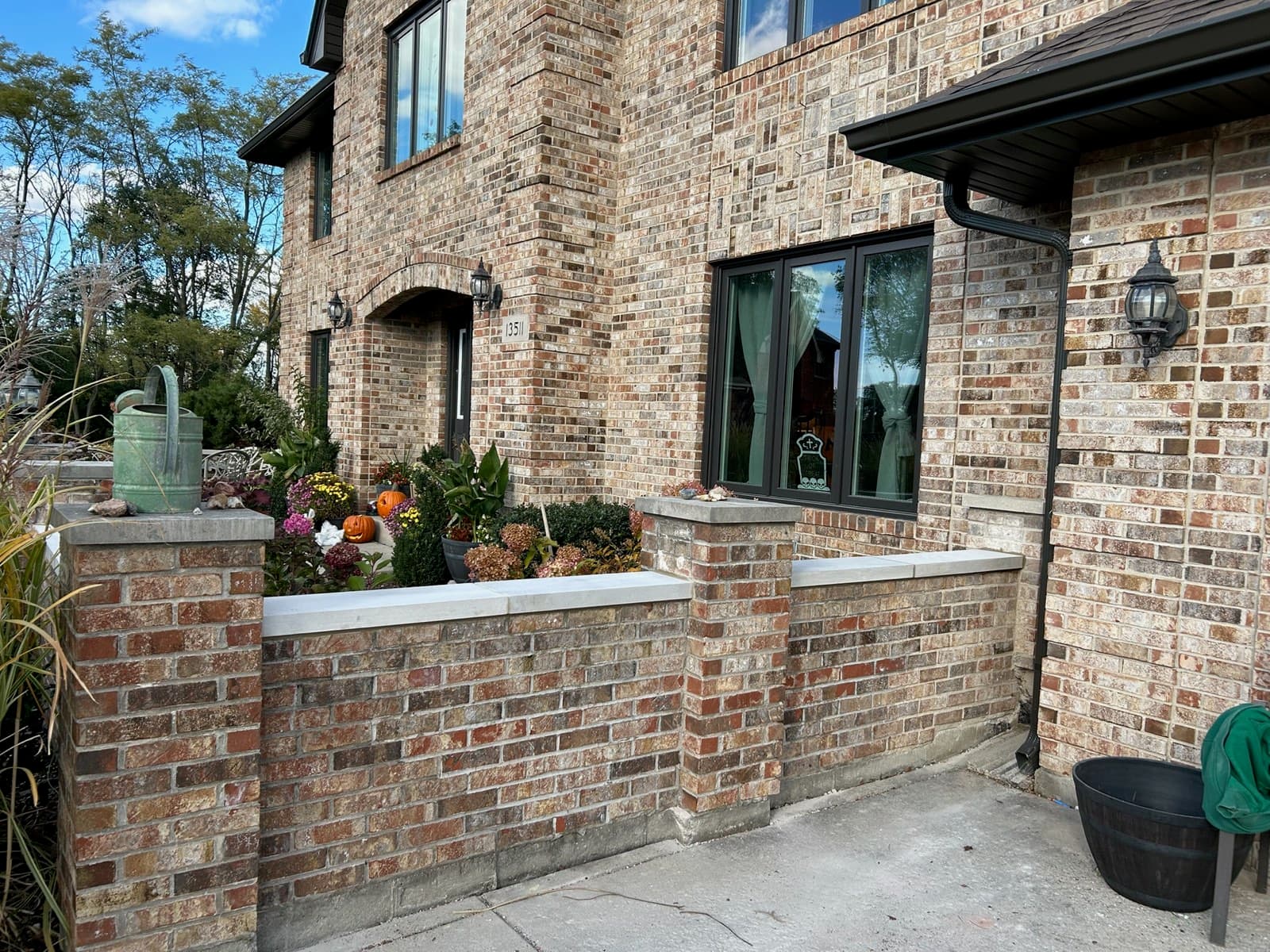
Homeowners judge a brick repair on colour. It is the obvious thing to look at.
Masons judge it on size and coursing — and that difference explains nearly every repair anybody has ever been unhappy with. A unit that is a shade off in colour disappears at twenty feet and weathers in over a few years. A unit that is the wrong height never disappears, because it throws the joint lines off, and joint lines are what your eye actually follows across a wall.
Paul Lally's Masonry Inc. is a family-owned, insured masonry contractor serving Chicago and the Chicagoland suburbs since 1988 — tuckpointing, brick repair and replacement, chimney repair and rebuilds, lintel replacement, masonry restoration, and waterproofing for residential and commercial properties. Built on Craftsmanship. Backed by Experience. Free on-site estimates — call (708) 448-8866.
Coursing is the thing your eye reads
Before sizes, the concept that makes them matter.
Coursing is the repeating vertical rhythm of a wall: one brick plus one mortar joint, over and over, up the elevation. It is why the horizontal joint lines on a well-built wall run dead straight and level for thirty feet.
Your eye is extremely good at spotting a break in that rhythm, even when it cannot say why. Replace a brick with a unit that is a quarter inch shorter in height, and the mason has two bad options: thicken the mortar joints around it to make the coursing line up, or let the coursing step. Either one is visible forever.
That is why a competent mason asks about dimensions before colour.
The sizes actually in Chicagoland walls
There is no single "brick size," and a wall in this region can contain several standards depending on when and how it was built.
Older common and face brick. The nineteenth- and early-twentieth-century units in bungalows, greystones, two-flats and workers' cottages. Dimensions varied by manufacturer and by era, and they are not what a modern brick yard stocks.
Chicago common brick. The local workhorse — made from regional clay, fired unevenly, and used for side and rear elevations while pressed face brick went on the street front. Its salmon-to-buff-to-pink colour range is a direct result of uneven firing, which is exactly why new production cannot reproduce it. Our guide to Chicago brick bungalows and greystones covers the stock.
Modular brick. The modern standard, sized so that units plus joints work out to neat whole-inch modules. It courses cleanly with itself and frequently not with anything older.
Oversize, utility and jumbo units. Common in mid-century and later construction — taller units that cover more wall with fewer courses. A modular brick dropped into an oversize wall is immediately obvious.
The practical rule: match the size first, the texture second, the colour third. Get that order backwards and you get a repair everyone notices.
Bond patterns, and why a repair has to respect them
The bond is how the units are arranged and interlocked.
Running bond — every course offset half a brick. The default on veneer walls and most modern construction.
Common bond — running bond with a header course every fifth, sixth or seventh course, where bricks are turned end-on to tie the outer wythe to the one behind it. Extremely common on older Chicago solid masonry, and it is structural, not decorative.
Flemish and English bonds — headers and stretchers alternating within or between courses. Found on older and higher-end work.
Stack bond — no offset at all, joints aligned vertically. Decorative, and weak without reinforcement.
Why it matters on a repair: on a solid masonry wall in common bond, those header courses are doing a job. A repair that replaces headers with stretchers because stretchers were what was on the truck both looks wrong and quietly breaks the tie between wythes. Our post on brick veneer versus solid masonry explains why that distinction changes the whole repair.
Where the replacement brick comes from
| Source | Best for | Trade-off |
|---|---|---|
| Salvage yards | Older and historic walls | Supply is variable; sizes must be verified unit by unit |
| Current production | Mid-century and newer veneer | Easy to source; colour and texture rarely exact on old walls |
| Harvested from your own building | Prominent elevations where the match must be right | Requires a hidden elevation to take from, and new brick goes there instead |
That third route is the one most contractors never raise and the one that produces the best result on a front elevation. If the back of a detached garage or a rear wall behind a fence can donate forty units, the repair on the street face becomes invisible and the new brick lives where nobody looks.
Mortar is half the match
A perfect brick in the wrong mortar still reads as a patch, because roughly a fifth of the visible surface of a brick wall is joint.
Joint thickness. Old walls were often laid with thinner or thicker joints than modern practice. The replacement has to match the wall, not the current convention.
Joint profile. Concave, weathered, raked, grapevine, flush — the tooling shadow changes how the whole elevation reads. See mortar joint profiles.
Colour and sand. The sand does most of the colour work in mortar. Change the sand source and the joint changes colour with identical cement and lime.
Hardness — and this one is structural, not cosmetic. Mortar must stay softer than the brick around it. Mortar is the sacrificial element, designed to take movement and weathering so the units do not have to. Put hard modern mortar around soft century-old brick and the stress goes into the brick instead, spalling faces that cannot be replaced. On older Chicagoland masonry that usually means Type N or softer rather than Type S. See type N versus type S mortar and mortar matching in tuckpointing.
One more detail: wet mortar is always darker than cured mortar. A colour judged on a damp joint will read lighter once it dries, and by then it is on the wall.
How the work is actually done
- Identify the wall. Unit size, bond pattern, joint thickness and profile, mortar hardness, and whether it is solid masonry or veneer.
- Find the water source. Brick spalls because water got in and froze — open joints, a failed sill, a corroding lintel, coping, or gutter discharge. Replacing units without fixing that is a repair on a timer. See spalling brick.
- Source the units, verifying dimensions against the wall rather than against a catalogue.
- Cut out the failed brick carefully, without chipping the neighbours. Slow work, and where damage gets done by people in a hurry.
- Tooth the opening so new work interlocks with existing coursing instead of forming a straight-edged rectangle.
- Set the units, reproducing the bond — headers where headers belong.
- Point and tool to the existing joint thickness and profile, with matched mortar.
- Clean down gently. No sandblasting and no high-pressure washing — both strip the hard fired skin from brick and guarantee the next round of spalling. See power washing and sandblasting brick.
How to check the match yourself, before the crew leaves
You do not need a mason's eye to catch the two mistakes that matter. Both checks take a minute.
Sight down the joint lines. Stand at one end of the wall and look along a horizontal joint that runs through the repaired area. It should stay dead straight and level the whole way. If the line kinks, steps, or the joint visibly fattens and thins around the new units, the coursing is off — and that is the fault you will see every day for the rest of the wall's life.
Step back to the street. Then judge the colour. Not from three feet, where every repair on every building ever made is visible, but from where the wall is actually seen. A match that disappears at normal viewing distance is a good match, and one that vanishes at three feet is a match nobody achieved on a hundred-year-old wall.
Wet it. A splash of water on the repaired area and the wall beside it shows how the two will read after rain. Differences in absorbency show up here that are invisible dry, and it is worth knowing before the scaffolding comes down.
Check the bond. If the wall has header courses at intervals, confirm they continue through the repair.
Raise anything now rather than later. Adjusting a handful of units while the crew and access are still on site is a conversation; raising it in spring is a project.
The one exception: when replacement is the wrong answer
Sometimes the honest recommendation is not to replace units at all.
Where spalling covers a large area of an elevation, where units are loose across a whole section, where the bond between wythes has failed, or where the wall has moved, picking out individual bricks is treating symptoms on a wall that needs rebuilding. Replacement unit by unit in that situation costs more over a few years than taking the section down and relaying it properly, and it looks worse throughout.
The dividing line is roughly this: scattered failures in a sound wall get replaced; concentrated failures in a wall that has lost its integrity get rebuilt. A contractor who will only ever quote one of those two is not assessing your wall. See brick wall rebuilding and when to rebuild.
Why this is not a DIY job
Brick replacement looks like the most approachable masonry repair there is: remove a bad unit, put a good one in.
What actually decides the result is a series of judgements a homeowner has no way to make — whether the unit on the shelf will course with the wall, whether the bond carries headers that must be reproduced, how thick and what profile the joints should be, and whether the mortar is softer than the brick. Get the last one wrong and you will not find out for five years, at which point the faces are coming off the bricks either side of your repair.
The Chicagoland context
Three regional realities shape this work.
A very wide range of eras in a small area. A single block can hold an 1890s greystone, a 1920s bungalow, a 1960s ranch and a 2015 teardown replacement — four different unit sizes, four bonds, four mortars.
Chicago common brick's variability. Uneven firing gave it a colour range within a single wall, which is forgiving on colour and unforgiving on everything else. It is also soft and absorbent, so it is the material most damaged by hard mortar and aggressive cleaning.
Freeze-thaw. Dozens of thaw-and-refreeze cycles a season working on any brick whose fired skin has been lost. It is why spalling spreads outward from a damaged unit if nothing is done, and why the water source matters as much as the unit.
What drives the cost
Number of units and how scattered they are — twenty in one area is a different job from twenty across three elevations. Height and access. Whether matching brick can be sourced, salvaged or harvested. How much repointing goes with the replacement. Whether a sill, lintel or coping has to be addressed as the water source. Weather windows, since mortar needs workable temperatures to cure.
We publish no figures, because a number that means anything requires seeing the wall. Free on-site estimate, in writing — call (708) 448-8866.
The short version
Colour is what people ask about. Size, coursing, bond and joint are what make a repair invisible or permanent. Ask any mason quoting your wall which unit they intend to use and how it courses — the answer tells you a great deal about the repair you are going to get.
Paul Lally's Masonry Inc. is family-owned, insured, and has matched Chicagoland brick since 1988. Our name is on every job. Related services: brick replacement, brick repair, tuckpointing and repointing, and masonry restoration.
Built on Craftsmanship. Backed by Experience. Get a free on-site estimate or call (708) 448-8866.
Frequently Asked Questions
Why does my replacement brick look wrong even though the colour matches?
Almost always size. If the replacement unit is a different height or length than the original, the mortar joints have to be thickened or thinned to make the coursing line up, and that mismatch in joint thickness reads from across the street far more than colour does.
Is all brick the same size?
No. Brick dimensions have changed repeatedly, and Chicagoland walls contain several standards — older common and face brick, modern modular units, and the oversize and utility brick used in a lot of mid-century construction. They do not course together.
What is coursing?
The repeating vertical rhythm of brick plus mortar joint up a wall. It is what makes joint lines run straight and level across an elevation, and it is the thing a mismatched replacement unit disrupts permanently.
What is toothing?
Cutting a repair area so the new brick interlocks with the surrounding coursing rather than sitting in a straight-edged rectangle. It ties the new work into the old structurally and makes the repair read as part of the wall.
Can you match Chicago common brick?
Closely, usually through salvage. Chicago common brick was made from local clay and fired unevenly, which is exactly why its colour range is so wide and why new production does not reproduce it. Salvaged units from the same era are the reliable route.
What is the best source for matching brick?
Three options: salvage yards, current production matched on size and texture, or harvesting units from a hidden elevation of your own building and putting the new brick there. The third gives the best result on a prominent wall and is the one most people never consider.
Does the bond pattern matter on a repair?
Yes. A wall laid in common bond has header courses at intervals that tie it together, and a repair that ignores them both looks wrong and breaks the tie. The repair has to reproduce whatever pattern the wall was built in.
Will the new brick eventually match?
It weathers in and the difference narrows considerably over a few years, though a century-old wall carries soot, weathering and freeze-thaw history that no new unit reproduces exactly. Judge a match at normal viewing distance rather than from arm's length.
Should the joints be repointed at the same time?
Usually at least locally, because new units set into old joints read as an island. If the surrounding joints are failing anyway, doing both while the access is set up costs less than doing them separately.
How much does brick replacement cost?
It depends on how many units, how scattered they are, height and access, whether matching brick can be sourced or salvaged, and how much repointing goes with it. Paul Lally's Masonry provides a free on-site estimate in writing.