
Chimney Repair & Rebuilds · Bridgeview, IL
Chimney Repair in Bridgeview, IL — On a Low Roof, the Flashing Matters More Than the Brick
Most chimney advice is written for tall stacks on steep roofs. Bridgeview is a village of low-slung post-war ranches, where the chimney barely clears the roof — and on a short stack the leak is far more likely to be at the flashing than in the brick.
Quick Answer
Paul Lally's Masonry Inc. provides chimney repair and rebuilds in Bridgeview, IL — repairing crowns, flashing and caps, repointing and rebuilding short stacks on the village's low-slope post-war roofs. Family-owned since 1988, insured. Free on-site estimates — call (708) 448-8866.
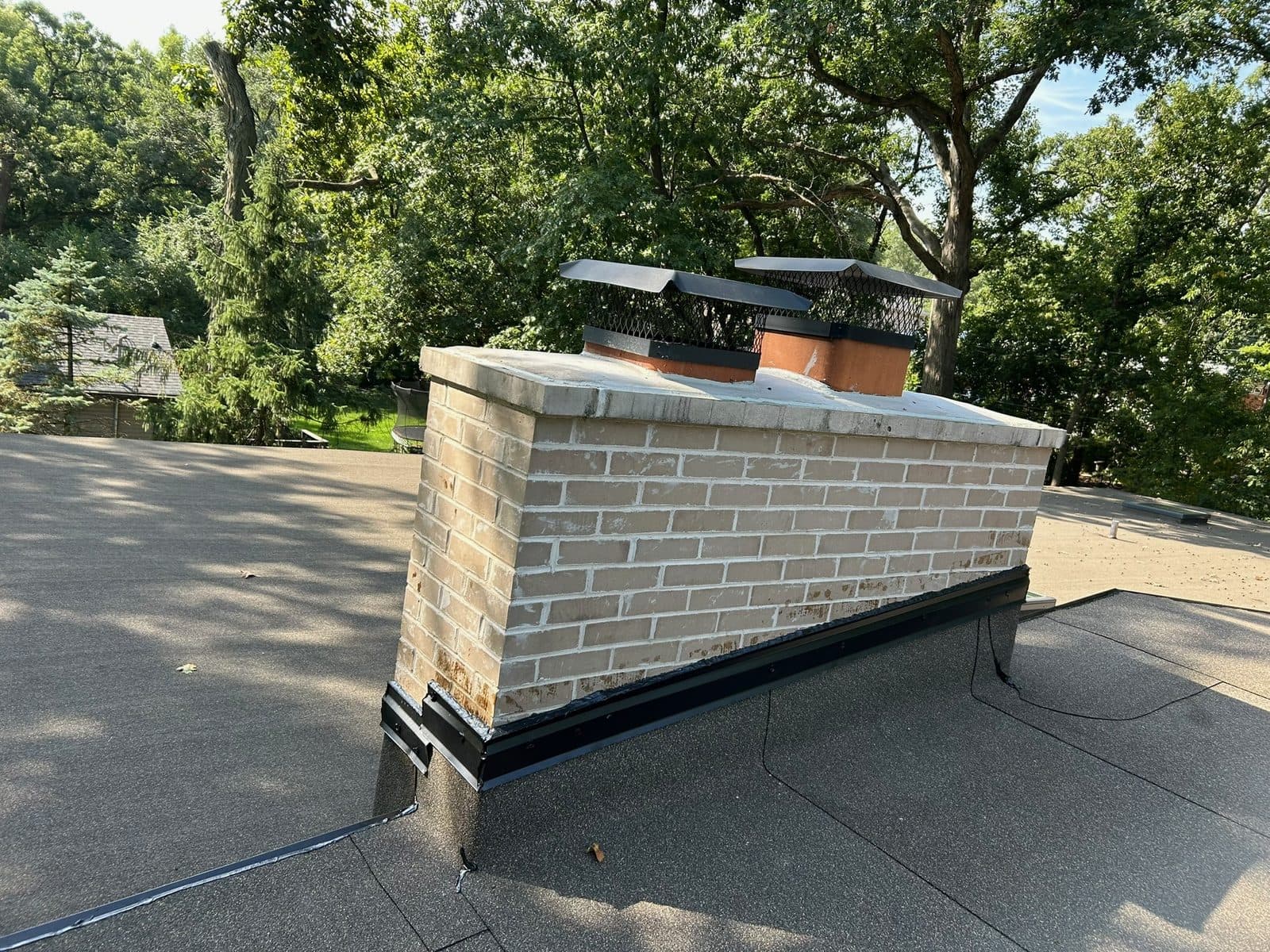
Chimney Repair in Bridgeview, IL
Chimney repair in Bridgeview, IL usually turns on something most chimney advice never mentions: how far your chimney actually stands above the roof. Paul Lally's Masonry Inc. repairs and rebuilds chimneys throughout Bridgeview and the surrounding southwest suburbs. Family-owned since 1988, insured, free on-site estimates. Call (708) 448-8866.
Because almost everything written on this subject assumes a tall stack on a steep roof. That is not what most of this village has.
Short Stacks Change the Diagnosis
Bridgeview built out largely in the post-war decades — compact ranches, Cape Cods and modest brick homes on generous but tightly-spaced lots, with shallow-pitched roofs. On a lot of these houses the chimney clears the roof by only a few courses.
That geometry changes three things, and no competitor page in this market acknowledges any of them.
The crown and the top course are the whole exposed chimney. On a tall stack, deterioration grades downward — worst at the top, better as it descends, sound at the roofline. On a short stack there is barely any gradient to read. What you have is a crown and two or three courses, and if the crown has failed, that is most of the problem.
Flashing becomes the dominant water path. On a tall chimney, most water gets in through the crown and the walls simply because there is so much of both. On a squat chimney, the ratio flips: there is very little masonry above the roof and a full perimeter of flashing at the junction. Proportionally, that junction is where the leak usually is.
Snow sits against it. On a low-slope roof, snow banks up against the chimney and stays there instead of sliding clear. The courses nearest the roof line spend weeks sitting in meltwater, going through freeze-thaw cycle after cycle. That is why on these houses the bottom of the exposed stack is often as bad as the top — which is the reverse of what the textbooks describe.
On a Bridgeview ranch, "my chimney leaks" is a flashing question until proven otherwise.
How the Flashing Should Actually Be Built
Worth knowing, because the shortcut version is everywhere.
Step flashing is metal woven into the shingles course by course up each side of the chimney, each piece lapping the one below so water is carried over the top of the next rather than behind it.
Counterflashing is the piece that makes it work. It is set into a cut groove in the mortar joint, mechanically secured, sealed, and bent down to lap over the step flashing — so water running down the brick face is thrown out onto the roof instead of getting behind the assembly.
The failure you will recognise: metal simply smeared onto the face of the brick with roof cement or caulk, with no groove cut and nothing holding it mechanically. It looks sealed on day one. Sealant is a wear item, a brick face is not a bonding surface, and within a few seasons water runs straight behind it.
Crown and Cap Are Not the Same Thing
The crown is the sloped slab across the top of the masonry, shedding water off the chimney. A proper one is formed, sloped, and overhangs the brick with a drip edge so runoff drips clear. What is on a great many chimneys instead is a thin mortar wash troweled flush — which cracks within a few seasons and then holds water rather than shedding it.
The cap is the cover over the flue opening, keeping out rain, snow, animals and debris. Cheapest protection on a chimney, and missing on a startling number of them.
Together those two are a small share of the cost and most of the service life.
The Modern Problem: An Oversized Flue
A great many chimneys of this vintage were built to serve a furnace that no longer exists. When a high-efficiency unit went in and vented out a sidewall, it frequently left the water heater alone in a flue sized for something far larger.
That exhaust is cooler, wetter, and nowhere near enough to warm the flue, so it condenses on the way up — soaking the tile and mortar joints from the inside while weather works from the outside. If your furnace was replaced and the flue was never looked at, that is worth doing.
Signs of Chimney Damage
From the ground, with binoculars:
- A cracked, spalled or missing crown, or a thin mortar wash instead of a real one
- Flashing lifted, rusted, or clearly just caulked to the brick face
- Mortar joints receding or open in the exposed courses
- Spalling brick — faces flaked or sheeted off
- A missing, rusted or dislodged cap
- Clay flue tile cracked or sitting proud of a broken crown
- Dark staining or white efflorescence on the stack
- Deterioration at the roof line as bad as at the top — the snow-load signature
- A visible lean, or a gap opening between chimney and house
Inside, check the attic where the chimney passes through — staining shows there long before a finished ceiling.
Risks of Waiting
Chimney damage accelerates itself. Once the crown cracks, water enters the top directly instead of running off it, saturating the masonry and speeding up freeze-thaw. Open joints admit more water, which opens them further, while that water runs into flashing, framing and finishes.
A short stack that has lost its mortar is still loose brick above a roof. And where anything vents into it, a cracked or spalled flue is a combustion-safety question that warrants a qualified inspection rather than a wait-and-see.
Our Process
- Inspect from the roof — not the driveway — plus the flue and the interior.
- Assess the flashing first on a short stack, because that is where the odds are.
- Sound the masonry to find where sound material begins.
- Establish the rebuild depth and confirm it with you before demolition.
- Set up access and protection — roof jacks or staging, membrane and ground protection.
- Take down the deteriorated section, salvaging brick worth reusing.
- Rebuild in matched brick and compatible mortar, holding original coursing and bond.
- Form a proper crown — sloped, with a bond break at the flue tile and an overhang with a drip edge.
- Cut a reglet and set counterflashing properly into the joint, lapped over step flashing.
- Repoint the sound masonry, fit a cap sized to the flue, and walk the finished work with you.
Materials
Type N mortar suits most of the village's post-war chimney brick, always mixed softer than the brick it sits against — mortar is the sacrificial part, because a joint can be replaced and a brick face cannot. Salvaged original brick wherever it is sound. A formed concrete crown rather than a mortar wash. Durable, non-corroding flashing metal, set into a cut joint rather than caulked to a face.
Related work: tuckpointing, brick repair and brick replacement, masonry restoration, and caulking at flashing transitions.
What Drives the Cost
- Whether the problem is flashing, crown, or masonry — three different scopes
- How far down sound masonry is found
- Roof pitch and access, and whether staging is needed
- Chimney size and number of flues
- Crown and cap work, and flue condition
- Brick matching
- Roofing coordination where flashing ties in
- Season, since mortar has curing temperature limits
We do not quote chimneys over the phone or from a photograph. The look is free and the estimate written.
Serving Bridgeview and Southwest Cook County
Paul Lally's Masonry Inc. is a family-owned, insured masonry contractor serving Chicago and the Chicagoland suburbs since 1988 — tuckpointing, brick repair and replacement, chimney repair and rebuilds, lintel replacement, masonry restoration, and waterproofing for residential and commercial properties. Built on Craftsmanship. Backed by Experience. Free on-site estimates — call (708) 448-8866.
We work throughout Bridgeview and neighbouring Hickory Hills, Burbank, Palos Hills and Chicago Ridge.
Get a Free Bridgeview Chimney Assessment
If your ceiling stains after every hard rain and the roof is not old, get someone up there to look at the flashing and the crown before buying more roofing. Call (708) 448-8866 or request a free estimate.
Chimney Repair & Rebuilds in Bridgeview, IL — Frequently Asked Questions
How much does chimney repair cost in Bridgeview, IL?
It depends on how far down sound masonry begins, roof access, chimney size, and whether the crown, cap and flashing all need work. On a short stack the flashing and crown often make up most of the job rather than the brickwork. Paul Lally's Masonry Inc. inspects from the roof and puts the estimate in writing — call (708) 448-8866.
My chimney is short. Does that change the repair?
Quite a bit. With only a few courses above the roof, the crown and the top course are effectively the whole exposed chimney, and the flashing where it meets the roof becomes a much larger share of the water risk than it would be on a tall stack.
My roof is newer and the chimney still leaks. What now?
Check the crown and the counterflashing before assuming the roof. Water enters through a cracked crown or open joints and runs down inside the chimney, appearing at a ceiling away from the entry point — and counterflashing that was surface-caulked to the brick rather than set into a cut joint fails within a few seasons.
What is the difference between a crown and a cap?
The crown is the sloped slab across the top of the masonry that sheds water off the chimney; the cap is the cover over the flue opening keeping out rain, animals and debris. A proper crown overhangs the brick with a drip edge instead of being troweled flush to it.
Why does snow sitting against my chimney matter?
On a low-slope roof, snow banks against the chimney and stays there rather than sliding off, so the masonry sits in meltwater through repeated freeze-thaw cycles. That is why the courses closest to the roof line often deteriorate as badly as the top on these houses.
My furnace was replaced and now only the water heater vents into the chimney. Is that a problem?
It can be. A flue sized for the original furnace is far too large for a water heater alone, so the cooler, wetter exhaust condenses inside the chimney and attacks the tile and mortar from within. It is worth having the flue looked at if that change was made.
Do you repair chimneys in Bridgeview and the nearby suburbs?
Yes, throughout Bridgeview and the surrounding southwest Cook County suburbs, on homes and commercial buildings alike. Paul Lally's Masonry Inc. has been doing this work since 1988. Free on-site estimates — call (708) 448-8866.
Chimney Repair & Rebuilds in Nearby Areas
Other Masonry Services in Bridgeview, IL
Learn more about our chimney repair & rebuilds services across Chicagoland, or view all service areas.
Free on-site estimates across Chicagoland.