
Foundation Masonry Repair · Hinsdale, IL
Foundation Masonry Repair in Hinsdale, IL — Repairing the Wall, Not Selling You Piers
Not every foundation problem is a structural one, and not every structural one is solved with piers. Knowing which of those you have is most of the work.
Quick Answer
Foundation masonry repair in Hinsdale, IL is the repointing, rebuilding, and unit replacement of deteriorated rubble limestone, brick, or block foundation walls — a masonry repair, distinct from structural underpinning or interior drain tile. Paul Lally's Masonry is a family-owned, insured Chicagoland masonry contractor working since 1988. Free on-site estimates — (708) 448-8866.
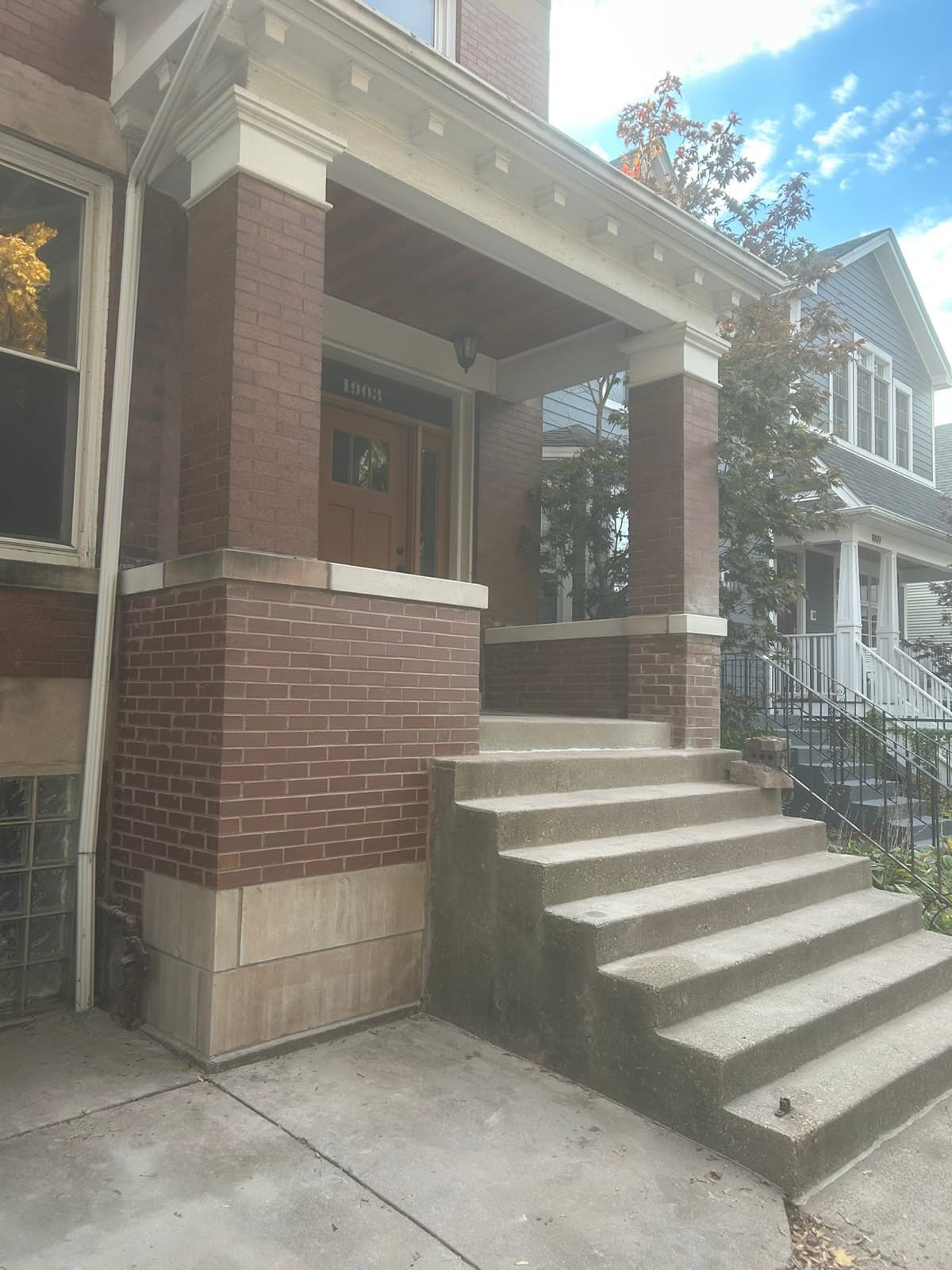
Search for foundation repair in Hinsdale and you will meet a very particular kind of website: a domain named after some other town entirely, a page titled for Hinsdale, no headings, no FAQ, no photographs of work, nineteen identical service links, and a toll-free number. Open a second result and you will find a different brand name, a different town in the domain — and the exact same page, with the exact same phone number.
That is a lead-generation network, not a masonry contractor. And it is why homeowners in Hinsdale so often end up being sold a structural solution to a maintenance problem.
Foundation masonry repair in Hinsdale, IL is a specific trade with a specific scope, and the first thing worth establishing is what it is not.
Paul Lally's Masonry Inc. is a family-owned, insured masonry contractor serving Chicago and the Chicagoland suburbs since 1988 — tuckpointing, brick repair and replacement, chimney repair and rebuilds, lintel replacement, masonry restoration, and waterproofing for residential and commercial properties. Built on Craftsmanship. Backed by Experience. Free on-site estimates — (708) 448-8866.
Three different trades get called "foundation repair"
They solve different problems. Confusing them is how people spend a great deal of money on the wrong thing.
Structural underpinning and piering. For a foundation that is settling because the soil beneath it will not carry the load. Piers are driven or drilled to competent bearing and the foundation is transferred onto them. This is engineering work, and where it is genuinely needed, nothing else substitutes.
Interior drainage and waterproofing. Drain tile, sump systems, vapor barriers. For managing water that is already reaching the basement. It manages symptoms of water, and does not repair masonry.
Foundation masonry repair. Restoring the wall itself — repointing eroded joints, replacing failed units, rebuilding deteriorated sections, parging over sound masonry. For walls whose material has deteriorated but whose position has not changed.
Most older Hinsdale foundations that homeowners worry about need the third one.
The single question that sorts it
Is the wall still straight?
A foundation wall that is plumb and in line, with eroded joints, sandy mortar, spalled brick, or missing material, has a deterioration problem. Mortar has a service life; on a wall poured or laid in 1905, the mortar has simply reached the end of it. That is masonry work.
A foundation wall that is bowing, bulging, stepped out of line, showing a long horizontal crack across a block wall, or cracking progressively wider over months has a movement problem. Movement is structural, and the honest answer there is that a structural engineer should look at it before a mason quotes anything.
We will tell you which one you have. If it is the second, we will say so rather than quoting around it — our name is on every job, and the wrong repair on a moving wall is worse than no repair.
What Hinsdale foundations are made of
Hinsdale's housing stock spans well over a century, and the foundation under a house tells you roughly when it was built.
Rubble limestone. Common on the village's late-nineteenth and turn-of-the-century homes, including much of the historic housing around Robbins Park and the older streets near the downtown. Irregular stone laid in soft lime-rich mortar. The stone is essentially permanent; the mortar is the consumable.
Solid brick. Widespread on homes from the 1890s through the 1930s. Brick foundations spall and lose joints, particularly at grade level where splash and salt collect.
Hollow clay tile. Used in some early-twentieth-century construction. Distinctive, hollow, and more fragile than it looks — a wall that should be handled knowledgeably.
Concrete block. Postwar construction through the present. Fails at the joints, cracks at control joints, spalls at the base, and produces the classic long horizontal crack when it is genuinely being pushed.
Poured concrete. Later construction, including Hinsdale's substantial stock of newer and teardown-replacement homes. Cracks rather than erodes.
Knowing which of these you have determines the mortar, the technique, and whether the repair is even a masonry repair at all. On rubble limestone in particular, using a hard modern mortar does real damage — the mortar must stay softer than the stone so it remains the sacrificial element.
Signs of a foundation masonry problem
- Sand or mortar dust on the basement floor along the base of the wall
- Joints you can rake out with a screwdriver — soft, receded, or missing
- Spalling or flaking on brick or block, especially near grade
- Step cracking through the mortar joints
- Efflorescence — white mineral bloom — indicating water actively moving through the wall
- Loose or displaced stone in a rubble wall
- Daylight or draft through a joint
- Damp patches that reappear on the same section after rain
And the ones that mean call an engineer first: bowing, bulging, a horizontal crack running the length of a block wall, courses sheared out of line, or upstairs doors going out of square.
Hinsdale, specifically
Two local factors shape this work more than anything else.
Age and materials. The historic core carries a genuine concentration of rubble limestone and early brick foundations, and those walls need soft, compatible mortar and someone who has worked them before. Historic district review may also apply, which is worth confirming with the village before any work begins.
Water and topography. Hinsdale sits in rolling terrain near Salt Creek and the Fullersburg Woods corridor, and a substantial number of homes here sit on lots that move water toward the house rather than away from it. Decades of added landscaping, raised grade, and mature root systems have made that worse on many properties. A foundation wall that is permanently damp deteriorates on a faster clock than one that dries out between rains — which is why we look at downspouts, grade, and window wells as part of the assessment rather than as somebody else's problem.
How we approach the work
- Assess the wall type and its condition — inside and, where relevant, outside.
- Establish whether it is deterioration or movement, and say so plainly.
- Repoint deteriorated joints with mortar matched in type, softness, color, and profile.
- Replace failed units — brick, block, or stone — matching what is there.
- Rebuild sections that have gone past repair.
- Parge over sound masonry where a continuous protective surface is appropriate.
- Address the water — grade, downspouts, window wells, splash — because the repair lasts only as long as the conditions allow.
What drives the cost
Wall type and how much of it is involved. Linear footage of repointing versus square footage of rebuilding. Whether work is interior, exterior, or both — exterior foundation work may require excavation, which changes the job substantially. Access, headroom, and whether the basement is finished. Whether stone or brick has to be sourced and matched.
We publish no prices, because no number means anything before someone looks at the wall. Free on-site estimate, in writing — call (708) 448-8866.
Serving Hinsdale and the surrounding DuPage suburbs
We work throughout Hinsdale and the communities around it — Clarendon Hills, Western Springs, Burr Ridge, Willowbrook, Downers Grove, and La Grange. Related services: foundation masonry repair, tuckpointing and repointing, brick repair, and masonry restoration.
For more on what your foundation is actually built from, see identifying your foundation masonry, and for the interior side, parging and interior basement walls.
Get a straight answer, from someone local
Family-owned since 1988, insured, and based here rather than behind a toll-free number and a town name we borrowed. Built on Craftsmanship. Backed by Experience.
Get a free on-site estimate — or call (708) 448-8866.
Foundation Masonry Repair in Hinsdale, IL — Frequently Asked Questions
Is my foundation problem a masonry repair or a structural one?
The dividing question is whether the wall is still straight. A wall that is plumb and true but has eroded joints, missing mortar, or spalled units is a masonry repair. A wall that is bowing, bulging, sheared out of line, or actively moving is a structural question that needs an engineer before a mason.
Do I need piers or underpinning?
Sometimes, but far less often than the volume of advertising suggests. Piering addresses a foundation that is settling because the soil beneath it will not carry the load. Deteriorated mortar in a hundred-year-old limestone wall is not a settlement problem, and piers do nothing for it.
What are older Hinsdale foundations actually made of?
It varies by era. Late-nineteenth and early-twentieth-century homes here commonly have rubble limestone or brick foundations, houses from the twenties through the forties often have brick or hollow clay tile, and postwar construction is usually concrete block or poured concrete.
Can a rubble limestone foundation be repointed?
Yes, and on a sound wall it is the right repair. The stone itself typically outlasts the mortar by generations, so restoring the joints with a compatible, appropriately soft mortar renews the wall without disturbing what is working.
Why is there sand on my basement floor?
Mortar is leaving the wall. The joints are eroding and depositing their sand content on the floor below. On a wall that is still plumb, that is deterioration and a repointing conversation — if the wall is also out of line, that is movement and a different conversation.
How much does foundation masonry repair cost in Hinsdale, IL?
It depends on the wall type, the linear footage involved, how much is repointing versus rebuilding, access and excavation if exterior work is needed, and whether stone or brick has to be matched. Paul Lally's Masonry provides a free on-site estimate in writing.
Will repointing the foundation stop my basement from leaking?
It helps considerably where open joints are the water path, but water in a basement is usually a drainage problem as much as a masonry one. Grade, downspouts, and window wells matter, and a mason who ignores them is only treating half the issue.
Do I need a permit for foundation repair in Hinsdale?
Structural foundation work commonly requires one, and Hinsdale's historic district may add review on top of that. Requirements are set by the village, so confirm with the building department before work begins.
Foundation Masonry Repair in Nearby Areas
Other Masonry Services in Hinsdale, IL
Learn more about our foundation masonry repair services across Chicagoland, or view all service areas.
Free on-site estimates across Chicagoland.