
Chimney Repair & Rebuilds · Naperville, IL
Chimney Repair in Naperville, IL — Crowns, Caps, and Knowing What Your Chimney Actually Is
Half the chimney problems in Naperville aren't masonry at all — they're a framed chase with siding on it. Knowing which one you have decides who should be up there.
Quick Answer
Chimney repair in Naperville, IL covers the masonry above the roofline — the crown, cap, spalled brick, mortar joints, and flashing — on true masonry chimneys. Many newer Naperville homes have framed prefab chases instead, which is a different trade. Paul Lally's Masonry has repaired Chicagoland chimneys since 1988. Free estimates: (708) 448-8866.
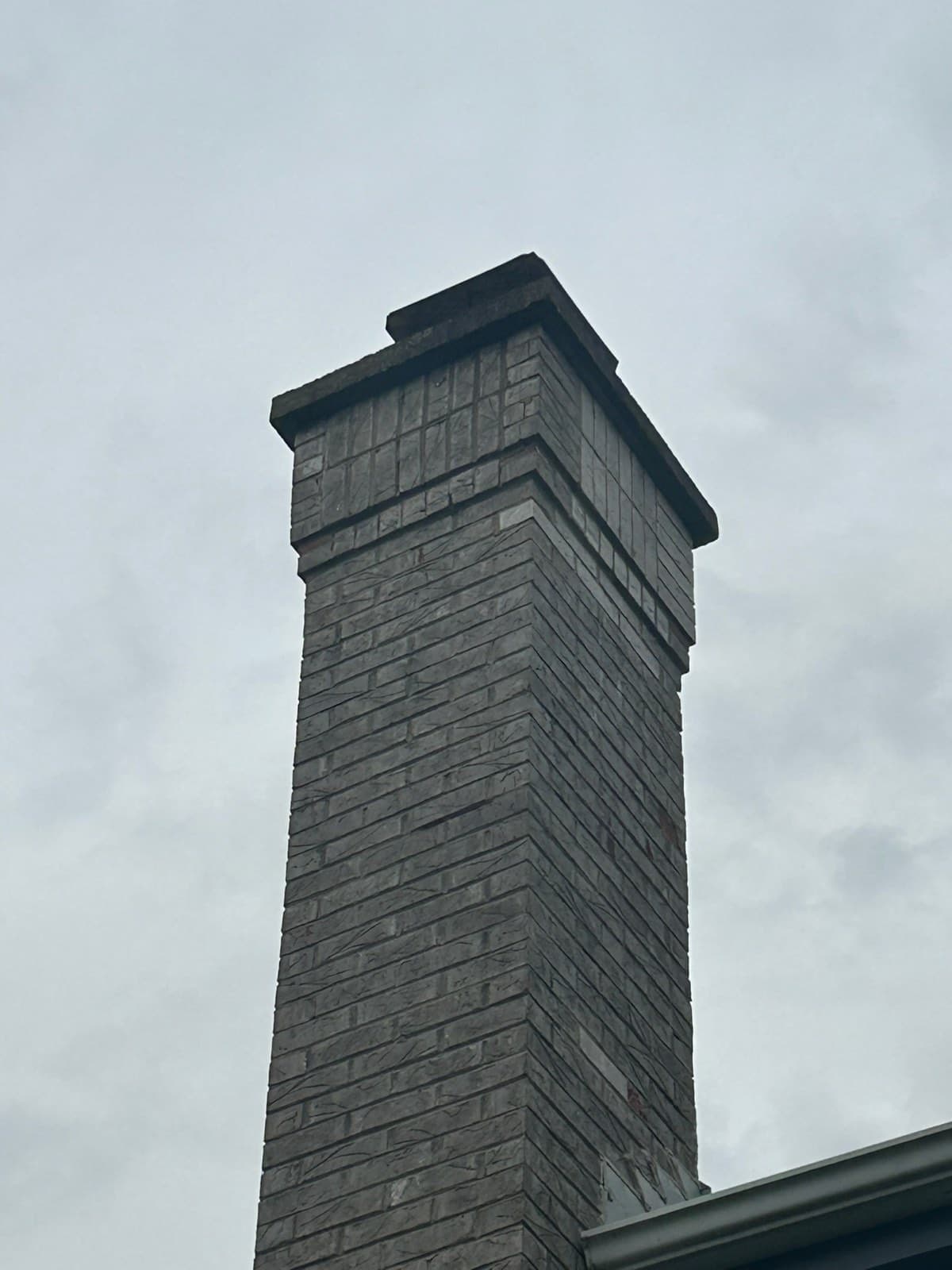
Before anything else on a Naperville chimney call, we ask one question — and a surprising share of the time the answer changes who should be standing on your roof.
Is it a masonry chimney, or a framed chase?
Chimney repair in Naperville, IL is masonry work: crowns, caps, brick, joints, and flashing on a genuine brick or stone chimney. But a great many homes here — particularly from the 1990s onward — have a prefab metal fireplace inside a framed chase with siding or a thin brick skin on the outside. That's carpentry and sheet metal, not masonry. Paul Lally's Masonry has been repairing Chicagoland chimneys since 1988, and we'd rather tell you that on the phone than after we've quoted.
Telling them apart from the ground
| | Masonry chimney | Prefab chase | |---|---|---| | Structure | Brick or stone, full height | Wood-framed box | | Exterior | Brick or stone all the way | Siding, or a thin brick veneer skin | | Top | Concrete crown | Sheet metal chase cover | | Flue showing | Clay tile, square or rectangular | Round metal pipe | | Weight | Sits on its own footing | Framed onto the structure | | Who repairs it | Mason | Carpenter / sheet metal / chimney specialist |
The quickest tell: look at the top. Concrete across the top with a clay tile poking through means masonry. A metal lid with a round pipe means a chase.
A chase can absolutely have brick on it — a single decorative wythe over framing — and that veneer is masonry we can repair. But the chase cover, the framing, and the flue system are not ours, and anyone quoting a "chimney rebuild" on a framed chase should be asked exactly what they mean.
What a chimney crown actually is
On a masonry chimney, the crown is the single most important detail — and it's the one most commonly built wrong.
A proper crown is not a flat smear of mortar across the top of the brick. It's a cast concrete cap with three specific features:
- An overhang. It should project past the face of the brick by an inch or more, so water sheds clear of the masonry rather than running down it.
- A drip edge. A groove cut into the underside of that overhang. Without it, water clings to the concrete and tracks back onto the brick — surface tension defeats the overhang entirely.
- A flexible joint at the flue. The clay flue tile and the concrete crown expand at different rates. If the crown is cast tight against the tile, it cracks — every time, usually within a few years.
Most failed crowns we see in Naperville were mortar washes — a sloped bed of mortar troweled across the top with no overhang, no drip edge, and no expansion joint. They crack, water enters the top of the chimney, and the brick below starts spalling from the inside.
The three water paths
A chimney leaks in three places, and a roofer touches none of the first two:
1. The top. Cracked crown, missing cap, open flue. Water goes straight down into the chimney body.
2. The sides. Failed mortar joints and spalled brick. On a chimney these fail faster than anywhere else on the house because the masonry is exposed on four sides above the roofline — no interior to shelter it, freeze-thaw from every direction.
3. The flashing. Where the chimney passes through the roof. Deteriorated flashing and counterflashing is a classic leak source and it's frequently blamed on the roof.
Signs your Naperville chimney needs work
- Water stains on ceilings or walls near the chimney chase, at any level
- A cracked or crumbling crown
- No cap on the flue — an open pipe into your house
- Spalled brick — faces flaking, powdering, or popped, especially at the shoulders
- Soft, receding mortar joints you can dig out by hand
- Rust staining or deteriorated flashing at the roofline
- Brick or mortar debris in gutters, on the roof, or on the ground
- White efflorescence on the chimney or the wall below it
- A visible lean — urgent, always
- A damp or musty smell near a fireplace
Repair, or rebuild above the roofline?
| Condition | Usually | |---|---| | Soft joints, sound brick, crown intact | Repoint | | Cracked crown, brick sound | Rebuild the crown | | Missing cap | Cap it — cheapest fix on this page | | Spalled brick, chimney plumb | Replace units + repoint + re-crown | | Brick spalling through, lost bond | Rebuild above the roofline | | Chimney leaning | Assess promptly — safety | | Flashing deteriorated | Coordinate at the roof line |
Nearly always only the portion above the roofline needs rebuilding. The masonry inside the house is sheltered and usually fine — so a "chimney rebuild" should generally mean the exposed part, not the whole stack. Ask any contractor to be specific about that.
How Paul Lally's Masonry repairs a chimney
- Confirm what it is — masonry chimney or framed chase — before quoting anything.
- Get up to it. A chimney cannot be assessed from the driveway. Roof pitch and access shape both the scope and the schedule.
- Check whether anything still vents through it. If that isn't clear, we'll tell you to confirm with a heating professional before we go further — venting safety isn't a masonry judgement.
- Assess all three water paths — crown, masonry, flashing — and find where water is genuinely entering.
- Protect the roof. Membrane and shingle protection before any brick comes off.
- Take down what's unsound, salvaging brick that's a good match.
- Rebuild plumb on mortar matched to the original masonry.
- Repoint sound sections, joints cut back to solid mortar and tooled to match.
- Cast a proper crown — with overhang, drip edge, and a flexible joint at the flue.
- Cap the flue and coordinate the flashing condition.
- Clean the roof and gutters and walk the work with you.
Materials
Mortar matched for type, color, sand, and joint profile — standard Type N on most Naperville chimneys, softer mixes on older, softer brick, Type S only where exposure and structure genuinely call for it. Salvaged brick where matching matters. Cast crowns rather than mortar washes. Proper caps sized to the flue. Breathable penetrating sealers where sealing is warranted — a chimney is genuinely one of the best candidates for it, since it's the most exposed masonry you own.
The rule that governs chimney work as much as any: mortar should be softer than the brick. Hard mortar on soft brick spalls the faces at the joints — permanent damage, on the masonry that takes the worst weather on the house.
What drives the cost
- Height and roof access — pitch, height, and how staging is set
- Scope — repoint, crown rebuild, partial or full above-roofline rebuild
- Crown work — a proper cast crown is more than a mortar wash
- Flashing condition and coordination
- Brick matching and salvage
- Debris handling — chimney masonry is heavy and has to come down and out
- What's found once the top courses come off
We don't quote chimneys from the ground, and you should be cautious of anyone who does. Paul Lally's Masonry gives a free on-site estimate in writing after getting up to it.
Local context: Naperville's two chimney populations
Naperville's enormous growth range means the chimney you own depends heavily on when your house was built.
The older stock — the historic district, the streets near downtown and the Metra corridor, and the mid-century neighborhoods — has true masonry chimneys: brick or stone, full height, on their own footing, with clay flue tile and a concrete crown. Soft brick on the oldest, and those want soft mortar and a careful hand.
The 1990s-onward subdivisions are where the confusion lives. Many have prefab metal fireplaces in framed chases, often with a decorative brick veneer skin and a metal chase cover on top. Some have genuine masonry chimneys in brick veneer. You cannot tell from the street without looking at the top.
There's a third group worth naming: homes where a high-efficiency furnace conversion left the original masonry chimney with little or nothing venting through it. Common across DuPage. That chimney still weathers and still leaks — see your furnace doesn't use the chimney anymore.
DuPage County weather does the rest: repeated hard freeze-thaw cycling, wet springs, and wind-driven rain from the west and northwest hitting a structure exposed on all four sides above the roof.
Related masonry services in Naperville
Chimney work commonly travels with tuckpointing and repointing on the upper walls, brick repair and brick replacement for spalled units, caulking and joint sealant, and masonry waterproofing once the masonry is sound. For whole-house scopes see residential masonry restoration.
Worth reading: chimney crowns, caps, and flashing, chimney repair vs. rebuild, signs your chimney needs repair, and who to call for what.
Nearby: tuckpointing in Naperville, brick repair in Naperville, masonry waterproofing in Naperville, lintel replacement in Naperville, and chimney repair in Downers Grove.
Find out what you've actually got up there
Paul Lally's Masonry Inc. is a family-owned, insured masonry contractor serving Chicago and the Chicagoland suburbs since 1988 — tuckpointing, brick repair and replacement, chimney repair and rebuilds, lintel replacement, masonry restoration, and waterproofing for residential and commercial properties. Built on Craftsmanship. Backed by Experience.
We'll get up to your chimney, tell you whether it's masonry or a chase, and scope only the part that actually needs work. If it isn't ours, we'll say so. Our family name is on every job.
Free on-site estimates — call (708) 448-8866 or request an estimate online.
Chimney Repair & Rebuilds in Naperville, IL — Frequently Asked Questions
Is my chimney masonry or a prefab chase?
A masonry chimney is brick or stone all the way up with a concrete crown on top and a clay flue tile showing. A prefab chase is a framed box — often sided or with a thin brick veneer skin — capped with a metal chase cover and a round metal flue. If the top is sheet metal rather than concrete, it's a chase, and that's a different trade from masonry.
What is a chimney crown, and what makes a good one?
The crown is the concrete cap across the top of a masonry chimney, and it's the first line of defence against water. A proper one overhangs the brick by an inch or more, has a drip edge cut underneath so water falls clear instead of running back down the brick, and has a flexible joint where it meets the flue tile so the two can move independently.
How much does chimney repair cost in Naperville, IL?
There's no flat rate. Cost is driven by roof pitch and height, how staging or roof access is set, whether it's repointing, crown work, or an above-roofline rebuild, how much brick has to be matched, and whether flashing is in scope. Paul Lally's Masonry provides a free on-site estimate in writing after getting up to it.
Why does my chimney leak when the roof is fine?
Because a chimney has three separate water paths and none of them are the roof membrane. A cracked crown lets water into the body of the chimney, failed mortar joints and spalled brick let it into the masonry, and deteriorated flashing lets it in where the chimney passes through the roof. A roofer replacing shingles doesn't touch the first two.
Can my chimney be repaired, or does it need rebuilding?
If the brick is sound and the joints are soft, it gets repointed and re-crowned. If brick is spalling through, the masonry above the roofline has lost bond, or the chimney leans, that section comes down and gets rebuilt. Nearly always only the portion above the roofline needs rebuilding — the part inside the house is usually fine.
Do I need a chimney sweep or a mason?
A sweep for what's inside the flue — cleaning, obstructions, liner condition, and whether appliances are venting safely. A mason for the masonry itself: crown, cap, brick, joints, and flashing. If your problem is a leak or crumbling brick, that's masonry; if it's smoke, smell, or draft, start with a sweep.
My furnace vents out the side wall now. Do I still need the chimney maintained?
Only if something still vents through it — many Naperville homes kept an atmospheric water heater on the old flue after a furnace conversion, so confirm that with a heating professional first. If nothing uses it, the masonry still weathers and still leaks, so it needs either capping and maintaining or taking down.
When is the best time of year for chimney work?
Late spring through early fall. Mortar needs workable temperatures to cure properly, and roof work in ice is neither safe nor good practice. Urgent conditions can often be stabilised in the off-season, but a proper rebuild belongs in mild weather.
Chimney Repair & Rebuilds in Nearby Areas
Other Masonry Services in Naperville, IL
Learn more about our chimney repair & rebuilds services across Chicagoland, or view all service areas.
Free on-site estimates across Chicagoland.